

Revelation 2-3 are the chapters that have been studied the most by people who have examined the Book of Revelation. Paul had spent three years in Ephesus, and during that time, ‘all who lived in Asia heard the word of the Lord, both Jews and Greeks,’ Acts 19:10.
All seven churches may have had their start during this time frame. They’re now facing a severe crisis, and there has been widespread persecution of Christians. Persecution came in the form of Judaizers, Pagans and the Roman government.
At the close of each letter, a special blessing is pronounced on those who overcome the persecutions. Let’s simply notice that Jesus says this to these congregations. He knows what’s going on in His church, and we need to let Him be the Head of the church, Colossians 1:18 / Ephesians 1:22-23 / Ephesians 5:23.
Jesus rebukes five of the congregations: Ephesus, Revelation 2:1-7, Pergamum, Revelation 2:12-17, Thyatira, Revelation 2:18-29, Sardis, Revelation 3:1-6, Laodicea, Revelation 3:14-22. Only two are not rebuked: the church in Smyrna, Revelation 2:8-11, isn’t condemned, and the church in Philadelphia isn’t rebuked, Revelation 3:7-13.
Five out of the seven are rebuked for things they are not doing or for things that they should be doing. Either they were doing something wrong, or they were lacking in some area.
During times of persecution, we mustn’t forget that Jesus is still the Head of the church and that we’re responsible as members of His church for how we live our lives. Revelation 3:21 reveals the encouragement that Jesus offers saints who live faithfully, 2 Corinthians 13:5.
In Revelation 1, we see Jesus standing in the midst of the seven churches, and when we get to Revelation 2, we find Jesus walking around the seven churches. Instead of the church giving its own evaluation on how things are going, Jesus is going to give His own evaluation as to how they are really doing.
Jesus Himself is the author of this letter to the Ephesians. Ephesus was a large and important city on the west coast of Asia Minor where the apostle Paul founded a church, Acts 18:19-21. And there were a number of factors which contributed to the importance of Ephesus.
1. The first factor was economics.
Ephesus was the most favourable seaport in the province of Asia and the most important trade centre west of Tarsus.
2. Another factor was size.
Ephesus was the largest city in the province, having a population of perhaps 300,000 people.
3. A third factor was culture.
Ephesus contained a theatre that seated an estimated 25,000 people.
4. The fourth, and perhaps most significant, reason for the importance of Ephesus was religion.
The temple of Artemis or Diana, at Ephesus, is ranked as one of the Seven Wonders of the Ancient World. If you were around in Biblical times and thought of Ephesus, your mind would automatically think about the city where you would find the ‘temple of Diana.’
In Acts 19, we find in Ephesus a silversmith by the name of Demetrius who made a living out of idol making, Acts 19:24, and he was causing all sorts of trouble for Paul and the other disciples, Acts 19:25-26. And we have recorded in Acts 19:27 that Diana was loved and worshipped by people from all over the world.
The original temple of Diana crumbled into dust many centuries ago, but when it was rebuilt, it became one of the Seven Wonders of the World. And it was to this temple that Alexander the Great came too.
He wanted his name carved on one of the one hundred and twenty-seven pillars, and so he offered all the riches of his eastern campaign for the privilege, but the city fathers turned down the offer.
And so even the mightiest mortal on earth at the time couldn’t even buy the privilege to have his name on a pillar in the temple of a god. No wonder, years later, the apostle Paul would write to the Ephesian church and tell them in Ephesians 2:19-22 that they were the temple, not of any old god but of Almighty God Himself.
The history of Christianity at Ephesus began around A.D. 50, perhaps as a result of the efforts of Priscilla and Aquila, as we read in Acts 18:18. Paul came to Ephesus in about A.D. 52, establishing the church and staying there for at least three years, as Acts 20:31 tells us.
And it was during that time that Paul wrote 1 Corinthians and was faced with many opportunities to share the Gospel but also faced many problems, as Acts 18:23-41 tells us.
We also know that it was in Ephesus that Paul baptised believers who apparently came to know the Gospel through disciples of John the Baptist, Acts 19:1-5, and he opposed the strong influence of magic, Acts 19:11-20.
But by the time that John penned these words in Revelation 2:1-7, the church at Ephesus was busy working for the Lord but had no sincere love for Him. They had all the church programs but had no passion.
They were a busy church with great statistics, but they were a church that was drifting away from their heartfelt devotion to Christ. Ephesus was a busy church with high spiritual standards. The work had been difficult, but they had not collapsed.
Looking from the outside, in every way, this church is what we would call a successful church. And from the outside, people would look in and think that this is a church that deeply loves their God.
As we get into the text, we will soon see that Christ is more concerned about what we do with Him, rather than what we do for Him. And so, to everyone else, this was a greatly successful church, but to Christ, who is now walking amongst them, this church is in the process of falling.
Notice how it begins: it is addressed to the angel of the church, but in Revelation 2:7, it is addressed to the ‘churches’. John is either telling us that churches have guardian angels who have some sort of spiritual responsibility for a church, or he is simply showing us that the angel is the personification of the church.
Kercheville, in his commentary, says the following.
‘The seven stars in Christ’s right hand are the human messengers that have come to John to receive this revelation. These human messengers represent the local church they are from and are pictured in the Lord’s powerful right hand, protected and safe. They are instructed to write the words of Christ about their churches.’
John reminds them straight away that ‘Jesus holds the seven stars in His right hand’, which is figurative language meaning the life or death of the church resides within Jesus, Revelation 1:20 / Ephesians 1:22-23. Jesus walks among the seven golden lampstands, Revelation 1:20 / Exodus 25:31-37.
Coffman, in his commentary, says the following.
‘This indicates the active, constant, and persistent energy with which Christ is concerned with the welfare of every church and every Christian.’
Remember that Ephesus was a great city for debating; everyone loved to debate with anyone about life and religion. And so, both Paul and John are both saying that Christ is the absolute authority. There is no room for debating the facts about what Jesus is about to say to this church.
Notice how Jesus begins to deal with their reputation; he begins by talking about all the things which are right with this church. They had a lot going for them, and the Lord lets them know that He has seen all the good they are doing in His Name, Hebrews 4:13.
1. He commends their service and says, ‘I know your deeds,’ Revelation 2:2.
Jesus recognises that this church, over the years since it was planted, has accomplished many great things for the glory of God. They have been working hard, and Jesus has seen their efforts.
This was no Sunday morning-only church; they were actively serving the Lord wherever and whenever they could, using their own expenses and personally sacrificing all they could for the glory of God. They had their benevolence programmes and youth programmes, and they persevered.
In other words, despite all the opposition they were receiving, they continued to work. The people in Ephesus did not appreciate these Christians or their zeal for the Lord, and they opposed them publicly and physically, Acts 18-20.
But these Christians endured the opposition and the persecution, and they continued to serve the Lord faithfully in spite of everything thrown against them. And so not only does He commend their service.
2. He also commends their separation, Revelation 2:2.
There are times when the church needs to stand for truth. These Ephesian Christians were quick to defend the truth in so many ways. John tells us in Revelation 2:6 that they rejected the works of the Nicolaitans.
Who are those guys? The Nicolaitans are identified by Irenaeus and Hippolytus, two early church fathers, as a sect which grew out of Nicolas, who is mentioned in Acts 6:5.
They were the ones who apostatised from Christ. However, they originated, they were known as perverts, with low morals, a sect that was loose-thinking and practised loose living. And thankfully, the Ephesians couldn’t bear them.
The Ephesians also exposed deceivers who claimed to be apostles, Revelation 2:2. All in all, we would say that they were morally and doctrinally approved. The Ephesians dealt with their opposition quickly and stood for what they knew was right. And despite all the opposition and all the trials that come from being followers of the Christ they have hung in there and didn’t grow tired of it all, Revelation 2:3.
And so outwardly, the church at Ephesus looks great; the Ephesian Christians think that everything is going well, and they are doing everything they are supposed to be doing.
And people on the outside and possibly even other churches of the Lord are looking at the Ephesian church and thinking, ‘Wow, I wish we were more like that church.’
And they wish that, until the reality check comes from Jesus. After offering this church some words of commendation, Jesus now gives them some words of condemnation.
There is nothing like bursting your spiritual bubble, is there? You can’t help but almost hear the disappointment in the words of Jesus. Jesus says that while they look good on the surface, there are problems in the heart that must be dealt with.
Notice how Jesus wants them to know that this is a personal matter. It seems that Jesus is grieved by the problems He sees in this church. Jesus looks at these people whom He loves and for whom He died and tells them that they simply do not love Him as they used to, Revelation 2:4 / Matthew 22:37.
The church of Ephesus was active in the Lord’s work, but they were serving out of a sense of duty and not out of a fervent love for Him. They had become like Martha, who laboured, but not out of love, Luke 10:38-42 / 1 Corinthians 13:1-3.
The Ephesians’ first love was Jesus Himself and His church, but because they were so obsessed with being doctrinally pure, they were actually departing from loving Jesus and His brotherhood in the process. It is also possible that the Ephesian church had forsaken their first love in terms of their eagerness and joy, Jeremiah 2:2.
Remember that Jesus has not come to hurt the Ephesian church; He has come to help them. He offers words of commendation, words of condemnation, and now He is going to speak a word of correction. He’s going to tell them how they can fix what is wrong in their congregation.
There are lots of things we have to remember in this life, but here Jesus says, ‘remember’ or ‘consider how far you have fallen’. Here is a church which was flying high in its own eyes, but Jesus says, Remember how far you have fallen’, Revelation 2:5.
He wants them to remember that moment when they first came to know Him. He wants them to reflect on what He did for them. He wants them to recall all the excitement and emotion of those early days with Him.
He wants them to look back to on time when their love for Him motivated everything they did. He wants them to recognise that although they thought they were flying, they had actually fallen. If we don’t love Jesus and His people as we did before, the cure is repentance, Revelation 2:5 / 2 Corinthians 7:10.
Change your mind about it and let that change of mind result in a change of conduct. The word ‘repent’ is the Greek word ‘metanoeo’, and it means ‘a change of mind that leads to a change of action’.
But what exactly is it they have to repent of? Well, it’s quite simple. Jesus says they need to repent of their coldness and fall back in love with Him all over again, Revelation 2:5.
Notice that repentance leads to action: the Ephesian church was to do the things they first did. In other words, their good deeds were to be motivated by love again.
Remember that Jesus saw all their good deeds, but they were serving without love. But now, He says, I want you to continue in those good deeds, but with the motivation of love behind them.
He says to the church in Ephesus, ‘If they don’t repent, then He will come and remove their lampstand,’ Revelation 2:5. He’s not talking about the second coming here, because His coming totally depends on whether or not they will repent.
In other words, if they do repent, He won’t come and remove their lampstand, but if they don’t repent, He will come and remove their lampstand. If the congregation at Ephesus doesn’t remember, repent, and do something about it, then destruction will come upon them.
McGuiggan, in his commentary, says the following.
‘This coming depends upon whether or not they repent; if they repent, he will not come and remove their candlestick.’
Ignatius, who was one of the apostolic church fathers, says the following.
‘The church in Ephesus must have listened to and obeyed Jesus words for a while anyway.’
But where is the church in Ephesus now? There’s no church there now, and there hasn’t been for a long time. We can only imagine what goes through the minds of all those visitors who have been to Ephesus today.
They would say, ‘Let’s go to Ephesus, you know that place where Christians used to meet.’ And as they walk around the place, they stumble across a baptistery which is all dried up and covered in leaves. What a sad picture that is, isn’t it? Jesus visited Ephesus and removed the church; the candlestick; it’s gone, Revelation 2:5 / Matthew 23:27.
As mentioned above, the Nicolaitans are identified by Irenaeus and Hippolytus, two early church fathers, as a sect which grew out of Nicolas, who is mentioned in Acts 6:5.
They were the ones who apostatised from Christ. However, they originated, they were known as perverts, with low morals, a sect that was loose thinking and practised loose living. And thankfully, the Ephesians couldn’t bear them.
Jesus says He hates the practices of the Nicolaitans just like the Ephesians do, Revelation 2:6. Although the phrase ‘love the sinner, hate the sin’ is nowhere found within the Scriptures, we do find the principle being taught throughout the Scriptures.
In other words, love the sinner but hate the sin, hate the deeds but love the people, John 3:16 / John 8:10-11 / Jude 1:22-23. Someone once said, ‘I love the sinner by telling them how much God hates their sin.’ It’s all about getting the balance right, Revelation 2:14-15.
In both our love for the sinner and our hate for the sin, we must be careful to act in a way that honours God, Philippians 4:5. We must also be careful to speak with gentleness and respect, 1 Peter 3:15.
Jesus uses this phrase ‘whoever has ears let them hear’ very often: Matthew 11:15 / Matthew 13:9 / Matthew 13:43. Here, He emphasises they must listen to the Spirit, Revelation 2:7.
One of the main words in the Book of Revelation is the word ‘victorious,’ or as other translations have it, ‘overcome.’ This word is used about eleven times in the Book of Revelation: Revelation 2:7 / Revelation 2:11 / Revelation 2:17 / Revelation 2:26 / Revelation 3:5 / Revelation 3:12 / Revelation 3:21 / Revelation 15:2 / Revelation 21:7.
In essence, when Jesus uses the word ‘victorious,’ He’s saying that if we overcome, if we refuse to give up, if we persevere, and if we endure, then we can come over and live with Him, Luke 11:22 / John 16:33. This is one of the biggest encouragements that the Book of Revelation has for each child of God.
Coffman, in his commentary, says the following concerning ‘the tree of life,’ Revelation 2:7.
‘These words regarding the ‘tree of life’ are found in Genesis 2:9 and in Revelation 22:2 / Revelation 22:4 / Revelation 22:19, thus binding the beginning and the end of the Bible together, all of which, first to last, is concerned with the recovery of that which was lost in the Fall.’
The third heaven was known as the dwelling place of God; this is God’s spiritual, eternal home. This isn’t physical and isn’t created. This third heaven is also known as ‘paradise’, Revelation 2:7, which is used in connection with ‘the third heaven.’ Paul speaks about being ‘caught up in the third heaven and caught up in paradise’ in 2 Corinthians 12:2-4.
In other words, the third heaven and paradise are the same location. And there’s no need to speculate where Paul was because John tells us that paradise is the heavenly realm of God, Revelation 2:7.
And there’s no need to speculate where Lazarus was located; he was in paradise, Luke 16:23, the heavenly realm of God. And there’s no need to speculate where Jesus and the thief on the cross were going that very day, Luke 23:43. They were both going to paradise, the heavenly realm of God. The third heaven, paradise, is the place where Paul and all Christians long to go, 2 Corinthians 5:6-8.
The book was written to first-century Christians to tell them not to give up, but Christians still suffer today. The Bible promises us that ‘everyone who wants to live a godly life in Christ Jesus will be persecuted,’ 2 Timothy 3:12.
We may well suffer, but the Book of Revelation tells us that if we overcome, if we are victorious, if we never give up, if we never bow down, and if we never allow our tribulations and troubles to overcome us, but instead we overcome them, then we can come over and live with Jesus in the heavenly realms, Ephesians 1:3 / Ephesians 2:6 / Ephesians 6:12.
We are victors in Christ, whether we live or die, Philippians 1:21. We are victors in Christ when we remain faithful in good times and hard times. And our reward for our faithfulness is the right to eat of the tree of life in heaven, Revelation 2:7.
John tells us that the tree of life answers to the water of life, Revelation 22:1-3. It is the food and the river and the drink of the saints. The tree of life stands for spiritual sustenance; it is the ‘food’ of the righteous.
It reminds us of the events in the garden when man had unbroken fellowship with God, Genesis 2:9. So, whether by life or death, here or hereafter, the victorious Christian is secure.
We know what the church in Ephesus was like and how it started, but concerning the church in Smyrna, we know absolutely nothing about its beginnings.
In all probability, the church in Smyrna was established around 55-56 A.D. after or during Paul’s third missionary journey. It was possibly Paul who established this church, but it would seem more likely to have been established by some of his students from the lecture hall of Tyrannus, as Acts 19:8-10 tells us.
Because we don’t know anything about its beginnings, we need to take some lessons from its present state. This city, which was famous for its loyalty and faithfulness, became the host of a church commended by the Lord for the same faithfulness.
We find people with convictions even before they became Christians. The city of Smyrna was called the ‘Glory of Asia.’ It was proud Smyrna, deeply religious Smyrna, heathen Smyrna. Smyrna was the centre of Caesar worship and the leading city of emperor worship for many years.
Smyrna built a shrine to ‘Roma’ as early as 195 B.C., and as the Republic spread, the worship of Rome became more widespread. According to the historian Balsdon, in July 44, four months after the assassination of Julius Caesar, ‘an unexpected comet appeared in the sky. It was a prodigy, accepted by the people as evidence that Julius Caesar was now in heaven, a god, Divus Julius.’
And since the spirit of the empire was reflected in the leaders, it was easy enough for people to begin to believe the supreme leaders were the embodiment of the spirit of the empire.
The emperors began to be viewed with awe, and one Roman writer tells us, ‘from the time of Augustus a new form of Roman cult makes its appearance, the worship of the emperor.’ He goes on to say that in the east, ‘the line drawn between God and man was not too distinctly drawn’.
It wasn’t this way in Rome; the Romans were too stubborn for such nonsense. When Augustus accepted the name, there immediately sprang up a cult around him. Herod the Great, for example, built a temple and shrine to him, but no emperor, however, was consecrated to godhood until after his death.
And as time went by, a priesthood was formed to serve in the emperor worship and in the process of time, it became necessary that the citizens or subjects show their loyalty to the state by the worship of the emperor. And so, Smyrna won a contest, a contest to see who would erect a shrine to the deified Tiberius.
The Christians lived in a heathen town which embodied not only the eastern gods but also the gods of Rome. The Roman gods were of the more dangerous kind; their servants could bring down punishment upon the heads of the Christians for not submitting to those gods.
But Smyrna also has Jews, lots of them, hostile and vocal Jews, Jews of the sort who would take the lead in the execution of Polycarp, who was a disciple of the apostle John. They were not faithful Jews but the sort who lived in the days of Antiochus 4th Epiphanes, the kind that didn’t worship God but worshipped survival.
The city of Smyrna was about thirty-five miles from Ephesus, and it was a city of about 100,000 people in John’s day. It was called the ‘crown city’ because it was surrounded by hills that resembled a crown. It possessed a safe harbour where ships from all over the world came to buy and sell goods.
Several things made this a special city in its day; for example, the production of myrrh. The substance came from a shrub-like tree; when the leaves were crushed, a very fragrant odour came from them.
Myrrh was used as a fragrance by the living and as an embalming agent for the dead. And if you remember, myrrh is mentioned in association with the life and ministry of the Lord, Matthew 2:11 / Mark 15:23 / John 19:39.
The word ‘myrrh’ means bitter, and so it came to be associated with suffering and death. And so, straight away, we can see that Smyrna was a planned city, a free city, and a beautiful, wealthy pagan city.
The leading god of Smyrna was ‘Dionysus’, who was the god of wine. Smyrna was famous for its vines; each year, the death and resurrection of ‘Dionysus’ was acted out in public plays. But the Christians knew the difference between myth and solid, indisputable historical fact.
Jesus identifies Himself as ‘the first and the last’, and we should be familiar with that title because it’s a name which was applied to God in the Old Testament, Isaiah 44:6 / Revelation 1:4 / Revelation 1:17 / Revelation 2:8 / Revelation 19:6 / Revelation 21:6 / Revelation 22:13.
And so, straight away John, reminds these Christians and says, ‘Come what will, Christ is with us,’ Isaiah 9:6-7. Smyrna, which claimed to be first in the world, John assures the saints there that Christ is first and last, Revelation 2:8, and there is no competition, and so there is no room for human pride.
Now those words ‘who died and came to life again’, Revelation 2:8, should read ‘became dead and came back to life again’. So, what is John talking about? He’s talking about the resurrection of Jesus.
He says the risen Christ is He who experienced death, and who passed into death, through death and out of death, and who came to life again in the triumphant event of the resurrection, overcoming death, and who is alive forevermore, Revelation 1:18.
Jesus experienced the very worst that life had to offer, but He has conquered the worst that life can do. He experienced death so that we don’t need to be afraid of it anymore, 1 Corinthians 15:55.
And it’s because of this that only Jesus can demand such loyalty from His followers and be able to reward those who are loyal to Him. The church in Smyrna was a crushed congregation.
Don’t underestimate that word ‘afflictions’, Revelation 2:9. He’s not saying that being a Christian in Smyrna was a headache. He’s not saying it’s an inconvenience. He’s saying that because you’re Christians, you’re under all sorts of pressure, grinding, crushing pressure.
Remember, the Roman Emperor Domitian was ruling at this time, so they were experiencing the crushing load of the Roman forces trying to destroy Christianity.
Don’t underestimate that word ‘poverty’ either, Revelation 2:9. This is not just being poor; it means they were absolutely destitute. In other words, they were poor and unable to help themselves.
They were poor, perhaps, because they were from a poorer class to begin with, but most likely because of robbery, job rejection, and business boycott as forms of persecution. But despite the already existing pressure from Roman worship, the slander of the Jews, and their extreme poverty, these lovely people were faithful.
Jesus says to these faithful Christians in Smyrna, ‘You guys aren’t poor; you are all tycoons.’ You guys are filthy rich, Revelation 2:9. In other words, what these Christians lacked in the world, God would make up for them in heaven, Matthew 6:24.
Should we be intimidated by others when they have a go at us for being Christians? It does not always pay to be a Christian, but it is better after you die. When times are hard, and you become poor, be faithful. Why?
James says that God has a currency which is eternal riches, and so be faithful when poverty strikes, James 2:5. Paul says, don’t worry when times get hard, for the Lord knows who are His, 2 Timothy 2:19-21.
The Lord knows each and every one of us intimately, Luke 12:7, and He knows everything He needs to know about the church in Smyrna. He knows they are facing persecution; He knows they are facing poverty.
Think about this in practical terms: because they were Christians, they were denied jobs because of their relationship with Jesus Christ. And Jesus knows this, and He knows that they faced the prospect of being sent to prison.
And if all that wasn’t trouble enough, he tells them that there was even more trouble ahead. But despite all the tribulation, thanks be to God, Smyrna was a consistent church.
Notice the word ‘slander’. It should be the word ‘blasphemy’ which is used, Revelation 2:9. The word ‘blasphemy’ is the Greek word ‘blasphemia’, which means reviling, but here it is used not primarily to direct blasphemy against God but reviling against believers.
In other words, Satan is tempting the saints to blaspheme in the name of Christ. Although there is no rebuke for this church, there certainly are a few words of caution.
Jesus says, ‘I know about the slander of those who say they are Jews and are not, but are a synagogue of Satan’, Revelation 2:9. Notice that word ‘say’. They ‘say’ they are Jews.
These guys wouldn’t have recognised Abraham if he had appeared wearing a name badge. This very same Jesus had spoken to an audience of Jews, and if you remember, He recognised their racial status but denied their relationship with Abraham, John 8:57-59.
The Lord doesn’t only know you and me intimately; he also knows everyone else intimately, too. My point is that these people were proud to be Jews; they were proud of their synagogues, and all the while, Jesus says that they were a synagogue, and the Devil dwelt in them.
Notice that this church had a positive testimony. The Lord didn’t have a rebuke for this church as He did for many of the others. And so not only did they have a positive testimony, but they also had a very powerful testimony.
How do we know that? Simply because in spite of all the wickedness which was going on around them, and in spite of all the affliction that they were put through, they remained faithful.
And so, because of this, they received comfort from Jesus Himself. Jesus comes to them as ‘The first and the Last, He that was dead and is alive,’ Revelation 2:8. He is reminding them that ‘He knows’ what they are facing because He has faced tribulation and suffering as well.
Satan was doing the tempting, but God, at the same time, is proving, testing, and trying them, Revelation 2:10. Why? Jesus doesn’t want them to lack anything; we must accept that difficulties come for a reason. They come to help us grow and become mature as Christians, James 1:2-4.
Jesus says that God will let His people suffer, 2 Timothy 3:12, but it’s not all doom and gloom because Jesus reminds us that He has overcome the world, John 16:33. They were about to feel the pressure increasing; they were about to join the long list, the long, glorious list of those who were imprisoned for righteousness’ sake.
Jesus knows His people and those who are not His, and this would include the devil himself. He tells them that ‘the devil will put some of you in prison,’ Revelation 2:10.
He tells them that not too long from now, some of you, not all of you, but some of you, will be put in prison. Now, if that isn’t frightening enough, under Domitian, if you were being put in prison, that meant that you were going there just before being put to death.
They were about to be tested for ‘ten days’, Revelation 2:10. Now, this is not literal; this is the Hebrew way of saying for a short time. Daniel, for example, was tested for ten days, Daniel 1:12-16, and Jacob was tested by Laban ten times, Genesis 31:7.
The Bible Hub says the following concerning the ten days.
‘The number ten in Scripture can represent fullness (as with the Ten Commandments or the ten plagues in Exodus). Thus, ‘ten days’ may highlight a short but complete season of testing. The number ten in biblical numerology often signifies completeness or divine order. In the context of ten days, it can represent a complete cycle of testing or a divinely appointed period for a specific purpose. This is evident in both Daniel’s dietary test and the persecution of the church in Smyrna, where the ten days serve as a complete period of trial leading to a greater revelation of God’s power and faithfulness.’
It’s not hard to see the origin of ‘testing, and you will suffer persecution for ten days,’ Revelation 2:10. By the time we get to the New Testament, it had become the expression for a period of trial by hardship.
And so, Jesus cautions them and says, ‘Don’t be afraid, but be faithful, even to the point of death’, Revelation 2:10. In other words, don’t worry about whether they kill you, because you will be at home.
When times are really tough, nothing can separate us from the love of God; persecution can’t, and death can’t, Romans 8:34-39. Jesus is looking for total, lifelong commitment to Him in faith and, with such faithfulness, secures the ‘crown of life,’ Revelation 2:10 / James 1:12.
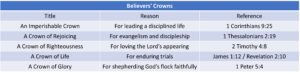
The crown was, among the Romans and Greeks, a symbol of victory and reward. The crown or wreath worn by the victors in the Olympic Games was made of leaves of the wild olive. In the Pythian Games, the crown was made of laurel. In the Nemean Games, it was made of parsley, and in the Isthmian Games, it was made of pine.
The Romans bestowed the ‘civic crown’ on anyone who saved the life of a citizen, and it was made of the leaves of the oak. But these crowns died because they were made of leaves and things. This crown, the crown which Jesus gives, lasts. Why? Because it is made of life, Revelation 2:10 / 1 Peter 5:4.
Another wonderful lesson that we can learn from the Book of Revelation is that persecution can have great spiritual value, Revelation 2:10. Jesus said of certain Christians in Revelation 2:10 that they would have to endure persecution for a period of time, but if they were faithful ‘even unto death,’ then He would give them ‘the crown of life.’ Through their persecution, these people learned great spiritual lessons and were forced to think about what was really important.
That same lesson is true for us today as well. When we face trials or tribulations, or when things happen to us that are difficult, we can gain spiritual wisdom and insight as we allow such things to be of benefit to us, Romans 8:28. True, we don’t often think about it like that, but that is what Scripture teaches, James 1:2-4.
Our trials can help us and can have real spiritual value; it’s as though we are being tested in the fire. Impurities that we do not need in our lives will be seen, and we can be refined by those tests, 1 Peter 1:7.
Paul said, ‘We must go through many hardships to enter the kingdom of God,’ Acts 14:22. Trials and tribulations help us see what really matters. In 2 Timothy 3:12, we are told that ‘and all who desire to live godly in Christ Jesus will suffer persecution.’
I hope that these main points will give us a better insight into the Book of Revelation by helping us understand to whom it was written, why it was written, and that its main application is that we must never give up, regardless of what happens to us in this life. We must be faithful to God, and in the end, we will have the hope of eternal life.
Remember, despite the fact that this letter and the others are written to a specific church, it applies equally to the other churches and, in fact, to all the churches. All the churches are to hear what the Spirit has to say, Revelation 2:11.
The expression ‘second death,’ Revelation 2:11, is found three other times in the book of Revelation, Revelation 20:6 / Revelation 20:14 / Revelation 21:8. J.H. Thayer defined the ‘second death’ as ‘the miserable state of the wicked dead in hell’.
This condition is characterised as the second death because it follows physical death. It is designated as death because it is the terminal separation from the Lord, Matthew 25:41 / 2 Thessalonians 1:9.
The first death speaks about what all humans will face one day, when we die naturally. What is the second death? The second death is the ultimate and eternal separation from God. In other words, Jesus is saying to these faithful Christians in Smyrna and to us today that it’s so much better to die the first death in faithfulness to Christ than to die that second death, Revelation 2:11.
Think about it: Jesus says, because He is alive after death, Revelation 2:8 / Revelation 1:18, so it will be with the Christian; we can escape hell if we remain faithful. Jesus says, I know about all the afflictions and poverty we experience, which are only temporary.
He says, ‘Nothing will separate us from Him,’ Romans 8:35-39. In fact, Jesus says the faithful lose nothing but gain everything worth gaining, and that is Jesus Himself, Philippians 1:21.
Pergamum was the capital of the Roman Province of Asia. It was a royal city, the grandest city of its time, and it was the cultural city of Asia. When we think of Pergamum, we think about the University of Asia Minor, with its huge and famous library.
Its library of over 200,000 parchment rolls was surpassed only by Alexandria, and we know that parchment was actually invented here. They gloried in their knowledge and culture; it was a city of fashion. It was one of the great religious centres in the eastern world; it was the centre of emperor worship.
Being the Roman capital of Asia and the centre of emperor worship explains the reason for much of the persecution and death of Christians during its time. Because it was located inland and on a rocky hill, this prevented it from becoming a commercial centre.
And so there it sat, like a throne, on top of a hill, surveying the valley around it; it was a throne indeed. But who sat on that throne? Well, Rome did. Pergamum was the seat of the state religion; it was where the original Augustan Temple was built.
But who else sat on the throne? Zeus did. One of the most famous altars in the world was there at Pergamum. Up on a ledge jutting out from the hillside, eight hundred feet up, sat the huge altar, from which smoke ascended endlessly from the sacrifices offered there.
Barclay, in his commentary, says the following.
‘No one could fail to see it,’ since ‘it would look like nothing so much as a great seat or throne’.
Who else sat on that throne? Asklepios did. Asclepius, the god of healing, was here. Thousands of sick people from near and far would visit the temple site. ‘Asklepios the Saviour’ was on the tongue of eager worshipers day after day.
Just like the church in Smyrna, we know nothing of its beginning, but from Acts 19:10, we can say that it was probably Paul or some of his students who established the church there.
Just as we did with the church in Smyrna, the lessons we are going to learn are not found in its beginnings but rather in its present state, or condition, as we find it written here in Revelation.
Notice that Jesus is the One who has the ‘doubled-edged sword,’ Revelation 2:12. It’s not the sword of the Spirit, as we usually understand it to mean; it’s not the word of God like Paul uses it in Ephesians 6:17. This is the Greek word ‘rhomphaia’, and it means a weapon of war and judgement, and we see it being used in Revelation 19:11-16.
It is the sign of authority, and if you possessed this sword, that meant you had the right to use it. The Romans carried a short broadsword, and it had a distinct curved sabre-type blade. When the Romans were given governing powers, they were given the power to inflict capital punishment; this was called ‘the right of the sword.’
But who then had the power of life and death? Asklepios, their god of healing? Who was supposed to be able to raise the dead or kill the living? Zeus, the supreme god of the Greek world? No!
Was it the Romans? John 19:10-11. The Roman governors were divided into two classes: those who had the right to the sword and those who did not. In other words, Rome had the power of life over death; others didn’t.
Here, Jesus says that He has the right to the sword; He has the power of life and death, and He has the power to judge and the power to carry it out, Revelation 2:12.
This again reminds us that we should never be afraid of anyone who tries to persecute us for being Christians, but we should always be afraid of the One who made it possible for us to become Christians in the first place, Matthew 10:28.
Jesus knows this church as He does the others; He knows each of us individually, and He knows what’s happening in His church. But what does He know about the church in Pergamum?
Jesus knows where you and I live. He knows our address and postcode, Acts 10:5-6. The Christians at Pergamum had a permanent earthly dwelling, and it should be encouraging for us to know that the Lord knows our address, even to the street. And although the Christians were very active in Pergamum, Satan was very active too.
And if I learn anything from this, it’s simply this: it is possible for Christians to be Christians where Satan is strongest. Jesus knows where everyone lives, but He also knows where Satan lives.
Pergamum is where Satan’s throne is, Revelation 2:13. In other words, this was a church in difficulty because this was where Satan was politically active. That word, ‘throne,’ is the Greek word ‘thronos’, which basically means a seat for a royal king who has power. In other words, anyone who sits on the throne holds dominion or exercises authority.
The idea is that this is a city where Satan rules, or the city ruled by Satan, and he is influencing everything within it. We can see that Satan influenced everything because there was pagan worship, the worship of Asclepius, the god of healing and medicine, emperor worship, and the persecution of Christians.
But despite all the persecution and evil which was happening around them, they remained true to Jesus, Revelation 2:13. And sometimes that faithfulness to Jesus meant death.
We don’t know anything about this person named Antipas, but we do know that he was faithful even in death, Revelation 2:13. History says nothing about him, but legend says that he was roasted to death; he was never ashamed to die a Christian.
He witnessed for Christ at Pergamum, and he died for the cause. And won’t it be wonderful when we die to have the eternal pleasure of fellowship with this unknown hero?
And so, this church, which was caught up in a whole world of different religions and persecuted time and time again, held on to their faith; they stayed true to the name of Jesus, Revelation 2:13 / Acts 4:12 / Acts 5:41 / Matthew 10:2.
These Christians were like you and me; they were baptised in the Name of Jesus, Acts 2:38. Baptised into the name of the Father, Son and Holy Spirit, Matthew 28:19-20.
In other words, our journey began in the Name of Jesus; we became Jesus’ possessions, and just like these Christians, we too should never give up what belongs to Jesus, and that is our souls.
The Christians in Pergamum hung on in there despite the temptations, despite the persecution. And so, after the Lord makes them aware of the things that were right, He then brings to their attention the things that were not right.
One of the saddest words in the English language is the word ‘but’, and we use it all the time, don’t we? I love you, but!’ ‘I loved the meal, but!’ ‘I enjoyed the worship, but!’ Jesus says, ‘I know where you live and I know the temptations and persecution you are facing, and I’m so proud of you for hanging on in there, but!’
Jesus is practising what He preached, Matthew 18:15, and He is being honest with them; He is being gentle with them, like we should be when someone is involved in something they shouldn’t be, Galatians 6:1.
Jesus says there were some in the church who were trying to teach others to sin. They were encouraging others to eat sacrificed meat and encouraging others to commit fornication, Revelation 2:14.
There were some who held the teaching of Balaam, Revelation 2:14, but let me ask you: why should Jesus reprimand the church because ‘some’ hold this teaching? Well, simply because there must have been some kind of unlawful silence by the church in regard to the matter, there must have been a lack of discipline.
Paul rebukes the Corinthians for not disciplining the ungodly man in their congregation, 1 Corinthians 5:1-13, but this congregation weren’t obviously rebuking anyone for holding on to this teaching. But what is the teaching of Balaam?
Remember, Balaam wasn’t wrong in everything; he wanted to die the death of the righteous. He knew, by the word of God, what Israel would do to Moab and the rest. But he also loved gain, and he urged on idolatry mingled with fornication.
Baalism was a compromise of morals, and for people in this city to eat things sacrificed to idols meant engaging in the feasting and various other wicked things of the wicked idolatrous temples, including fornication, Revelation 2:14.
In other words, the teaching or the doctrine of Balaam was a perversion of the Christian doctrine of liberty, Galatians 5:13. Peter talks about the way of Balaam in 2 Peter 2:10-15. He says the way of Balaam is really the way of covetousness and refers to anyone who hires themselves out to do religious work merely for personal gain.
It’s the selling of our spiritual gifts for personal gain out of covetousness. Jude tells us the error of Balaam in Jude 11. Balaam thought that he could get God to curse His people and bypass His covenant promises because of their evil.
Seeing their evil, Balaam supposed that a righteous God must curse Israel, but he was blind to God’s faithfulness to His promises. And so, since Balaam found out he could not curse Israel, he realised he could cause them to corrupt themselves by getting them to marry the beautiful women of Moab, Numbers 25:1-3.
Picture the scene: these women came into the camp of Israel and caught the eyes of the men of Israel. They invited them to their sacrifices full of immorality and idolatry, and before you know it, the men are eating at the tables of false gods, sleeping in the beds of pagan women, and bowing themselves down to worthless idols.
But did this really happen? Yes, it did, Numbers 31:13-16. In other words, Balaam was the first person to introduce the doctrine of ‘once saved, always saved’. Jesus says the church in Pergamum was tolerant of compromise, and they had become compromisers.
Baalism taught them to go out among those who practice idolatry and just get along with them. In other words, he wanted God’s people to compromise for practical reasons.
We need to understand that coming out of idolatry often causes problems. A great part of social life was the idol feasts, and so, because of this, many Christians often lost their jobs, trade, friends, and family. And so, to a degree, we can see why they may want to compromise.
You can imagine that these teachers were encouraging some Christians to attend some feasts, just eat a little meat, and just burn a little incense. Trying to convince others that owning an idol is nothing, after all; a man must live and feed his family.
You can imagine them asking vulnerable Christians, ‘How can we defeat Satan unless we know what Satan is doing?’ And before you know what’s happening, they became tolerant of evil, idols and fornication, 1 Corinthians 8-10.
The teaching of Balaam wasn’t the only false teaching which was happening in Pergamum; they also had the problem that the church in Ephesus had with ‘some that hold the teaching of the Nicolaitans,’ Revelation 2:15.
Remember what Revelation 2:6 says, “You hate the practices of the Nicolaitans, which I also hate.” Do you see the difference? What had only been the practices in the church at Ephesus have now become doctrine in the church in Pergamum.
It never ceases to amaze me how quickly a tradition or a practice becomes doctrine. We don’t know what the doctrine of the Nicolaitans was, so we must take into consideration the background context.
In the context of Revelation 2:6, we see in Ephesus that they came from within the church; they were bad people who were trying to improve and modernise Christians.
In the context of Revelation 2:15, we see in Pergamum that they were proud and they were trying to get Christians to conform to worldly standards, adjusting their Christianity to the world, advocating loose living.
In the context of Thyatira in Revelation 2:20, we see similar teaching, where they say evil is good and Christians need to know the deep things of Satan. Do you see the real problem Jesus has with this doctrine?
He says there are more serious problems that He sees: through the Nicolaitans, the world was changing the church, instead of the church changing the world, Matthew 5:13-16 / 1 John 2:15.
The church was not aware of the dangers and the results of their actions and their compromising attitude. And so, Jesus says to them, ‘You are tolerant in three areas.’
1. They are tolerant of the teachings of Balaam.
In other words, they were practising compromise; they were practising ‘once saved, always saved’.
2. He tells them they are tolerant of the teaching of the Nicolaitans.
In other words, they were the compromisers in the practice of evil itself.
3. And finally, they were tolerant of a lack of disciplinary action.
They should have dealt with the false teaching quickly and properly.
The call to repentance did not come to the false teachers but to the church, and Jesus tells this church to repent of its worldly ways, Revelation 2:16. In other words, there were some changes which had to be made; they had to change their attitude and become intolerant of compromise. They had to change their conduct because of their acceptance of their wrong way of life.
And please don’t tell me that Jesus never gets mad, because He does. He’s not talking about His final coming; He’s talking about coming in judgment against these ungodly sects, Revelation 2:16.
Remember that Jesus says that He has ‘the right to the sword,’ Revelation 2:12. He has the power and authority to exercise judgment. And so, what He is saying is that the church needs to make some changes too or else they too will suffer in His coming, Revelation 2:16.
Jesus says, ‘Are you listening? Do you hear and understand what the Spirit is saying?’ Revelation 2:17. He says, ‘Repent, listen carefully, remain faithful and die faithfully’, and He says, ‘If you do these things, you will be victorious, and you will be given some of the hidden manna,’ Revelation 2:17.
What is this hidden manna? Well, the first mention of manna is found in Exodus 16:4, where we find that manna was the food God provided to the Israelites when they wandered for forty years in the desert.
What else do we know about it? According to Exodus 16:31, we know “It was white like coriander seed and tasted like wafers made with honey.” And if you remember, according to Exodus 16:31-32, God wanted some manna saved and preserved for future generations to remind them of the Lord’s covenant of faithfulness, and so Moses placed a portion of manna in the Ark of the Covenant, Exodus 16:32-34.
Somewhere between the time Moses first placed it in the Ark and the dedication of Solomon’s Temple, the manna disappeared along with Aaron’s rod, 1 Kings 8:9. So, where did the manna go? Did God or an angel remove it and take it back to heaven?
We simply don’t know; however, some Jewish legends claim that Jeremiah hid it before the Babylonian captivity and that it would remain there until the Messiah showed up.
That’s one question we don’t have the answer to, but we do have the answer to this question. Who is this manna? The manna is Jesus Himself, who claimed to be the true manna, the real manna which came out of heaven, John 6:31-65.
Paul says that Christians were sustained by an invisible source, hidden manna, Colossians 3:1-4. What manna was to the Israelites, Jesus was to the Christians and much more.
The saints were already feeding on that hidden manna, of course, but the promise assures them of continued sustenance from Jesus, whatever the course of events.
Jesus says that these Christians couldn’t partake of the heathen feasts, but they could feed on something better. In other words, if you have to give up earthly pleasures, heavenly joys will be yours.
What else were the Christians in Pergamum promised if they repented, listened carefully, remained faithful, and died faithfully? Jesus says they will be given a ‘white stone with a new name written on it,’ Revelation 2:17.
The colour white symbolises innocence; it stands for purity, justice, nobility, victory, and joy, and so Jesus recognises their innocence. In Biblical times, white stones were given to people who were tried and acquitted.
They were given to a slave freed with citizenship. They were given to an athlete overcoming opposition. They were given to warriors coming back victorious. They were given to clients as being worthy of the privilege of sharing freely in their master’s abundance.
All these declare what Christians have and what they will receive if they remain faithful. Then there was the white stone that friends shared with each other, which guaranteed a warm reception anytime and anyplace they met.
Jesus says it will have a “new name written on it and known only to the one who receives it,” Revelation 2:17. The idea behind a new name indicates a new relationship, new hopes, and triumphs, and only the owner of the stone would know the name written on the stone.
In the Bible, a name was very important; you can see this in the many places where the name spoke of the events surrounding the birth of a child. You can see it in the many cases where names were changed to indicate a change in the circumstances or status of the one renamed. For example, Abram becomes Abraham, Genesis 17:1-5, and Jacob becomes Israel, Genesis 32:22-31. Simon becomes Peter, John 1:42, etc.
A ‘new name’ means a new relationship or status into which the child of God entered by virtue of some new experience with his Master, Isaiah 62:2 / Acts 11:26. But it was ‘his’ name, and nobody else would know it, Revelation 2:17. It was his trial, and it was his experience with God; it was his victory.
In other words, it’s personal to the individual Christian. The Lord knows where we are and what we are doing. Antipas was the example for the Christians in Pergamum, Revelation 2:13, and he is still our example today.
He certainly thought it was all worth it. Jesus says He wants faithfulness from every Christian, and that’s because it will only be the faithful who will be rewarded, Matthew 25:23.
Jesus writes to the church in Thyatira, Revelation 2:18. Thyatira was a town long recognised as a garrison town, and it was the gateway to the important areas of Asia Minor.
It had no real religious significance, but it was a town of trade unions of every kind, and we know from Acts 16:14 that Lydia, the seller of purple garments, lived there.
Metalwork flourished there, especially working with bronze. We know nothing about how the church was established, but it is possible, like some of the other churches, that Paul or some of his students, according to Acts 19:10, may have established the church there. It may also be possible that Lydia went back home to establish the church.
The town of Thyatira lay in the mouth of a long valley, which connected the valleys of Hermus and the Cuicua River. Today, there is still a railway that runs down the valley. And because of the great roads of the trade routes from Syria to Pergamum, it would have had some sort of strategic importance.
There must have been some sort of settlement there because in 290 BC its name emerged in history, and it was discovered as a military centre. If Thyatira fell, Pergamum lay open to attack. There was no hill to erect a lookout point, and this resulted in a town being fated to fight, be knocked down and built up again.
It was a great commercial centre because of its roads, and the valley brought trade from all over the world, and it was most famous for its wool trade and the dyeing industry.
Purple dye was very expensive, and it came from a little shellfish called a Murex. The dye was extracted from the throat. The Roman writer Pliny said that 1lb of purple dye cost around £100, and so Lydia must have been a wealthy woman, dealing in one of the costliest substances of the ancient world, Acts 16:14.
Thyatira was the centre for temples of Artemis and Apollo, but they were not especially famous. It’s interesting that though this was the smallest of the churches addressed in the book of Revelation, it’s the longest letter written.
Straight away, Jesus introduces Himself as the Son of God, Revelation 2:18, which means that He is the Saving One. He describes Himself as One who has eyes like blazing fire, Revelation 2:18 / Revelation 1:14 / Revelation 19:12, which means that He is the searching One, Daniel 10:6. He says He has feet like burnished bronze, Revelation 2:18 / Revelation 1:15, which is symbolic of judgment, Daniel 10:6 / Exodus 27:1-6 / Numbers 21:4-9.
Like we have seen in all the letters we’ve looked at so far, and like we will see in the letters to come, He knows what’s going on in each church, Revelation 2:19. Here is a congregation who were very active in doing good. Here is a congregation that is very loving in seeking one another’s highest good.
Here is a congregation that had confidence in their faith and was motivated by their faith, Revelation 2:19. Here is a congregation that is very active in their service for the Lord and each other.
They were very good in areas of benevolence; they took care of the poor and needy among themselves and around them, Revelation 2:19. They were a very patient church, Revelation 2:19, even in the midst of trials and sufferings.
And they were a church that was doing more now than they ever had, Revelation 2:19. They were making progress as a church; individually, they were growing in Christ, and non-Christians would certainly know they were Christians.
Jesus acknowledges that there’s a problem: ‘you’re too patient, and you’re too gentle in love with certain people.’ Jesus says your patience and love have led you to become tolerant of this woman called Jezebel, Revelation 2:20. Jezebel followed a similar line to that of the Nicolaitans, Revelation 2:15, and the Baalamites, Revelation 2:14, as we saw in the earlier letters.
And we can imagine some Christians saying, ‘What’s wrong with being a part of a trade union and attending the feasts which offered sacrifices unto the gods?’ It’s harmless, they would declare, especially as Paul wrote in 1 Corinthians 10, when you know that an idol is nothing. So, who is this, Jezebel? Well, there are three possibilities.
1. She is called that woman Jezebel, Revelation 2:20, and in Greek her name means wife, although we can’t be sure.
Some people believe that she was the wife of one of the elders and that she was a productive source of trouble, undoing all the work her husband did.
2. It has also been suggested that she is to be identified with the famous Oracle called the Sambathe.
It is possible that Sambathe may have been a Jewess. It was said that she was a Jewess who tried to destroy the Christians.
3. Some believe it was Lydia who found Christianity clashing with her business.
She wanted the church to compromise and attend some heathen festivals.
The original Jezebel was the daughter of the King of Sidon, and Ahab, the king of Israel, had taken her for his wife, 1 Kings 16:3. Her sin was that she brought her own gods to Israel, namely Baal and Astarte.
She obviously claimed to be one of God’s people; after all, she calls herself a prophet, Revelation 2:20. The problem here was that Jezebel was seducing the Christians from the worship of the true God and was teaching them to eat things offered to idols and commit fornication, Revelation 2:20, just as her predecessor had corrupted Israel, Numbers 31:13-16.
In other words, whoever this lying woman was, she was making the church suffer. Jesus is telling us that if we are too patient with people and too loving of people because we don’t want to upset them, then a congregation can die of compromises, Revelation 2:20.
Now, is it possible to be too patient with someone? Is it possible to be too loving to someone? If you take a moment to read 2 John, and if you read between the lines, especially 2 John 10-11, you will read about an elect lady who was so kind and so gentle and so loving that she had to be warned against welcoming false teachers into her home. And so, it is possible to be too patient and too loving.
Concerning Jezebel, Jesus’ patience and love for her are running out. Jesus says He has given Jezebel time to repent, but she isn’t willing to, Revelation 2:21. Remember, she claimed to be one of God’s people and calls herself a prophet, Revelation 2:20. But she is actively involved in sexual immorality and won’t repent, 2 Corinthians 7:10.
Jezebel refuses to repent, and because of her unwillingness to do so, Jesus goes on to declare her sentence. Jesus says, ‘I will cast Jezebel on a bed of suffering,’ Revelation 2:22, which, figuratively speaking, means she will be afflicted with disease.
Remembering that she is practising sexual immorality, and the chances are this might be some kind of sexually transmitted disease, but again, we don’t know for sure.
Jesus also says that he ‘will make those who commit adultery with her suffer intensely,’ Revelation 2:22. In other words, anyone who is participating with Jezebel in her sexually immoral living will also suffer the consequences with her.
And if they don’t stop participating in Jezebel’s ways, they will die spiritually for eternity, Revelation 2:22. But why? Why did Jesus want to discipline them? Well, to put it simply, the Lord was going to make an example of them to teach others what happens when truth is compromised and sin is tolerated.
Clarke, in his commentary, says the following concerning ‘I will strike her children dead’, Revelation 2:22.
‘That is, I will certainly destroy her offspring and memory, and thereby ruin her designs. Jezebel’s two sons, being both kings were both slain; and after that, all the seventy sons of Ahab; 2 Kings 10:1; in all which the hand of God was very visible. In the same manner God predicts the destruction of the heretics and heresies referred to. Revelation 2:16.’
Notice what Jesus says here: he’s not disciplining them just for the church in Thyatira’s benefit, but for all the churches’ benefit, Revelation 2:23. The One with the eyes like fire, Revelation 1:14, fire like a furnace, Revelation 19:12, fire like that in the forge used by the metal workers of Thyatira.
Jesus, with such eyes, sees all. The searing look burns its way through all appearances. It lights up the dark places, and it sees down into the very heart, Revelation 2:23.
We can deceive many people and even ourselves at times, but we cannot fool or deceive God, Galatians 6:8-9. God knows our minds’ innermost thoughts and feelings, and He knows our hearts’ desires.
Jesus is going to repay each of them according to their deeds, Revelation 2:23. The Lord, who knows all things, was going to make an example of those who are participating in Jezebel’s sexual immorality to teach other churches what happens when truth is compromised and sin is tolerated.
The church in Thyatira was tolerating this false prophet called Jezebel. She was a false teacher who was encouraging the members of this church to commit fortification which would ultimately lead them away from Christ.
Whoever she was, she was working from within the church. She was teaching immorality as a practice of Christianity, teaching that it was okay to eat meat offered to idols.
Remember that for many people, being a Christian involve exclusion from many social activities, economic opportunities, possibly even buying meat, and family ties. She was likely teaching that when you become a Christian, you don’t need to give up all these things because God would not expect you to.
She would teach that fornication was okay because it was practised in idolatrous worship. And so, by her attitude and life, she was teaching rebellion against God’s will by her active campaign to convert others to her will.
False teachers don’t come in with a sign on their heads, saying, ‘I’m a false teacher!’ They take their time, they make close friendships within a congregation, and slowly but surely begin to preach and teach their own ideologies, 2 Peter 2:1-2.
Jesus has dealt with Jezebel and dealt with those who are involved in her practises, but what about those who aren’t involved and remain true to Jesus?
To the faithful saints in Thyatira, the faithful saints who don’t learn or even listen to her teaching. To the faithful who don’t learn or listen to her teaching on Satan’s so-called deep secrets, Revelation 2:24.
Barnes, in his commentary, says the following concerning ‘Satan’s so-called deep secrets’, Revelation 2:24.
‘The allusion here is not to any trials or sufferings that Satan might bring upon anyone, or to any temptations of which he might be the author, but to his profound art in inculcating error and leading people astray. There are doctrines of error, and arguments for sin, to originate which seems to lie beyond the power of people, and which would appear almost to have exhausted the talent of Satan himself.’
To the saints who had not delved into her wickedness, Revelation 2:24, Jesus says, ‘He’s not going to impose any other burden on them, but they should hold on until He comes,’ Revelation 2:25.
To you and me, those words may not mean much, but to the citizens of Thyatira, they carried some weight. When this city was being threatened by an attack, they would have to try to hold off the enemy until the city of Pergamum was ready.
Thyatira was a weak city, but it had to make the best of it. And so, Jesus says to these weak saints, try to live courageously until He comes, Revelation 2:25. Our God knows all things, and He sees all things, 1 Corinthians 2:9-10, and when Jesus writes to the church in Thyatira, He sees His followers and understands what’s happening within that church. And so, because He sees and knows each of them individually, He knows that the faithful need some sort of reassurance concerning their destiny.
To those who are victorious and continue to do His will until death, he will give authority over the nations, Revelation 2:26. The authority Jesus offers the overcomer is the authority that He had already received from His Father, Revelation 2:27 / Matthew 28:18.
But what kind of authority is this? When is this kind of authority going to be given? We are already enjoying this authority. As Christians, we are fellow heirs with Christ right now, Romans 8:17 / 2 Timothy 2:10-12.
Paul says the world and all things already belong to the Christian right now, 1 Corinthians 3:21-23. John says that the prayers of the saints affect the world and cause God to send judgments on it, Revelation 8:3-5.
The very fact that Paul and Peter urge us to pray for kings and all that are in authority proves that the prayers of the saints affect world leaders, 1 Timothy 2:1-6 / 2 Peter 3:3-4 / 2 Peter 3:8-13.
We have already received that authority because we are at present reigning with Christ, and we use it all the time in our prayers to God, Romans 5:17. In other words, we not only share in Christ’s sufferings but we also share in Christ’s judgment.
When Jesus is talking about ruling them with an iron sceptre, Revelation 2:27 / Psalm 2:9, we need to understand that every time the words ‘rule with an iron sceptre’ are mentioned, they always mean shepherd. The rod of iron is said by some to be a staff with an iron top since this was often the weapon of a shepherd.
Barnes, in his commentary, says the following concerning Revelation 2:27 / Psalm 2:9.
‘The allusion in the Psalm, Psalm 2:9, is to the Messiah as reigning triumphant over the nations, or subduing them under him; and the idea here, as in the previous verse, is, that his redeemed people will be associated with him in this dominion. To rule with a scepter of iron, is not to rule with a harsh and tyrannical sway, but with power that is firm and invincible. It denotes a government of strength, or one that cannot be successfully opposed; one in which the subjects are effectually subdued.’
Notice that the weapon is not a sword; that’s because the metalworkers in Thyatira would quickly grasp the meaning of the word iron. And the potters would quickly grasp the meaning of the broken pieces of pottery, Revelation 2:27 / Psalm 2:9.
Ramsey, in his commentary, says the following.
‘At this time Rome was the only Power on earth that exercised authority over the nations, and ruled them with a rod of iron, and smashed them like potsherds. But the Christian, victorious through death, will be stronger than Rome and conquer Rome.’
Jesus is not through comforting the faithful. What comes to your mind when you think of the morning star? Revelation 2:28. You may be forgiven for thinking that the morning star is the guarantee that the night will end. If I were to say to you, I pray we all receive the morning star, what would you think?
You may think this is a little strange, but actually, it isn’t as strange as you think. Jesus is the morning star; that’s what He calls Himself, Revelation 22:16. Peter says the day star arises in our hearts and so floods us with light, 2 Peter 1:19.
Don’t misunderstand me here; this promise doesn’t mean we don’t already have Jesus because we do. John is speaking in terms of having a new appreciation of Jesus.
Paul speaks of the Galatians needing Christ to be formed in them again, Galatians 4:19. Some of the Galatians had gone from Christ, but many had not. It was as if they had to come to know Jesus all over again.
The faithful Christians in Thyatira had the morning star, and faithfulness unto victory would see them gaining a deeper and more intimate relationship with their Saviour. This would be true if they were faithful until they saw the upcoming threat pass, and it would also be true if they died in their faithfulness.
Lenski, in his commentary, says the following.
‘In the following three letters, this admonition is placed at the end instead of at the beginning, thus dividing the seven into two groups of three and four; but, ‘We are unable to say just why they are so divided.’
We have to listen carefully to what the Spirit says, Revelation 2:29. We must listen carefully to everything which is being taught in our assemblies. Yes, we may be a living, loving, steadfast, working church, but we need to be careful that that isn’t only on the surface.
The Lord is concerned with the heart, and He tells us if we are faithful, do what we need to do and hold fast, then because of our faithfulness, victory will be ours.
If we continue to make Christ our own, He will help us fall in love with Him all over again. If we continue to follow His way and do what He says, we will enjoy eternal life with Him, Matthew 7:24-27 / John 14:15. The only burden Jesus puts on us is to be faithful, which is no real burden at all.