
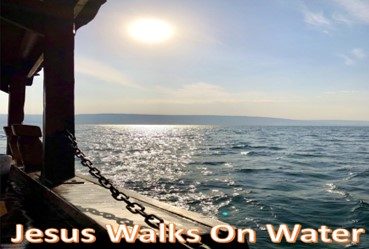
After the feeding of the five thousand, Jesus urged the disciples to leave Him so that He might go into a mountain and pray, Matthew 14:22-23 / John 6:15 / Luke 9:28. Jesus always needed some time alone to pray to the Father, John 6:16.
The Sea of Galilee was infamous for its storms, as they were sudden and violent in this area, causing common disruption of the fishing. The wind is offset by the mountains of the region and funnelled through the Jordan River valley, causing strong winds on the Sea of Galilee; this is common even today.
The disciples were rowing against the wind in the late evening, Matthew 14:24. The disciples were now in the middle of the Sea of Galilee and about three miles from the shore, John 6:19. They didn’t think that their lives were in danger; they were simply struggling against the wind.
The account of Jesus walking on the water is recorded in Matthew 14:22-36 / Mark 6:45-56 / John 6:16-21. In the early morning from 3:00 am to 6:00 am, the fourth watch, Jesus, walked by them on the Sea of Galilee, Matthew 14:25. The disciples left about 6 pm, but were still rowing when Jesus came to them in the fourth watch of the night, 3-4 am, and they had rowed only three or four miles, John 6:19.
The disciples were rowing against the wind in the late evening, Matthew 14:23-24. As I mentioned earlier, they didn’t think that their lives were in danger; they were simply struggling against the wind. The sea became so rough that some of the disciples were becoming seasick!
Jesus was passing by them, Mark 6:48, not in the sense of leaving them in their predicament, but in order to present the situation that would truly manifest His deity. It’s also possible that Jesus may have been exercising a sense of humour.
They were struggling against the wind, and He, with ease, was simply walking by on the water. They looked out at the sea and guess who they saw? They are frightened when they see Jesus; they think it is a ghost, Matthew 14:26 / Mark 6:49-50 / John 6:19.
They would think this again after His resurrection, Luke 24:37. They saw Jesus walking toward them on the water! This was a Divine display of His power over the natural laws.
Now let’s just pause and think about this for a moment. Jesus is walking on water, and I don’t know about you, but this is nothing less than a miracle, isn’t it?
You might be thinking, I don’t really believe that Jesus actually did walk on the water, but if you believe Genesis 1:1, where the Bible says, ‘God created the heavens and the earth and everything in them,’ then you shouldn’t have any problem believing this miracle.
If God can create the whole world and everything out of nothing, then why can’t the One who created the water in the first place be able to walk on what He created? Colossians 1:16-17.
Why can’t the One who created the sun stop the sun from going down, as we read about in Joshua 10? Why can’t the One who created life bring Lazarus back to life after he had been dead for four days, like we read about in John 11?
My point is that Jesus walked on water, so that means that Jesus is definitely afloat. Now seeing anyone walking on water would be enough to frighten me, and it frightened the disciples too, Matthew 14:26 / Mark 6:49-50 / John 6:19. And so knowing their fear, Jesus reassures them and says, ‘Don’t be afraid, it is I,’ Matthew 14:27 / John 6:20.
When Jesus says, ‘it is I’, Matthew 14:27 / John 6:20, this could be translated, ‘EGO EIMI,’ ‘I am’, Exodus 3:14 / John 8:24 / John 8:28 / John 8:58. Their superstitious nature led them to think that they were seeing a ghost, but Jesus reassured them that it was He.
Note that only Matthew records Peter walking on the water, Matthew 14:29-32. It teaches us that the unexpected should be expected when we spend time with Jesus.
And so Jesus is walking on the water, and the storm is still raging, and according to Matthew, when Peter saw Jesus, he asked, ‘Lord, if it is you’, which could be translated, ‘Since it is You,’ Matthew 14:28.
Peter became excited, and he said to him, ‘Lord, if that’s really you, let me walk to you on the water’, Matthew 14:28. Then Jesus answered Peter and said, ‘Come’, Matthew 14:29. Peter climbed over the side of the boat and started walking on the water to Jesus, Matthew 14:29.
This is a big lesson we all need to learn from time to time. When was the last time we stepped out in faith as Peter did? It’s easy to stay in the boat where everything is nice and safe. But when was the last time we got out of the boat and started to trust God as Peter did?
This is amazing, isn’t it? Peter didn’t create the water, so how did he manage to walk on the water? He had a little of what we all need as Christians; he had one of those things we can’t see: he had faith. There would come a time, however, when the disciples would have the faith to move mountains, Matthew 17:14-20.
And Peter’s faith was great until he began to look around. He felt the strong winds and saw the waves, and he became afraid and started to sink, Matthew 14:30. He had great faith until he took his eyes off Jesus, and it was then that he cried out to Jesus for help.
I want to raise an important point right here. Sometimes in life, we find ourselves drowning in all sorts of things. Adults drown in the waters of bereavement, sorrow and worries.
Adults drown in the waters of debt, family pressures and broken relationships. Children drown in the waters of peer-pressure, unloving parents, and having no good role models in their lives. Children drown in the waters of neglect, abuse and lack of support. Now, all these things can drown anyone, and sometimes they do.
Although Peter started off with great faith, and even though his faith achieved a great thing like walking on water, he took his eye off the Creator of the water and began to drown. The point is this, Jesus didn’t just leave him to drown, He reached out and saved him, Matthew 14:31.
There are times when life is great, and we feel like we are walking on water. But there are other times when life isn’t so great, and we begin to drown in the waters of life. But there is hope; you don’t have to drown. Why? Simply because Jesus has His arm outstretched and He is trying to save you. But you need to take hold of His hand.
As long as Peter kept his eyes on Jesus, he was walking on the water, but when he took his eyes off of Jesus, he began to sink. We face many storms in our daily life, but if we keep our eyes on Jesus, we can weather the storm, Hebrews 12:2.
When Jesus says to Peter, ‘You of little faith,’ ‘Why did you doubt?’ Matthew 14:31. I don’t think we’re to believe that Jesus was rebuking Peter; He probably had a smile on His face. The point is, we should do what Peter did; we need to reach out to God in times of need, Matthew 6:30 / Matthew 8:26 / Matthew 16:9.
Notice also that Peter must have walked on the water a second time to get back into the boat and it was then that the wind died down, Matthew 14:32. The disciple’s reaction indicates a growing faith, Matthew 14:33, and the result, they worshipped Him, saying ‘Truly you are the Son of God’, Matthew 14:33 / Mark 6:51-52.
They worshipped Him, Matthew 14:33, which tells us they recognised that Jesus was indeed God, John 1:1 / John 1:14. They proclaimed that Jesus truly is the Son of God, Matthew 16:16 / Matthew 26:63 / Mark 1:1 / Luke 4:41 / John 1:49 / John 6:69 / John 11:27 / Acts 8:37 / Romans 1:4.
Mark adds the statement in Mark 6:52 to associate these two miraculous wonders of Jesus. The miracle of the feeding of the five thousand and the walking on the water proved that Jesus was Deity, John 1:1-3. He had the power to create, Colossians 1:16-17. He also had the power to control that which He had created, Hebrews 1:3.
It was at this time in the ministry of Jesus that the disciples were beginning to realise who He was. At the time of the feeding of the five thousand, they were slow to understand who He was, Mark 3:5 / Mark 16:14. They hadn’t understood from the miracle that He was God.
They were astounded, for like Philip, their hearts were hardened, for they didn’t fully understand the implications of the signs of the loaves and fishes, Mark 6:52. Therefore, the statement that their hearts were hardened, Mark 6:52, must be understood in the context of what Jesus wanted them to understand concerning who He really was.
They had accepted Him as a good teacher who could work miracles as Elijah or one of the prophets, but Jesus was more than a prophet; He was the Son of God who had the power of creation, Matthew 16:18-19.
Jesus wanted them to realise that He was the Son of God. He could feed the hungry, He who could heal the sick, He could calm and control the tempest; therefore, He can and will take care of you. Anyone who follows Jesus for physical gain has missed the point and will not gain the spiritual benefits of salvation.
Many arguments have been built up around this miracle. Today, some people think that Jesus walked on a sandbank, while others say that the Greek indicates that He was still on the shore.
However, as the boat was three miles into the sea and Jesus got into the boat, it seems that the Biblical version holds more water! The boat then enjoyed some miraculous transportation to the shore. This miracle built up the faith of the disciples, also proving Jesus’ power over natural laws.