
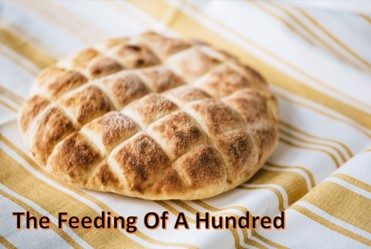
Remember, Elisha was in Gilgal and the land was going through a famine, 2 Kings 4:38, and it appears that sometime later, they are still going through the same famine. Because we read of one hundred men who were hungry and needed feeding. We read of an unnamed man who came from Baal Shalishah, 2 Kings 4:42.
The name Baal is usually associated with the Canaanite god, but it can also be associated with the Lord. The name Shalishah means third and is usually associated with the idea of multiplicity because in Hebrew, the number three was the smallest number which set forth the idea of multiplicity.
In other words, Baal Shalishah could mean the Lord who multiplies, which is very significant in terms of what is about to happen. This unmanned man was obviously a follower of God because of what he gave. Notice that he gave twenty loaves of barley bread from the first ripe grain, along with some heads of new grain, 2 Kings 4:42.
We’re not talking about the kind of bread we buy in our shops today; these would be very small flatbreads. In other words, he brought twenty small flat barley breads and some corn. Normally, the firstfruits were to be given to the Lord and the priests, Leviticus 23:20, but there is a famine happening right now, and this man brought some food for Elisha and the other prophets.
Barnes, in his commentary, says the following.
‘It appears by this that the Levitical priests, having withdrawn from the land of Israel, 2 Chronicles 11:13-14, pious Israelites transferred to the prophets, whom God raised up, the offerings required by the Law to be given to the priests, Numbers 18:13 / Deuteronomy 18:4.’
In terms of scale, this isn’t a huge amount, but in terms of heart, this man gave all he had. He understood that if he honours God with the firstfruits, God in turn would continue to bless him, Proverbs 3:9-10. He was helping God’s people, Hebrews 6:10, but this man had no idea that God was going to bless the little gift he offered to feed the multitude.
When Elisha tells the man to give it to the people, it’s not surprising that he thought this was a crazy suggestion because twenty small loaves of bread wouldn’t be enough to feed one hundred men, 2 Kings 4:42.
Didn’t the disciples think the same thing when Jesus was about to feed the five thousand? Matthew 14:15-17. Didn’t the disciples think the same thing when Jesus was about to feed the four thousand? Matthew 15:33-34. Didn’t they stop and think, ‘I’m sure we’ve read somewhere in the Torah about Elisha doing something similar.’
Notice that Elisha tells him to do it anyway, despite the man’s doubts and then adds that it was the Lord who said, ‘they will eat and have some left over’, 2 Kings 4:42-43. When Jesus fed the five thousand men, not including women and children, with five loaves of bread and two fish, by the time they were finished, they had twelve small baskets of leftovers, Matthew 14:20.
When He fed the four thousand men, not including women and children, with seven loaves of bread and a few fish, by the time they were finished, they had seven large baskets of leftovers, Matthew 15:37.
The Lord, through Elisha, said it would happen, and it did; they all ate until they were full, and they had some left over, 2 Kings 4:44. The miracle recorded here was shown in the fact that one hundred men could be fed with such a small amount of food. The purpose of the miracle was to once again prove to all the people that Elisha was God’s true prophet and that God was working through him.
What can we learn from this event?
1. God can meet your needs.
God met the hunger needs of the one hundred prophets, but let me ask you, do you believe that God cares enough about you to meet your needs? God doesn’t meet all your greeds but all your needs, and it does that on a daily basis, Philippians 4:19. If He meets all our needs, is there anything we lack? No, He meets all our needs, not just some.
Isn’t that what Jesus was trying to teach us concerning our daily bread? Matthew 6:11. The petition for ‘daily bread’ isn’t for milk and honey, the symbols of luxury, but for bread that will be sufficient for this day. And, as long as it is today, we don’t need tomorrow’s bread. He doesn’t give us as much as we want, but He gives us as much as we need.
When you stop and see how He blesses us every day with our daily essentials, like food and water and clothes, Matthew 6:31, maybe then we can see that He does give us the right amount. Our God fed millions in the wilderness with manna every day for forty years, Exodus 16 / Psalm 78:24-25 / Nehemiah 9:21.
He caused ravens to feed Elijah by the brook, 1 Kings 17:4-6. He filled Peter’s net with fish, Luke 5:4-11 / John 21:3-11. God is well aware of our basic needs, and if he can feed the one-hundred, the five-thousand and the four-thousand, He can certainly take care of our daily bread.
2. God will bless your gift.
The unknown man brought what most people would consider a small gift of bread and corn, and God blessed it abundantly. You have no idea how much God can bless a person who is feeling sick when you go and visit them.
You have no idea how much God can bless a person who is feeling low when you send them a text message. You have no idea how much God can bless a person who has lost someone close to them, and you send them a bunch of flowers and a card telling them you are praying for them.
God doesn’t ask us to give what we don’t have, but He does ask us to give what we do have, no matter how small it may seem, Matthew 10:42. Never underestimate what God can do with what you think is small.
3. Believe that God will do the impossible.
Even though this unnamed man had no idea what God was capable of doing, Elisha had no doubts about what God could do. Before I became a Christian, my life was in pieces, and I had no reason to carry on living.
I was in a hopeless, helpless situation because of the circumstances I found myself in. But one lady encouraged me to study the Bible and speak to God about it, and a few weeks later, I became a Christian. Jesus put my life back together again, and my life has never been the same since.
If you are not a Christian and your life is in pieces, then let me encourage you to go to the King and ask Him to help you. Because only King Jesus can put your life back together again and give you a reason to live. Only King Jesus can do what you can’t do for yourself; only King Jesus can do the impossible, Matthew 19:24-26.
The miracle recorded here was shown in the fact that one hundred men could be fed with such a small amount of food. This miracle and the first miracle recorded in this chapter, 2 Kings 4:1-7, are similar to the feeding of the four thousand, Matthew 15:32-39 / Mark 8:1-9, and the feeding of the five thousand, Matthew 14:13-21 / Mark 6:31-44 / Luke 9:12-17 / John 6:1-14, as done by Jesus.
They are also similar in nature to what Elijah did when he fed the widow of Zarephath and her son, 1 Kings 17:10-16. This again would prove to all the people that Elisha was God’s true prophet and that God was working through him.