
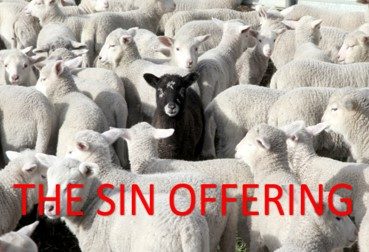
In Exodus 29:10-14, we’re introduced to the sin offering. Moses is to bring a bull to the front of the tent of meeting, and Aaron and his sons are to lay their hands on its head Exodus 29:10 / Leviticus 8:14. By placing their hands on the bull’s head, the priests symbolically put their sins on the animal that was to be sacrificed.
The priests are to offer sin offerings for the people, but they first had to sacrifice for their own sins, Leviticus 4:1-35 / Leviticus 6:24-30 / Hebrews 5:3. Moses is to slaughter it in the LORD’s presence at the entrance to the tent of meeting, Exodus 29:11 / Leviticus 8:14.
Field’s in his commentary says the following.
‘Killing the bull was an admission that ‘We deserve to die, but God in His grace accepts the death of this creature instead of my death.’
Some of the bull’s blood was to be put on the horns of the altar with his finger, and the rest of it was to be poured out at the base of the altar, Exodus 29:12 / Leviticus 8:15.
All the fat on the internal organs, the long lobe of the liver, and both kidneys with the fat on them, were to be burned the altar, Exodus 29:13 / Leviticus 8:16. The bull’s flesh, its hide and its intestines outside the camp, Exodus 29:14 / Leviticus 8:17. It is a sin offering, Exodus 29:14 / Hebrews 13:12-13.
Unintentional sins, Leviticus 4:2 / Leviticus 4:13 / Leviticus 4:22 / Leviticus 4:27, mean missing the mark, and there are two categories of motive mentioned here. First, there is missing the mark deliberately or willingly and missing the mark through weakness of the flesh.
In the Old Testament, no provision was made for a deliberate sin; the offender was put to death, Exodus 31:12 / Exodus 35:2 / Numbers 15:32-36 / Leviticus 24:10-23. The lack of knowledge was not then and is not now an excuse for the sin that they committed, Hebrews 10:26.
Meyrick, in his commentary, says the following.
‘Despite the fact of these other offerings having been outlined first, Leviticus 1-3, it was always the sin-offering or the guilt-offering which was first offered in the case of multiple sacrifices. The other three were presented first in the text because “they were already in existence, and had existed from the time of the Fall.’
In Leviticus 4:3-12 we’re told what the priests are to do for their sin offering. If the anointed priest sins, that is the high priest, Leviticus 8:12 / Leviticus 21:10 / Exodus 29:7, bringing guilt on the people he must bring a young bull without defect as a sin offering for the sin he has committed, Leviticus 4:3.
For unintentional sins, the priest offered a bull without defect, Leviticus 4:3 / Leviticus 4:23 / Leviticus 4:28 / Leviticus 4:32 / 2 Corinthians 5:21, and for sins against holy things, the sacrifice was to God, Leviticus 5:14-16.
For sins against a neighbour, the sacrifice was made to God, and a full restoration of property plus one-fifth was made to the neighbour, Leviticus 6:1-7. A young bull was sacrificed for the purpose of the consecration of priests and Levites to their office. For the high priest on the Day of Atonement, Leviticus 16:3; for the sin of the high priest, Leviticus 4:3; for the sin of the entire congregation, Leviticus 4:13.
The priest is to present the bull at the entrance to the tent of meeting, lay his hand on its head and slaughter it there, Leviticus 4:4 / Leviticus 4:15 / Leviticus 4:24 / Leviticus 4:29 / Leviticus 4:33 / Leviticus 1:4. Next, the priest is to take some of the bull’s blood and carry it into the tent of meeting, Leviticus 4:5.
Barnes, in his commentary, says the following.
‘The treatment of the blood was special in the sin-offerings. In the inferior sin-offerings it was smeared on the horns of the altar of burnt-offering, Leviticus 4:25 / Leviticus 4:30 / Leviticus 4:34, while in this offering for the high priest, and in that for the nation, the high priest himself sprinkled the blood seven times within the tabernacle and smeared it on the horns of the altar of incense, Leviticus 4:6-7 / Leviticus 4:17-18. The different modes of sprinkling appear to have marked successive degrees of consecration in advancing from the altar of burnt-offering to the presence of Yahweh within the veil.’
He is to dip his finger into the blood and sprinkle some of it seven times before the LORD, in front of the curtain of the sanctuary, Leviticus 4:6 / Leviticus 4:17 / Exodus 29:30.
Clarke, in his commentary, says the following.
‘The blood of this sacrifice was applied in three different ways.
1. The priest put his finger in it and sprinkled it seven times before the veil, Leviticus 4:6.
2. He put some of it on the horns of the altar of incense.
3. He poured the remaining part at the bottom of the altar of burnt-offerings, Leviticus 4:7.’
If the blood was sprinkled in the Holy Place or around the altar or near the veil seven times, then the entire animal was burned, Leviticus 6:30.
Coffman, in his commentary, says the following.
‘The sprinkling of the blood so near the veil seems to have resulted from the high rank of the sinner whose transgression was expiated by this offering. The usual place for the sprinkling of blood was upon the altar of burnt-offering, and only in the case of the priest, or of the whole people, was it sprinkled near the veil. The higher the rank of the sinner, the nearer to the presence of Jehovah within the veil was the blood sprinkled.’
The offence caused by the priest or priestly nation, viewed as God’s representatives, is taken into the Holy place, Leviticus 6:30. On the great day of Atonement, the offering sums up the sins of the people, known and unknown.
Sins not dealt with by the everyday offerings, sins of priests, high priest, nation, and individuals alike and takes them into the very throne room itself. He is then put some of the blood on the horns of the altar of fragrant incense that is before the LORD in the tent of meeting, Leviticus 4:7.
The remainder of the bull’s blood is to be poured out at the base of the altar of burnt offering at the entrance to the tent of meeting, Leviticus 4:7 / Leviticus 4:18 / Leviticus 4:25 / Leviticus 4:30 / Leviticus 4:34
Next, the fat and kidneys were separated from the animal and burned upon the altar, Leviticus 4:8-10. When the priest committed a sin of omission, not a deliberate sin, by unconsciously contracting sins from the people in his office.
Maybe it only applies to the anointed high priest; his sin affects the people. This sacrifice is closely linked with the guilt offering and continues in the style of the peace offering, Leviticus 4:10.
Clothes which had blood on them had to be washed or destroyed. Pots which were used to cook the portion given to the priests were either broken or scoured and cleaned. If the blood was sprinkled outside the bronze altar, all the fat was to be burned but the officiating priest received the flesh, Leviticus 6:24-29. This was not something done every day, Hosea 6:6 / Micah 6:7-8.
The flesh along with the skin, head and bones and remains of the animal were taken outside the camp to a clean place and burned and then buried, Leviticus 4:11-12 / Leviticus 4:21.
Barnes, in his commentary, says the following.
‘A clean place where the ashes are poured out, Leviticus 1:16. It was a place free from impurities, not like those referred to in Leviticus 14:40 / Leviticus 14:45. The flesh, though it was burned in an ordinary way, and not sent up in the fire of the altar, Leviticus 1:9, was not to be confounded with carrion, but was associated with the remains of the sacrifices. The priests could not eat the flesh of this victim or of that offered for the sin of the congregation, as they ate that of other sin-offerings, Leviticus 6:26. Compare Leviticus 10:17-18, because they were in these cases in the position of offerors, Leviticus 16:27 / Hebrews 13:11. The same rule was observed in regard to the meat-offering of the priests, Leviticus 6:23. It was only of the peace-offering that the offeror himself could partake.’
This is a picture of Jesus who was crucified outside of Jerusalem, therefore Jesus also, that He might sanctify the people through His own blood, suffered outside the gate, Hebrews 13:11-13.
In Leviticus 4:13-21, we’re told what the nation as a whole must do if they unintentionally sin. If the whole Israelite community sins unintentionally and does what is forbidden, even though the community is unaware of the matter, when they realise their guilt and the sin they committed becomes known, the assembly must bring a young bull as a sin offering and present it before the tent of meeting, Leviticus 4:13-14.
The elders of the community are to lay their hands on the bull’s head before the LORD, and the bull shall be slaughtered, Leviticus 4:15. This offering of a young bull was made by the whole congregation, incurring the displeasure of God, for a reason not discovered.
It was the same as the priest’s offering, but all of the elders placed their hands upon the head of the sacrifice before killing it, Leviticus 4:15 / Leviticus 4:4 / Leviticus 4:24 / Leviticus 4:29 / Leviticus 4:33 / Leviticus 1:4. The idea was to humble the leaders of the people to keep them pure and to keep them in their place.
Then the priest is to take some of the bull’s blood into the tent of meeting, Leviticus 4:16. He is to then dip his finger into the blood and sprinkle it before the LORD seven times in front of the curtain, Leviticus 4:17 / Leviticus 4:6 / Exodus 29:30.
The priests is to then put some of the blood on the horns of the altar that is before the LORD in the tent of meeting and the rest of the blood is to be poured out at the base of the altar of burnt offering at the entrance to the tent of meeting, Leviticus 4:18 / Leviticus 4:7 / Leviticus 4:25 / Leviticus 4:30 / Leviticus 4:34.
The fat is to be removed and burnt on the altar, just as it was done with the bull for the sin offering, Leviticus 4:19 / Leviticus 4:8. In this way, the priest is making atonement for the community, and they will be forgiven, Leviticus 4:19-20 / Leviticus 4:26 / Leviticus 4:31 / Leviticus 4:35 / Hebrews 10:3-4.
The word ‘atonement’ means to cover up; later in the New Testament, the word ‘atonement’ means to reconcile, Romans 3:25 / Hebrews 2:17. God cannot be approached with the guilt of sin on our shoulders; atonement must be made for sin, Habakkuk 1:13.
The bull is to be taken outside the camp and burned, as he burned the first bull, Leviticus 4:21 / Leviticus 4:12. This is the sin offering for the community, Leviticus 4:21.
Meyrick, in his commentary, says the following.
‘The ceremonial cleansing of the sinful Israelite by the sin-offering in the old dispensation foreshadows the effect of baptism in the new dispensation, for as Calvin noticed in his commentary, ‘All sins are now washed away by baptism, so under the Law also sacrifices were expiations, although in a different way’.’
In Leviticus 4:22-26, we’re told what the leaders of the nations must do if they unintentionally sin. When a leader sins unintentionally and does what is forbidden, when he realises his guilt and the sin he has committed becomes known, he must bring as his offering a male goat without defect, Leviticus 4:22-23 / Leviticus 4:3 / Leviticus 4:28 / Leviticus 4:32 / Leviticus 3:5 / 2 Corinthians 5:21.
A male goat was sacrificed for feasts and festivals, Leviticus 16:9 / Leviticus 16:15 / Numbers 28:15 / Numbers 28:22 / Numbers 28:30, for the dedication of the tabernacle and temple, Numbers 7:16, for the consecration of the priests, Leviticus 9:3, and for the sin of a ruler, Leviticus 4:23.
Turtledoves or pigeons were commonly used as a substitute for the lamb in cases of poverty, Leviticus 5:7. In extreme poverty, a tenth of an Ephah of flour was used, which was equal to the daily supply of Manna. Virtually everyone would have been able to take part in this sacrifice to God, Leviticus 5:7-13.
Barnes, in his commentary, says the following concerning the leaders, Leviticus 4:22.
‘Either the head of a tribe, Numbers 1:4-16, or the head of a division of a tribe, Numbers 34:18, compare Joshua 22:30.’
The leader is to lay his hand on the goat’s head and slaughter it at the place where the burnt offering is slaughtered before the LORD, it is a sin offering, Leviticus 4:24 / Leviticus 4:4 / Leviticus 4:15 / Leviticus 4:24 / Leviticus 4:29 / Leviticus 4:33 / Leviticus 1:4.
Then the priest is to take some of the blood of the sin offering with his finger and put it on the horns of the altar of burnt offering and pour out the rest of the blood at the base of the altar, Leviticus 4:25 / Leviticus 4:30 / Leviticus 4:34.
All the fat and intestines were to be burnt on the burnt offering altar, Leviticus 4:26. In this way the priest will make atonement for the leader’s sin, and he will be forgiven, Leviticus 4:26 / Leviticus 4:20 / Leviticus 4:31 / Leviticus 4:35.
Clements, in his commentary, says the following.
‘God always remained sovereign over the ritual which was offered to him. Forgiveness was his free prerogative, not man’s right, controlled by rigid conditions.’
The sin of the priests, or the religious leaders, appears to be more serious than the sin of the individual members, and even the rulers. The blood of the offering for the religious leaders was to be placed on the horns of the altar with sweet incense, Leviticus 4:7, whereas the blood of the sacrifice of the ruler or the individual member was to be placed on the horns of the altar of burnt offering, Leviticus 4:25 / Leviticus 4:30.
In Leviticus 4:27-31, we’re told what individuals must do if they unintentionally sin. If any member of the community sins unintentionally and does what is forbidden, when they realise their guilt and the sin they have committed becomes known, they must bring as their offering for the sin they committed a female goat without defect, Leviticus 4:27-28 / Leviticus 4:3 / Leviticus 4:23 / Leviticus 4:32 / 2 Corinthians 5:21.
A female goat was sacrificed by any individual who found they had unintentionally sinned. A female lamb was sacrificed for the sin of the common people, Leviticus 4:28, for a Nazarite to be released from his vow, Numbers 6:14, and for the cleansing of a leper, Leviticus 14:10.
They are to lay their hand on the head of the sin offering and slaughter it at the place of the burnt offering, Leviticus 4:29 / Leviticus 4:4 / Leviticus 4:15 / Leviticus 4:24 / Leviticus 4:33 / Leviticus 1:4.
Then the priest is to take some of the blood with his finger and put it on the horns of the altar of burnt offering and pour out the rest of the blood at the base of the altar, Leviticus 4:30 / Leviticus 4:25 / Leviticus 4:34.
The priest is to remove all the fat, just as the fat is removed from the fellowship offering, Leviticus 4:10, and the priest shall burn it on the altar as an aroma pleasing to the LORD, Leviticus 4:31. In this way the priest is making atonement for them, and they will be forgiven, Leviticus 4:31 / Leviticus 4:26 / Leviticus 4:20 / Leviticus 4:35.
If someone brings a lamb as their sin offering, they are to bring a female without defect, Leviticus 4:32 / Leviticus 4:3 / Leviticus 4:23 / Leviticus 4:28 / Leviticus 3:7 / 2 Corinthians 5:21. They are to lay their hand on its head and slaughter it for a sin offering at the place where the burnt offering is slaughtered, Leviticus 4:33 / Leviticus 4:4 / Leviticus 4:15 / Leviticus 4:24 / Leviticus 4:29 / Leviticus 1:4.
Then the priest is to take some of the blood of the sin offering with his finger and put it on the horns of the altar of burnt offering and pour out the rest of the blood at the base of the altar, Leviticus 4:34 / Leviticus 4:25 / Leviticus 4:30. The offence caused to God by an individual member is presented on the horns, the strongest part of the altar.
The priest is then to remove all the fat, Leviticus 4:15, just as the fat is removed from the lamb of the fellowship offering, Leviticus 4:8-10 / Leviticus 4:19 / Leviticus 4:19 / Leviticus 4:21. Then the priest is to burn it on the altar on top of the food offerings, Leviticus 4:35.
In this way, the priest is making atonement for them for the sin they have committed, and they will be forgiven, Leviticus 4:35 / Leviticus 4:26 / Leviticus 4:20 / Leviticus 4:31. The sacrifice was aimed at securing forgiveness and obtaining a renewed fellowship.
Barnes, in his commentary, says the following.
‘Three points are to be observed in regard to the victims for sin-offerings.
1. The common people had to offer a female, as the less valuable animal; they might present either a sheep or a goat to suit their convenience.
2. The rulers had always to offer a male goat.
3. The goat was preferred to the sheep, unlike the victim for a peace-offering or burnt-offering.’
In Leviticus 5, we find there are three different offences in which a person would have to submit a guilt offering. The first is directed to anyone who does not publicly speak up to testify to the truth in the courts, Leviticus 5:1 / Leviticus 6:5 / Judges 17:1 / Matthew 26:63 / John 9:24.
If they do not speak up, they will be held responsible, Leviticus 5:1 / Leviticus 5:17. This would be like holding back evidence from the courts, which could affect the final outcome of the accused person.
Jamieson, in his commentary, says the following.
‘A proclamation was issued, calling anyone who could give information to come before the court and bear testimony to the guilt of a criminal. The manner in which witnesses were interrogated in Jewish courts of justice was not by swearing them in directly, but by adjuring them. The offence, then, for the expiation of which this law provides, was that of a person who neglected or avoided the opportunity to testify.’
The second one is directed at those who touch anything which is ceremonially unclean, Leviticus 5:2-3 / Leviticus 12-15. We can imagine someone walking down the street, and without knowing it, they have touched something which was unclean, but later they become aware of it.
These people needed to offer a sin offering, Leviticus 5:6, because they didn’t observe the rules for purification, Leviticus 11:24-31. After the purification process, they would be restored back into fellowship with God and His people.
Clarke, in his commentary, says the following.
‘All such persons were to wash their clothes and themselves in clean water, and were considered as unclean till the evening, Leviticus 11:24-31. But if this had been neglected, they were obliged to bring a trespass-offering.’
The third offence is directed at those who make oaths, Leviticus 5:4-5 / Psalms 106:33. We can imagine someone with all good intentions who makes an oath but fails to fulfil that oath for some reason; they would be guilty of not fulfilling that oath.
We can also imagine someone making a careless oath, an oath that they knew they couldn’t fulfil, they too would be guilty of making such an oath in the first place, Judges 11:30 / Numbers 11:1-3 / Joshua 6:26.
If anyone made an oath they didn’t fulfil or made a careless oath, they couldn’t fulfil, they had to confess their sins before they made a sin offering, Leviticus 5:5.
These oaths were given on the condition of expectation, it’s the hope to receive, and so the offering was in the form of a vow. The meat had to be eaten, and the carcass had to be burnt within two days of the offering. There were also voluntary oaths, vows or promises to consecrate someone or something to God, Leviticus 27:1 / Deuteronomy 23:21-24.
There was also the Nazarite vow, where a person vowed to abstain from wine or all drink that could affect them. It included avoiding contamination from dead bodies, bones, and graves; it also included refraining from mourning the dead and not cutting their hair, Numbers 6:1-11 / Judges 13:4-5 / Judges 14:6-9 / Luke 1:13-15.
The sin offering for anyone guilty of breaking an oath or carelessly giving one is in mind in Leviticus 5:6. The person who broke his oath or carelessly made an oath had to bear the guilt of his sin against another, for the oath was made in reference to another.
A female lamb or goat from the flock as a sin offering; and the priest shall make atonement for them for their sin, Leviticus 5:6. The word ‘atonement’, means to cover up, later in the New Testament the word ‘atonement’ means to reconcile, Romans 3:25 / Hebrews 2:17. God cannot be approached with the guilt of sin on our shoulders, atonement must be made for sin, Habakkuk 1:13.
Anyone who cannot afford a lamb is to bring two doves or two young pigeons to the LORD as a penalty for their sin, one for a sin offering and the other for a burnt offering, Leviticus 5:7 / Leviticus 1:14-16 / Leviticus 12:8.
Here we can see God’s provision for those who aren’t well off, Leviticus 5:7 / Leviticus 5:11. In other words, people have no excuse to follow and obey God’s requirements for personal sacrifice.
They are to bring their sin offering to the priest, and the priest is to first offer the one for the sin offering, Leviticus 5:8 / Leviticus 1:16. He is to wring its head from its neck, not dividing it completely, Leviticus 5:8, then to splash some of the blood of the sin offering against the side of the altar. While the rest of the blood is to be drained out at the base of the altar, Leviticus 5:9.
It is a sin offering, Leviticus 5:9 / Leviticus 5:12. The priest is to offer the other as a burnt offering in the prescribed way and make atonement for them for the sin they have committed, and they will be forgiven, Leviticus 5:10 / Leviticus 5:13 / Leviticus 6:26 / Romans 3:25 / Hebrews 2:17.
In Leviticus 5:11-13, we can see God’s provision for those who aren’t well off. If they cannot afford two doves or two young pigeons, Leviticus 5:7, they are to bring as an offering for their sin a tenth of an ephah of the finest flour for a sin offering, Leviticus 5:11 / Leviticus 19:36.
They are to bring it to the priest, who is to take a handful of it as a memorial portion and burn it on the altar on top of the food offerings presented to the LORD, Leviticus 5:12.
It is a sin offering, Leviticus 5:12 / Leviticus 5:9. By doing this, the priest is making atonement for them for any of these sins they have committed, and they will be forgiven, Leviticus 5:13 / Leviticus 5:10 / Romans 3:25 / Hebrews 2:17. The rest of the offering will belong to the priest, as in the case of the grain offering, Leviticus 5:13 / Leviticus 2:1-16.
Clements, in his commentary, says the following.
‘Different types of sacrifices are not needed for different types of sin, nor is there a need to fear that there are some kinds of sin which have not been covered by the sacrifice which God has provided in Jesus Christ. All sin is atoned for by him, so that he fulfils the Old Testament demand for sacrifice as the way of atonement and forgiveness with God.’
We can see that the sin offering was an offering that related to relationships between people. We all know that relationships, especially bad relationships, can affect not only our relationship with God but also with those around us. The point here is simple enough: if your relationship with each other isn’t right, then our relationship with God isn’t right either.
In Leviticus 6:24-30, God once again speaks to Moses and asks him to tell Aaron and his sons the regulations for the sin offering, Leviticus 6:24-25. The sin offering is to be slaughtered before the LORD in the place where the burnt offering is slaughtered, Leviticus 1:11, and God says it is most holy, Leviticus 6:25 / Leviticus 2:3.
Notice that this sin offering was to be eaten in the outer courtyard of the tabernacle structure, and it was only to be eaten by those whom God had separated for the priesthood, Leviticus 6:26 / Leviticus 6:16 / Leviticus 7:6.
The blood and fat of the sacrificed animal weren’t permitted to be eaten but they were to be burnt with fire. The fat was used as oil for the continual burning of the sacrificial fires.
Barnes, in his commentary, says the following.
‘The key to the special sanctity of the flesh of the sin-offering, as set forth in Leviticus 6:26-30, must, it would seem, be found in the words of Moses to the priests, Leviticus 10:17. The flesh of the victim, which represented the sinner for whom atonement was now made, was to be solemnly, and most exclusively, appropriated by those who were appointed to mediate between the sinner and the Lord. The far-reaching symbolism of the act met its perfect fulfilment in the One Mediator who took our nature upon Himself. Philippians 2:7.’
Whatever touches any of the flesh will become holy, and if any of the blood is spattered on a garment, the priest must wash it in the sanctuary area, Leviticus 6:27. The clay pot the meat is cooked is to be broken, but if it is cooked in a bronze pot, the pot is to be scoured and rinsed with water, Leviticus 6:28.
Because Aaron and his sons were a holy priesthood, a separated people, they could eat the meat of the offering so that they could bear the sins of God’s people, Leviticus 6:29. Any sin offering whose blood is brought into the tent of meeting to make atonement in the Holy Place, Leviticus 10:18, must not be eaten, and it must be burned up, Leviticus 6:30.
Sin offerings were made in order to illustrate that, in reference to our relationship with God, life had to be taken in order to receive atonement. Once the blood was placed on the horns of the altar, the fat was burned upon the altar, and the rest of the body parts were burned outside the camp, Hebrews 13:11-12.
There is a degree of overlap between the sin offering and the trespass offering. The sin offering is indicated for our general sinful condition before God, Leviticus 5:13.
The sin offering is indicated for unintentional sins, Leviticus 4:1-2 / Leviticus 4:27, especially by leaders or by the people as a whole, Leviticus 4:3 / Leviticus 4:13 / Leviticus 4:22. The sin offering is indicated for individuals among God’s people, Leviticus 4:27.
The shedding of the blood was pointing toward a greater sacrifice in the future, that is, the blood of Christ, Hebrews 9:10-13 / Hebrews 10:19-22. With these sacrifices, we can see that the blood moves from the outer circle into the centre as the guilt moves from the heart of an individual towards the heart of a nation.
Sin separates people from God, and the relationship can only be restored by the death of a sacrifice, an innocent victim. It stresses the quality of sin, its nature, and thus man’s state because of it. In the sin offering, the attitude of the person is stressed in the trespass, and the act of sin is stressed.
Spiritually minded people should see that all this pointed to Christ, the Messiah. Abraham saw the day of Christ and rejoiced, John 8:56; Moses suffered for Christ, Hebrews 11:26; Isaiah saw the glory of the Messiah, John 12:41. Christ was the sin and trespass offering, 2 Corinthians 5:21 / Hebrews 9:14 / Hebrews 13:12 / Hebrews 10:14 / Ephesians 5:2.
The good news of the sin offering is that Christ has fulfilled the sin offering, once for all, Hebrews 9:26 / 2 Corinthians 5:21 / Romans 8:3. Based on faith in what Christ has done for us by His death on the cross, we can be released from slavery to our sinful nature and its tendencies. Jesus said, ‘Everyone who commits sin is a slave of sin. If the Son shall set you free, you shall be free indeed’, John 8:34-36.