
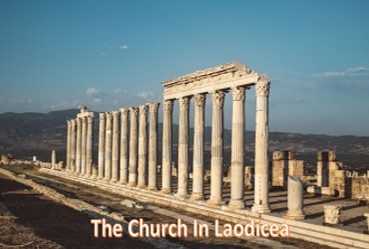
Out of all the churches written to in Revelation 2-3, I think it’s sad that the church in Laodicea has been the most studied and preached. The church that made famous the shocking saying of Jesus, ‘I will spew you out of my mouth!’ Revelation 3:16.
The town itself lay around forty-three miles southeast of Philadelphia, and the Laodiceans were a rich community. They were famous for glossy black woollen garments and for their famous eye powder.
This powder was exported all over the world in tablet form. It was then ground into powder and used to relieve eye complaints. Phrygia was one of the areas in Asia Minor where eye diseases were rampant.
The city is located in the Lycus River Valley together with Hierapolis and Colossae. This valley is a natural route of travel from east to west. The city was founded by the Seleucid king Antiochus II and named for his wife Laodice about 260 BC.
It has a famous aqueduct, and the water that was piped to Laodicea was rich in calcium, which over time would cause the pipes to clog. The engineers designed the aqueduct with vents covered with stones that could be removed periodically for cleaning.
There were also many stadiums, one of which is still preserved today. The one at Laodicea was built by Nicostratus and dedicated to Vespasian in AD 79, according to an inscription found in it.
The stadium is circular at both ends, and the total complex was nine hundred feet long. Used primarily for running races, the length of the track was fixed at six hundred feet.
This church was planted and received the Gospel not from the apostle Paul but from his helper Epaphras during the time Paul was in Ephesus, Colossians 4:12-13.
Jesus begins by describing Himself as the ‘Amen’, Revelation 3:14. Usually, when we think of the word ‘Amen’, we automatically think it means ‘so be it,’ but here it doesn’t mean that.
In describing Himself as the ‘Amen’, Jesus is saying that He is the firm One, the definite One, Isaiah 65:16. In other words, Jesus is the One who is steady and unchangeable in all His purposes and promises.
He also says, ‘He is the faithful and true witness,’ Revelation 3:14 / Revelation 1:5. As we go through this letter, you will soon see that there was nothing distinctive about the Laodiceans. They had no ‘witness’, and they were not ‘faithful’ to the testimony they had concerning Jesus.
They really stood for nothing; they weren’t concerned with heresy, and they weren’t concerned about being heretics. After all, to become a heretic takes energy, and they didn’t have any energy.
Jesus says, ‘He is the faithful and true witness,’ Revelation 3:14, whose testimony of God and to men ought to be received and fully believed. But Jesus also has another testimony, and that is the testimony of men to God, and that too will be fully believed because Jesus is the true witness, Revelation 3:14.
Notice what else Jesus describes Himself as; He says He is “the ruler of God’s creation,” Revelation 3:14. Now the KJV uses the words ‘The beginning of the creation of God’, which can be very misleading.
The word ‘beginning’ here doesn’t mean that Jesus was the first thing created, as some people like to believe. It means Jesus is the ‘cause’ or ‘source’ of the creation of God, John 1:1-3 / Colossians 1:15 / Colossians 1:18 / Hebrews 1:1-2.
Jesus is reminding the rich, self-reliant church in Laodicea where all the blessings come from. Every human being is blessed by God, Matthew 5:45. The main problem in the church in Laodicea was that it was their church, not the Lord’s. Jesus immediately identifies their problem, and it was a problem of possession.
It was their church, and they did as they pleased, and they never considered the will of the Lord. Jesus says He is the steady, unchangeable One; He is the One who is faithful and is the true witness. He is the One who is the source of all blessings, Revelation 3:14, and it’s His church, Ephesians 1:22-23, not ours.
Once again, we’re reminded that Jesus sees and knows everything that every Christian is doing or not doing, and He sees the congregation as a whole, Revelation 3:15 / Revelation 2:2. He says that you Christians in Laodicea are ‘neither cold nor hot but lukewarm,’ Revelation 3:15.
They were lukewarm, which doesn’t mean they were going from cold to hot, but they were actually going from hot to cold. The hot springs of Laodicea were not really hot but comfortably warm, so it was good for having a bath in, but horrible to drink.
But let me ask you, did Jesus want them to become cold? Would He really rather have had them cold than lukewarm? Well, that’s what He said, Revelation 3:15, and maybe He said it that way simply to stress the horror of their position.
And what was the horror of their position? They were neither hot nor cold, Revelation 3:16. In their present state, they couldn’t claim they hadn’t known; they couldn’t claim that they had never been moved.
In that way, it would have been better for them never to have been moved than to have been moved to become moderate, 2 Peter 2:21. To these lukewarm Christians, Jesus says, you are neither cold nor hot but lukewarm, and because of that, I’m going to reject you; I’m about to spit you out of my mouth, Revelation 3:16.
In other words, here is a church which had lost its passion for the things of the Lord. They had become indifferent and apathetic. They had reached a place where they were going through the motions, but they were unmoved by the things of the Lord. They didn’t care too much about the cross of Jesus; they weren’t really interested in what the Word of God meant.
They didn’t really care about the condition of the lost people around them. These Christians were not burning hot with passion for Jesus, nor were they totally dead and cold; they were somewhere in between.
Someone once said the following.
‘Let your words be few and sweet. It’s better this way when you come to eating them.’
God always hears what we say, and He has this tremendous memory. The trouble with us is, we have such large mouths and so little worth saying. Without Jesus, we can do nothing, John 15:5.
The church in Laodicea is guilty of the ‘atheism of the pound’. Now, what do I mean by that? I mean, in come the pounds and out goes God. This is a church that thought it could buy its way to congregational success, Revelation 3:17 / Psalm 50:12.
The Laodiceans say, ‘they are rich’ and ‘we need nothing,’ Revelation 3:17. Jesus tells them they are ‘wretched, pitiful, poor, blind and naked,’ Revelation 3:17.
Barnes, in his commentary, says the following.
‘Salvation is often represented as a garment, Matthew 22:11-12 / Revelation 6:11 / Revelation 7:9 / Revelation 7:13-14, and the declaration here is equivalent to saying that they had no religion. They had nothing to cover the nakedness of the soul, and with respect to the real needs of their nature, they were like one who had no clothing in reference to cold, and heat, and storms, and to the shame of nakedness.’
Can you imagine how you would have felt if Jesus had written these words to you? The truth is that we all hate to see ourselves for who we really are. Jesus says to this church, ‘You are not rich; you are totally poor.’ He says, ‘You are not blessed; you are wretched,’ which means afflicted. ‘Pitiful is what you are,’ Jesus says.
All their wonderful medicine, for which they were famous, to help eye complaints, can’t help them; they are blind, Revelation 3:17. Their beautiful, black, shiny garments, which covered the bodies of so many, even in foreign lands, can’t hide their own embarrassing nakedness, Revelation 3:17. These are strong words, and we need to remember that how we see ourselves may not be how God sees us.
The town of Laodicea had a banking centre, but sadly, its vaults didn’t hold the gold of God. Their gold, Revelation 3:18, was the type of perishable gold which Peter describes in 1 Peter 1:18. And yes, their black garments covered the body, but as we know, God’s white garments covered the soul, Revelation 3:18 / Revelation 3:17 / Revelation 3:4.
And so, Jesus sees and looks at the heart, 1 Samuel 16:7, and He tells them that their famous eye medicine can’t deal with real eyes, the eyes where you can see the real you, Revelation 3:18 / 1 Corinthians 13:12 / James 1:23-25.
We know that discipline is needed spiritually as much as it is needed physically, Hebrews 12:4-13. We know that God wants to mould us and help us to look more and more like His Son, Jesus, Romans 8:29 / 2 Corinthians 3:18 / Ephesians 4:11-15.
But we need to understand that discipline is not something God does to us, but discipline is something which God does for us, Revelation 3:19. If God did that for Jesus and for our benefit, Proverbs 3:12 / Hebrews 5:7-8, don’t we want God to have His way with us to help us grow in obedience to Him?
Our problem is that we want to get out of the trial too early; we want it over and done with. But God is working in us, and because He loves us, He is trying to produce perseverance in our lives; He is trying to help us become mature, where we lack nothing, James 1:2-4.
And when discipline comes our way, it may be because we’re heading off in the wrong direction, and we may need to think seriously about it and turn towards God again, Revelation 3:19.
If you’ve already been immersed into Jesus Christ for the forgiveness of your sins but you’re slowly drifting away, why don’t you come home again? This passage of Scripture was written with people like you in mind, Revelation 3:20. Why don’t you let Jesus back in?
Now, there are some who teach what they call the ‘sinner’s prayer’, and the Scripture they use to support this idea is this very verse. There is a great variation when it comes to the ‘sinner’s prayer’, but most say something like this: ‘Jesus, I now realise I have sinned against you. Please forgive me for my sin. Please come into my life and change my heart. I want you to be my Saviour. In Jesus’ name I pray. Amen.’
Let me ask you: Who is Jesus speaking to in Revelation 3:20? He’s not speaking to non-Christians, but He’s speaking to people who have already become Christians. There’s not one teaching anywhere in the Bible about saying a prayer to become a Christian.
Jesus, in an effort to get back into His church, is standing, knocking at the door, Revelation 3:20. And He says, ‘If anyone hears my voice and opens the door, I will come in and eat with that person, and they with me,’ Revelation 3:20 / Isaiah 55:1 / John 7:37 / Revelation 22:17.
Barnes, in his commentary, says the following concerning coming in and eating together, Revelation 3:20.
‘This is an image denoting intimacy and friendship. Supper, with the ancients, was the principal social meal; and the idea here is that between the Saviour and those who would receive him there would be the intimacy which subsists between those who sit down to a friendly meal together. In all countries and times, to eat together, to break bread together, has been the symbol of friendship, and this the Saviour promises here.’
Dummelow, in his commentary, says the following.
‘The blessings which Christ gives, both here and hereafter, are often spoken of under the figure of a feast, Revelation 19:9 / Matthew 25:1 / Luke 22:29.’
Do you see how our relationship with Jesus is so personal? Fellowship together, eating with one another. Jesus will knock, and He will wait, but He will not break down the door. It must be opened by you, and that’s because Jesus won’t enter anyone where He is not invited.
Notice that although Jesus is speaking to the whole church, He actually addresses them individually; He doesn’t say, ‘if everyone,’ but ‘if anyone,’ Revelation 3:20. Now, why is that important?
Well, simply because, as a church, we can drift away, but it only takes one Christian to invite Jesus back into their life again to get the church moving in the right direction again.
Isn’t God a gracious God? Isn’t God a patient God? He’s about to spit them out of His mouth, Revelation 3:16, because of their lukewarm attitude and their self-sufficiency, but! But He says, if they repent and change their attitude towards their Lord Jesus, Revelation 3:19, then He will bless them richly.
This church seemed to be absolutely overrun and overcome with lukewarmness and self-confidence. And yet it was possible, by the rebukes and warnings of Christ, that they might be inspired with fresh zeal and vigour and might come off conquerors in their spiritual warfare, Isaiah 54:17 / 2 Corinthians 10:3-5 / Ephesians 6:11-13 / James 4:7 / 1 Peter 5:8-9.
Think about it: God is a God who wants to forgive. And if they repent, then all their former faults will be forgiven, and they will have a great reward. And what is that reward?
‘They shall sit down with me on my throne, as I also overcame, and have sat down with my Father on his throne,’ Revelation 3:21 / Revelation 2:26-27 / Romans 8:17.
We know that Christ Himself had met with His own temptations and conflicts, Matthew 4:1-11. And we know that He overcame them all and was more than a conqueror. And we also know that Christ’s reward was to be seated in glory with the Father on His throne, Revelation 3:21.
Barnes, in his commentary, says the following.
‘All things are put under his feet, and in the strictest unison and with perfect harmony he is united with the Father in administering the affairs of all worlds. The dominion of the Father is that of the Son, that of the Son is that of the Father; for they are one, John 5:19 / Ephesians 1:20-22 / 1 Corinthians 15:24-28.’
Jesus is saying that those who are conformed to Christ in His trials and victories shall be conformed to Him in His glory. And He says they shall sit down with him on His throne, on His throne of judgment, on His throne of glory to all eternity, Revelation 3:21.
Clarke, in his commentary, says the following concerning sitting on the throne, Revelation 3:21.
‘Here is a most remarkable expression: Jesus has conquered, and is set down with the FATHER upon the Father’s throne; he who conquers through Christ sits down with Christ upon his throne: but Christ’s throne and the throne of the Father is the same; and it is on this same throne that those who are faithful unto death are finally to sit! How astonishing is this state of exaltation! The dignity and grandeur of it who can conceive?’
Isn’t that worth changing your attitude for? Isn’t it comforting to know that God really does want to reward us for our faithfulness?
Are we listening? Revelation 3:22. Have we listened to what the Holy Spirit has been saying to us through all of these letters? All seven letters have closed with a demand for our attention, Revelation 2:7 / Revelation 2:11 / Revelation 2:17 / Revelation 2:29 / Revelation 3:6 / Revelation 3:13 / Revelation 3:22. They are written for all the churches, in all ages and in all parts of the world, 1 Peter 4:17.
May we strive to always do what is right in the eyes of the Lord, and may we also be ready and willing to repent as individuals or as a congregation. The rewards for faithfulness are just too great to lose out on.