
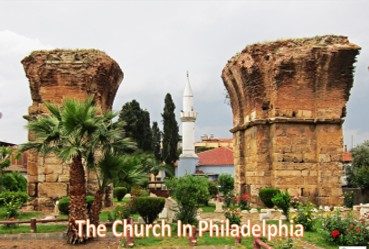
As we go through this letter written by Jesus to the church in Philadelphia, Revelation 3:7, we will see that the church is praised by Jesus, not for its numerical strength, but for its faithfulness, even though it’s weak.
The word ‘Philadelphia’ is the Greek word for ‘one who loves his brother’. The city was named for Attalus II, whose love for his brother Eumenes earned him the name Philadelphos. The city itself was situated at the border of Misia, Lydia and Phrygia but was not a garrison city.
It was located on the Calamus River about one hundred and five miles from Smyrna, and it was founded with the deliberate intention of being a missionary city of Greek culture and language to Lydia and Phrygia, and it had a successful missionary spirit.
Its rich and fertile volcanic soil made it a grape-growing and wine-making centre, and it was subject to frequent earthquakes and daily tremors. It was a city with many names of gratitude, for example, ‘New Caesarea’, which means ‘city of Caesar’. They named it ‘New Caesarea’ out of gratitude for Tiberius, who restored the city after the earthquake of 17 AD.
Another example is ‘Vespasian Philadelphia’ or ‘Flavia Philadelphia’. The people understood what it meant to receive a new name, as it was in relation to the emperor who was reigning at the time.
Philadelphia became and remained a wealthy city and an important trade centre as the coastal cities declined. It grew in a spirit of persistence against overwhelming odds, and it had many magnificent temples and other public buildings.
As we’ve seen with most of these letters, we have no record of how the church was established or by whom. Of the seven letters to the seven churches found here in Revelation, only two didn’t receive any sort of correction or rebuke. One was the church in Smyrna, Revelation 2:8-11, and the other is this church, the church in Philadelphia.
While the letter to the church in Smyrna is a challenge for them to remain faithful unto death, this letter is filled with compliments and praise. The other five letters all contained words of complaint and correction, but this church receives nothing but praise from the Lord. And as we go through this letter, we become quickly aware that this is a church that the Lord is using for His glory.
There is no doubt that Jesus has His Jewish enemies on His mind when He writes this letter, as He says, ‘He is holy, and He is true’, Revelation 3:7. The Jews claimed to be a holy nation; they were set apart for holy service to God, Exodus 19:6.
But as we know from reading through the Bible, we can clearly see that the claim had only an appearance but no substance. Jesus was the sanctified One, and His claim had substance, Hebrews 4:15. The word ‘true’, Revelation 3:7, means ‘genuine, the substantial reality.’
Barnes, in his commentary, says the following.
‘He that is true is another characteristic of the Saviour well suited to be referred to when he addresses people. It is a characteristic often ascribed to him in the New Testament, John 1:9 / John 1:14 / John 1:17 / John 8:40 / John 8:45 / John 14:6 / John 18:37 / 1 John 5:20, and one which is eminently adapted to impress the mind with solemn thought in view of the fact that he is to pronounce on our character, and to determine our destiny.’
Sometimes the Bible uses the illustration of a shadow, and it is always associated with the Jewish religion, Colossians 2:16-17. Jesus truly is the Holy One in every sense of the word, and He is also the real deal.
Notice what Jesus is holding: He is ‘holding the key of David’, Revelation 3:7 / Isaiah 22:22. And what are keys used for? Opening and closing things. That’s why He says, “What he opens no one can shut, and what he shuts no one can open,” Revelation 3:7-8.
To most people, this is no big deal, but to the Jew, this was a rebuke. Because this is about holding the key of power and authority, Jesus says, ‘He has this power and authority’.
But what authority is He talking about? Some people like to believe He’s referring to the authority over the treasury, which I will explain in a moment. But the authority here under consideration is a whole lot more than a city treasurer.
In Isaiah 22:15-25, we read that Shebna was treasurer and governor, Isaiah 22:15. And when we read on, we read that his authority was to be taken from him and given to someone else, Isaiah 22:20-22.
Is there any doubt in your mind that Revelation 3:7 alludes to Isaiah 22:22? Eliakim was to be put over the ‘house of David,’ Isaiah 9:6-7. And in Isaiah 36:3, we read of the removed Shebna as being a scribe and Eliakim as being ‘over the household.’ He basically represented the city against the invader.
The key was the symbol of power and authority, and not only does Jesus have the key, but He also has the power to use the key, Revelation 3:7-8 / Matthew 28:18-19. In other words, Jesus holds the key to life and death, Revelation 1:18, and some Jews couldn’t or wouldn’t accept that.
Or to put the point across more simply, Jesus, in claiming to be the promised Messiah, also claims the right of inclusion and exclusion. He had let the Philadelphians in; he had opened the door, and not all the Jews under heaven could close it.
No matter how hard they tried, all their slandering and mockery made no difference. The open door is the door to blessing, but notice that Jesus is also a shutter of doors, Revelation 3:7. To enter the presence of God means going through Jesus, and there is no other way, John 14:6.
There can be no entrance into the presence and blessing of God except through Jesus. And so, despite all their slandering, the door to blessing was closed against the Jews.
Despite all their cries of, ‘we’re descendants of Abraham!’ John 8:33-35. Despite all their ritual keeping, despite all their claims to history, their law and their prophets, the door was firmly shut, Luke 11:52. The door of blessings was shut by the One who has the key of the house of David, Revelation 3:7.
Time and time again, we have seen that Jesus knows everything, Revelation 3:8 / Proverbs 15:3. And Jesus sees and knows everything which is happening in this world. The open door here is a door of service, and notice that they haven’t provided it, but God has, Revelation 3:8.
The idea is that of access or ability to enter the kingdom of God, eternal, or to take advantage of opportunities. The opportunity is provided by the Lord, but we as Christians must take advantage of it, 1 Corinthians 16:9 / 2 Corinthians 2:12 / Colossians 4:2-3.
An open door could be a large opportunity to share the Gospel with hundreds of people or even a nation. But an open door can also come in the form of a simple chat with a workmate or a friend. Or by chatting with someone on the bus or in a queue in a shop.
God can open a door by helping others out in times of trouble or by providing food for those who really need it. According to our text, when God opens a door, no one can shut it, Revelation 3:8. This means that no external power, no resources, no excessive wealth, no military forces, and no heavenly bodies can shut what Jesus opens.
Jesus has the power and authority, and He says to the church in Philadelphia, “I know that you have little strength,” Revelation 3:8. In other words, they were weak in influence and had no political sway.
Many scholars believe that this was speaking about the size of this church, a small church with limited resources and few workers. But what they probably saw as weakness, the Lord saw as strength, Romans 8:31-32 / 2 Corinthians 12:10.
The Lord saw their little strength but said, I am going to bless you with open doors because “you have kept my word and have not denied my name,” Revelation 3:8.
Barnes, in his commentary, says the following.
‘When Christians were brought before pagan magistrates in times of persecution, they were required to renounce the name of Christ, and to disown him in a public manner. It is possible that, amidst the persecutions that raged in the early times, the members of the church at Philadelphia had been summoned to such a trial, and they had stood the trial firmly. It would seem from the following verse, Revelation 3:9, that the efforts which had been made to induce them to renounce the name of Christ had been made by those who professed to be Jews, though they evinced the spirit of Satan. If so, then the attempt was probably to convince them that Jesus was not the Christ. This attempt would be made in all places where there were Jews.’
Remember, this part of the country was prone to earthquakes, and so they are going to have opportunities to do mission work not only in their own area but also in the regions beyond because of their faithfulness. And so, this church is going to be greatly blessed, but there are others who won’t be blessed.
There were some Jews who were a part of the synagogue of Satan pretending to be Jews who were a part of the synagogue of God, Revelation 3:9 / Revelation 2:9. Even today, there are many Jews who need to know about their spiritual state, Revelation 3:9. They are lost, undone, Christ-less and therefore priest-less, and so in effect they are hopeless, because apart from Jesus there is no hope.
The real Jew is a physical descendant of Abraham through Jacob who has given his life to Christ. If he hasn’t done that, he is no Jew, and that’s not me saying that; it’s the apostle Paul, Romans 2:28-29 / Romans 9:6-7.
They can claim to be Jews all they want, but if they haven’t given their lives to Jesus, they are not real Jews. And it’s to these Jews that Jesus says, “I will make them come and fall down at your feet and acknowledge that I have loved you,” Revelation 3:9.
We don’t know what kind of people the Philadelphian church was made up of. If they were Gentiles, then the ‘insult’ here is of the plainest kind, which must have made the Jews howl when they heard it, Isaiah 60:14.
Jesus, in this same letter, says he will write on them ‘the name of the city of my God’, Revelation 3:12. His favoured ones will be ‘called’ the ‘city of God.’ The Philadelphians will know the joy of having the Isaiah passage fulfilled in them, Isaiah 60:14, and they will be called the city of God.
The ‘Holy One’, who is also the ‘True One,’ Revelation 3:14, will cause these lying, arrogant haters of the Gentiles to bow down before them, Revelation 3:9. And then these Jewish Gentile haters will know that God loved the church there, Revelation 3:9.
In other words, there was in store for the Philadelphians a day of justification. A day when the Jews would be humiliated. And this was going to be the church’s assurance that in the coming hour of trial, they would be kept safe.
To understand what Jesus means here, we need to go back in time to a time when the emperor Domitian was ruling. When Domitian came on the scene, persecution began, and so anyone who refused to worship the emperor became an enemy of the state.
Christians came under the terrible pressure of Rome for about two and a half centuries until the Edict of Toleration under Galerius. The Jews, too, had their troubles with Rome, for it was Hadrian who urged the termination of circumcision and aimed at building a shrine to Jupiter on the site of Jerusalem.
This rebellion of the Jews in 132 A.D. under Bar Kosheba was perhaps the bloodiest of the Jewish battles with Rome. The historian Dio Cassius reports that over 580,000 Jews died in the war.
In the early stages prior to the revolt, the Christians were suffering greatly at the hands of the Romans. They were patient, but how was Jesus going to keep them from the hour of trial? Revelation 3:10.
Does this mean that the church was not going to suffer? Not at all; that’s why He tells them to “Hold on to what you have, so that no one will take your crown,” Revelation 3:11. This is the crown rewarded for enduring trials, James 1:12 / Revelation 2:10.
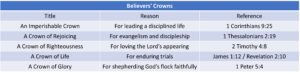
In Ezekiel 9:1-8, we are told the righteous would be kept from the hand of the destroyer, but the ‘keeping’ didn’t mean they would be saved from physical suffering or death. In Ezekiel 21:3-4, we read of the same judgment as taking away the righteous as well as the wicked.
The point is they were preserved all the way through it, and so they came ‘out of’ it. In other words, Jesus keeps them from the hour, Revelation 3:10, keeping them from what the hour could produce.
So, what could that hour of trial produce? Apostasy, falling away. In other words, Jesus would safely see them through their time of trouble, Revelation 1:1 / Revelation 1:11 / Revelation 1:16, but the Jews had no such promise.
Philadelphia was known as ‘Little Athens’ for it was full of idols and idol temples. It would not have been the first time that the worshipers of the idols had felt the ground shake and the pillars crack and tumble due to the earthquakes. At such a time, there would be only one thing to do, and that is to run.
But God’s temple cannot crumble, whatever happens in the physical realm. The pillars in that temple are mature Christians, solid, stable, and immovable, Revelation 3:12 / Galatians 2:9.
Barnes, in his commentary, says the following.
‘It is not uncommon in the New Testament to represent the church as a temple, and Christians as parts of it, 1 Corinthians 3:16-17 / 1 Corinthians 6:19 / 2 Corinthians 6:16 / 1 Peter 2:5.’
Christians like James, Peter and John, Christians who stand firm are the overcomers. When Jesus says, “Never again will they leave it,” Revelation 3:12, he’s saying that the saints will never have occasion to run because of fear.
We don’t know whether the church in Philadelphia was made up of Jewish Christians or Gentile Christians or both, but there is a lot of Jewish symbolism in these last few verses. In Isaiah 56:3-8, we find an amazing piece of Scripture.
If the church is Gentile, we have Isaiah speaking of the foreigners who have said, in Isaiah 56:3, “The LORD will surely exclude me from his people.” Also, in Isaiah 56:3, there is a reference to the eunuchs, who were a despised group, and they have the same reservations, believing they will not be acceptable to God.
But in Isaiah 56:5, we are told the foreigners and eunuchs are not to worry, for “to them I will give within my temple and its walls a memorial and a name better than sons and daughters; I will give them an everlasting name that will endure forever.”
In Isaiah 56:7, he says, “These I will bring to my holy mountain and give them joy in my house of prayer, for my house will be called a house of prayer for all nations”.
In other words, if the congregation is Gentile or predominantly so, we have the Scriptural assurance for them. If the congregation is Jewish or predominantly so, we have comfort for them. So, whoever they are, the scorned, the weak, they all have the Son of David behind them.
This is an open door for both Jew and Gentile. The door is open for both the Jews and Gentiles to receive the eternal blessings and promises from God, John 10:16. And it’s to the Christian who doesn’t fall away when persecution comes that Jesus says, “I will also write the name of my God and the name of the city of my God, the new Jerusalem,” Revelation 3:12.
Notice Jesus says, ‘my God’, Revelation 3:12 / Revelation 3:2 / Revelation 1:6. We must remember that Jesus is God, but the reference here alludes to Jesus’ humanity.
The Father became Jesus’ God when Jesus was in Mary’s womb, Psalm 22:10, and since Jesus was human, we know that God is the God of all flesh, Jeremiah 32:27. Hence, when He speaks to Mary, he tells her to go and tell His disciples, ‘I am ascending to My Father and your Father, and My God and your God,’ John 20:17.
Remember also that Jesus ascended back to the Father in His new glorious body, which was also physical, Mark 16:19 / Luke 24:50-52 / Acts 1:9-11. In other words, in heaven Jesus still has His humanity; hence why He calls the Father ‘my God’, Revelation 3:12.
Remember, the Jerusalem of Judea had long since ceased to be the ‘city of God.’ And it was there that they plainly examined and cruelly rejected their God. But there’s another Zion, and this Zion had as its foundation, and His name is Jesus the Christ, Isaiah 28:16.
This was the ‘new’ Jerusalem, Revelation 3:12, the ‘stones’ of which were members of the ‘new’ covenant, Jeremiah 31:31-34. Notice where this new Jerusalem comes from: it comes ‘down out of heaven’, Revelation 3:12, and that’s very significant. This tells us of its divine origin; this is a city made without hands, whose builder and maker is God.
While the beast-like kingdoms of Daniel 7 rise out of the water or the earth, the Messianic kingdom is set forth in the Son of Man who rides in the heavens. What a wonderful picture that is, isn’t it?
But Jesus isn’t finished yet; the ‘new’ name of Jesus would be written on them, Revelation 3:12 / Revelation 2:17. Remember, this is referring to endorsement, being identified with, Matthew 10:32. In other words, Jesus would own the overcomer as His own.
But what is this new name? It is ‘Jesus, the Lord.’ Paul says this will have to be confessed, one way or another, Philippians 2:9-11. And the day is coming when everyone, born or dead, every demon in hell, is going to have to confess that Jesus is Lord.
And so, Jesus says to all Christians, whether you’re alive or dying, whether you’re in peace or at war, whether you are rich or in poverty. If you remain faithful to Him, you will be unashamedly owned by Jesus.
Are we listening? Revelation 3:13. May we always listen and pay close attention to what the Spirit is teaching us today. May we always keep our eyes open for those precious doors which God opens for us to share the Gospel with others. May we never give up or think about falling away when hard times come.
May we never forget the place and authority of Jesus. And may we never give God the opportunity to disown us because we have disowned Him, Matthew 10:33 / 2 Timothy 2:12.
Remember, when He finishes with those same words to all the seven churches, Revelation 3:13, He is actually teaching the same lesson to all the churches so that they, too, will pay close attention to what He says.