
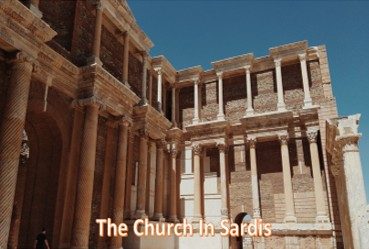
Sardis was the capital city of Lydia, and it was founded about 1200 BC. The city itself was located fifteen hundred feet up in the air on a ledge of rock jutting out of the side of a mountain.
There was one narrow road leading into the city; the other sides of the plateau were just steep cliffs, which made the city very safe and nearly impenetrable to invading armies.
Gold and silver coins were first minted there, and it was famous for the industries that operated there. Carpet, wool, and dyed cloth were their primary products, and it is said that the art of dyeing material was invented at Sardis. The fall of Sardis began when the people of the city became complacent in their wealth, their power and their city’s apparent invincibility.
The city was proud of its past, and it was proud of its reputation, but its reputation was all it had left. For all intents and purposes, the city of Sardis was dead, even while it lived. Sardis today is a wilderness of ruins and thorns, where the only habitations are a few huts of the Yurok nomads.
We know nothing at all about how the church in Sardis started. As we go through Jesus’ letter to the church in Sardis, you will find that He has no words of commendation for them, but He does have some words of condemnation and counsel.
John begins by reminding us that Jesus is the One ‘who holds the seven spirits of God and the seven stars,’ Revelation 3:1 / Revelation 1:16. What does that mean? Well, the good news is we don’t need to speculate because the best interpretation of the Bible is the Bible itself.
John tells us that ‘seven spirits’ are equated with ‘seven eyes,’ Revelation 2:20 / Revelation 5:6. This clearly means that Jesus has all-seeing power and also implies He has all wisdom.
Barnes, in his commentary, says the following.
‘If the phrase, “the seven Spirits of God,” as they are supposed, refers to the Holy Spirit, there is great propriety in saying of the Saviour, that he has that Spirit, inasmuch as the Holy Spirit is represented as sent forth by him into the world, John 15:26-27 / John 16:7 / John 16:13-14.’
The number ‘seven’ would, of course, indicate ‘fullness’ or ‘completeness’, but it may also be used to speak of the total knowledge concerning the ‘seven’ churches. In other words, as we have seen in all the other letters, Jesus sees all and understands everything.
And this isn’t anything new; way back in the days of Zechariah, we find the same idea, Zechariah 3:9 / Zechariah 4:10. It looked to some as though the temple, which had begun its building work about sixteen years previously, would never be completed.
And so, God assembles the people and has a top stone set before Zerubbabel according to Zechariah 4:7, and He then swears that Zerubbabel, who started it, will finish it. Engraved on the stone are seven eyes, Zechariah 3:9. But whose eyes are they? God’s eyes.
God is challenging the people to look at this top stone; they couldn’t see the completion of the temple, but God’s eyes could see the completion because He is greater in knowledge and wisdom.
His eyes could see all the obstacles which needed to be removed, the things which must be taken care of, for the job to be finished, 2 Chronicles 16:9. The ‘seven spirits’, which are equivalent to the ‘seven eyes’, speak of the total wisdom and insight which comes from the Spirit.
Remember that each letter ends with the words “Whoever has ears, let them hear what the Spirit says to the churches,” Revelation 2:7 / Revelation 2:11 / Revelation 2:17 / Revelation 2:29 / Revelation 3:6 / Revelation 3:13 / Revelation 3:22.
In other words, no matter what appearances might say, Jesus knows and sees the reality. Jesus says He knows every individual and every congregation as they really are. In fact, Jesus tells the church in Sardis, “I know your deeds; you have a reputation of being alive, but you are dead,” Revelation 3:1.
This was a church which worked, and much like we do today, they probably broke bread every first day of the week and contributed of their means. Jesus says to the church in Sardis, ‘You have the reputation of being alive, but the fact is, you are actually dead’. The church in Sardis outwardly looked great, but inwardly, they were rotting away.
We know that the city of Sardis was ‘alive’ during times of strife and war, but it couldn’t live in peace. The church in Sardis had not been at war with Rome, and it wasn’t having any trouble with the prominent group of Cybellian worshipers who lived there. There are no records of slanderous Jews attacking the church. In her peace, she seems to have drifted into a coma and then on into death.
This congregation was living on its past reputation without any present achievements. They used to be heavily involved in mission work, but they are doing nothing except glorying in the past.
Jesus isn’t so concerned about the things they used to do as a church, but He is very concerned about the things they are doing or not doing today as a church. We can’t live in the past, and the church can’t live on its past reputation.
Here is a church that started lots of things but finished none; here is a church that promises so much, but delivers so little. In other words, they were great starters but terrible finishers, Revelation 3:2.
The church in Sardis had no excuse for not completing what it started out to do. They weren’t under attack from within or from outside the church. There’s no indication that there were people arguing over the Deity of Jesus; there’s no indication of legalism.
In other words, they were just lazy, and they were content with a second-hand faith, 2 Timothy 3:5. Jesus says the church in Sardis stood for nothing and had fallen from everything.
They were not dying, but they were dead as a church; some individuals were still alive but on their way to dying, Revelation 3:2, as we will see in a moment. Being ungrateful was somewhat characteristic of a Sardinian, and the citizens of that city had changed the church into having the same character.
Some of the Christians were in the world, but sadly, of the world, John 17:14-16. They had developed an attitude of laziness and just didn’t care anymore for themselves or those around them.
They simply didn’t care for their own Christian life, Romans 13:11. They simply didn’t stand firm in the faith, 1 Corinthians 16:13. They simply didn’t resist the devil and flee from him, 1 Peter 5:8. They simply didn’t watch and wait, 1 Thessalonians 5:6.
They were barely alive and ready to die, Revelation 3:2, but they were spiritually dead. And so, each member had to repent in their hearts and show that repentance in their attitude by actually finishing the things they had started, Revelation 3:2.
Notice Jesus says, ‘my God’, Revelation 3:2 / Revelation 3:12 / Revelation 1:6. We must remember that Jesus is God, but the reference here alludes to Jesus’ humanity.
The Father became Jesus’ God when Jesus was in Mary’s womb, Psalm 22:10, and since Jesus was human, we know that God is the God of all flesh, Jeremiah 32:27. Hence, when He speaks to Mary, he tells her to go and tell His disciples, ‘I am ascending to My Father and your Father, and My God and your God,’ John 20:17.
Remember also that Jesus ascended back to the Father in His new glorious body, which was also physical, Mark 16:19 / Luke 24:50-52 / Acts 1:9-11. In other words, in heaven Jesus still has His humanity; hence why He calls the Father ‘my God’, Revelation 3:2.
If they don’t wake up and repent, then there will be consequences. He would come like a thief in the night, Revelation 3:3. We all know that most thieves work at night, and they never come at a time when we expect them to.
As Christians, we should be familiar with the words of Jesus here, Revelation 3:3 / Revelation 16:15 / Matthew 24:43, as this illustration of ‘a thief in the night’ is used a lot throughout the New Testament, 1 Thessalonians 5:1-4.
Barnes, in his commentary, says the following.
‘Every man who is warned of the evil of his course, and who refuses or neglects to repent, has reason to believe that God will come suddenly in his wrath, and call him to his bar, Proverbs 29:1. No such man can presume on impunity; no one who is warned of his guilt and danger can feel that he is for one moment safe. No one can have any basis of calculation that he will be spared; no one can flatter himself with any probable anticipation that he will have time to repent when God comes to take him away.’
There were some Christians in the Sardis church who were faithful, and that’s who Jesus is going to address next.
Notice that Jesus makes the distinction between the individual Christian and the congregation, Revelation 3:4. They had become an ungrateful church, and they had forgotten all that God had done for them, Hebrews 2:1.
The church did start to drift away because they didn’t pay attention to what they had heard, but there were a few Christians who remained firm, and they were the ones who didn’t soil their clothes, Revelation 3:4 / Jude 23. In other words, they didn’t allow anyone or anything to kill the strength and blessings of being a Christian.
It is possible for a Christian to live among sinners and not be affected by their evil. Jesus says that the faithful in Sardis ‘will walk with Him’, Revelation 3:4. This is an allusion to Enoch, Genesis 5:22-24.
In other words, Enoch lived during that time of evil before the flood, when no one listened to or trusted God, but he did. He was surrounded by evil, but he continued to stay close to God. Jesus says to the faithful in Sardis, despite all the evil influences around them, despite all the un-Christ-like behaviour among some of their own members.
The faithful few in Sardis will walk faithfully with God, and they have remained true to their faith, which was reflected not only in their talk but also in their walk, Revelation 3:4. And they are so worthy, not because they earned that worthiness but because their conduct reflected their Christian faith.
Notice also that they are dressed in white, Revelation 3:4. The colour white in this text represents purity and victory in the presence of God, Revelation 7:9. This text is symbolic of the Feast of Tabernacles, which was the most joyful of all Jewish feasts. It followed the harvest of the crops and the ingathering of the grapes, and it followed the great Day of Atonement when the sins of the nation were removed. And at that one moment, they were pure and victorious in God’s eyes, being right with God again. What a wonderful day that must have been.
Look how personal this is. Jesus knows each of them intimately, even to the point of knowing their names, Revelation 3:5. In this world, we’re nothing more than a national insurance number or a reference number.
But Jesus, He knows my name, and He knows your name. He will never blot out our names from the Book of Life: Revelation 3:5 / Revelation 13:8 / Revelation 20:12 / Exodus 32:32 / Luke 10:20 / Philippians 4:3.
We must note that there is a difference between the Book of Life and the other books. They are not the same book but two separate books. The Book of Life contains the names of the redeemed and those who belong to God, Revelation 3:5 / Revelation 13:8 / Revelation 21:27 / Philippians 4:3.
Those whose names are not found in the Book of Life will end up in hell, Revelation 17:8 / Revelation 20:15. The other books contain the records of the specific earthly deeds, choices, and works of every individual, whether good or bad, Daniel 7:10 / Revelation 20:12.
Barnes, in his commentary, says the following.
‘The book which contains the names of those who are to live with him forever. The names of his people are thus represented as enrolled in a book which he keeps, a register of those who are to live forever. The phrase “book of life” frequently occurs in the Bible, representing this idea: Philippians 4:3 / Revelation 15:3 / Revelation 20:12 / Revelation 20:15 / Revelation 21:27 / Revelation 22:19. The expression “I will not blot out” means that the names would be found there on the great day of final account, and would be found there forever.’
Clarke, in his commentary, says the following.
‘In all this there may also be an allusion to the custom of registering citizens. Their names were entered into books, according to their condition, tribes, family, and when they were dead, or had by unconstitutional acts forfeited their right of citizenship, the name was blotted out, or erased from the registers, Exodus 32:32.’
He says He would be proud to name His faithful ones as His own before the Father and His angels, Revelation 3:5 / Matthew 10:32. People can wear and use the Name of Jesus for all sorts of reasons, but they still might not be known to Jesus. The ones who are known to Jesus are the ones who do the will of the Father, Matthew 7:21-23.
Jesus didn’t ask the faithful in Sardis to get up and move; He encouraged them to stay, Revelation 2:7. Paul says the stronger brethren are supposed to bear the burdens of the weaker brethren, not move away, Romans 14:1 / Galatians 6:2.
Even if the congregation is being exposed to false teaching, what are the faithful supposed to do? Get up and leave? Paul says it is the evil leaven, which is to be removed, not the leavening influence of the faithful few, which is to be removed, 1 Corinthians 5:6-7.
Are we listening? Revelation 3:6. Are we awake and walking with Jesus victoriously in all purity? Jesus knows our ways and thoughts. Jesus is very much alive, and if any church claims to belong to Him, then they too need to ensure that they stay alive.