

Let me begin by asking you a question: why is it important to present a study on elders? Simply because it’s God’s will that each of His congregations has a sound, scriptural, spiritual leadership in place to tend, feed and guide His people. Now we can clearly see that creation was created with order, and so God brought order to the universe, Genesis 1:1-2.
In the original text, the terms formless and void were meant to convey the idea of confusion and disorder. God created the earth to be inhabited, but for a brief time, before He created plants, animals, man, light and so forth, the earth was void of anything. If God had just left things the way they were in Genesis 1:2, there would be no life.
And so God set the universe in order, and this tells us that our God is a God of order, Psalm 8:3-4 / 1 Corinthians 14:33 / 1 Corinthians 14:40. And so our God is a God of order who has never left His people without organisation, and the role of an elder isn’t anything new.
Elders existed before the church had them.
a. Among the Gentiles.
Egyptian elders accompanied Jacob’s body back to Canaan, Genesis 50:7. The nations of Moab and Midian used elders to buy Balaam’s curse, Numbers 22:7.
b. Among the Jews Seventy elders were appointed to assist Moses in ruling the people, Numbers 11:16.
1. The elders served as local magistrates in bringing murderers to trial, Deuteronomy 19:12 / Deuteronomy 21:1 / Joshua 20:4.
2. Punishing a disobedient son, Deuteronomy 21:19.
3. Inflicting a penalty for slander, Deuteronomy 22:15.
4. For noncompliance with the Levitical marriage law, Deuteronomy 25:7.
5. Enforcing the Law, Deuteronomy 27:1.
6. Conducting the service in expiation of unwitting violation of the Law, Leviticus 4:13.
There are no qualifications laid down in the Old Testament as we have in the New Testament for elders, but someone who was older and has lots of experience in life, knows God and His will, seems to be the criterion to govern God’s people during the Old Testament.
The Sanhedrin included elders who would help persecute Jesus, Matthew 16:21. Elders managed public affairs in various cities, Luke 7:3.
c. In the Heavenly Realms, twenty-four elders surround the throne of God, Revelation 4:4 / Revelation 5:14.
In New Testament times, a congregation without elders was the exception, not the rule. The Galatian churches had elders Acts 14:23. The churches in Pontus, Galatia, Cappadocia, Asia and Bithynia had elders, 1 Peter 5:1.
The church in Philippi had elders, Philippians 1:1. The church in Judea had elders, Acts 11:30. The church in Jerusalem had elders, Acts 15. The church in Ephesus had elders Acts 21:18. And the church in Crete had elders, Titus 1:5. I will say it again, in New Testament times, a congregation without elders was the exception, not the rule, and we need to remember that.
In every example we have in the New Testament, there is a plurality of elders in each congregation, never just one elder, Acts 20:17 / Acts 31:18.
1. Unscripturally organised.
This means governed by something other than elders and deacons.
2. Scripturally unorganised.
This means something that is expedient, useful or helps us. Business meetings and men’s meetings, the church commits men to lead, but this isn’t right because the men aren’t qualified. They have no scriptural authority which means they can’t carry out scriptural discipline. Men need to be spiritually mature enough to do this.
3. Scripturally organised.
This means God governs the church, and elders are what God wants in place, Acts 14:21-23. Each church, in pagan cities where was no Jews, no synagogues. We can’t say that these elders had a Jewish background and were already familiar with God.
Also, these elders were in place in ‘Antioch of Pisidia’, ‘Lystra’, ‘Iconium’, and ‘Derbe’ just three months after the churches in these places had been planted. Were these men novices? They had the gift of supernatural faith, 1 Corinthians 12:9.
Elders were required in every town; this task was unfinished and not complete until elders were in place, Titus 1:5. There is a sense of urgency. So we could say that at the moment, some churches are incomplete until they have elders in place.
1. The Elder is described as God’s Steward, Titus 1:7.
2. The Pastor is an office held with the Son’s approval, Ephesians 4:11.
3. The Bishop, ‘overseer’, is appointed through the work of the Holy Spirit, Acts 20:28.
Their role is described in the Bible names.
1. Elder, ‘presbuteros’. 2. Bishop, ‘episkopos’. 3. Pastors, ‘poimen’.
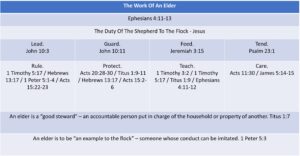
These words describe a man who is older and experienced in the faith, i.e., ‘an elder’, a person who is a decision-maker, manager of church affairs, and leader, i.e., ‘bishop’, and one who maintains a careful watch for the spiritual needs of all the members of the flock, i.e., ‘pastor’. Ultimately, the role of an elder is to feed, tend, protect and lead the church, Acts 20:28.
They have a specific role in the work of the church, Ephesians 4:11-13. The gifts mentioned in Ephesians 4:11 are the apostles, prophets, evangelists, pastors, and teachers. They are gifts given by the Lord Jesus, Ephesians 4:7-10. Spiritual gifts are only mentioned indirectly because the apostles and prophets of the early church had these gifts.
The apostles were direct witnesses of Christ who then laid the foundation for the church. Accomplishing their duty, they remain with us through their writings in the New Testament.
The prophets existed to fill the gap between the establishment of the church and the recording of Christ’s law. They too continue with us today through their writings, but as Paul stated, there would not be new prophets once their work was completed, 1 Corinthians 13:8-11.
Evangelists, ‘preachers, ministers’, pastors, ‘elders, bishops, overseers’, and teachers continue to exist in the church, teaching the things recorded by the apostles and prophets to build up the church. They are meant to provide leadership for the congregation according to the will of God, 1 Peter 5:1-3.
1. We saw that God set the universe in order, and this tells us that our God is a God of order.
2. We saw that there were elders in the Old Testament, whom God again put in place for His people.
3. We saw the role of an elder in the Old Testament.
a. The elders served as local magistrates in bringing murderers to trial.
b. Punishing a disobedient son.
c. Inflicting a penalty for slander.
d. For noncompliance with the Levitical marriage law.
e. Enforcing the Law.
f. Conducting the service in expiation of unwitting violation of the Law.
4. We saw there are no qualifications for an elder in the Old Testament, but they seemed to be men who were older and had lots of experience in life and knew God and His will.
5. We saw there were elders in the New Testament before and after the church was established.
6. We also saw that in every example in the New Testament, there is always a plurality of elders.
7. We saw that all congregations should strive to have elders, as this is God’s ideal for His church.
8. And finally, we saw that the role of an elder is basically to feed, tend, protect and lead the church.
From 1 Thessalonians 5:12-13, we clearly see that the congregation has a responsibility to ‘recognise’ the elders. In other words, if a congregation had elders, do you know who they are? Does the church recognise the elders as the leaders of the congregation?
1 Thessalonians 5:12-13 also tells us that a congregation has a responsibility to ‘esteem’ the elders. In other words, the congregation must give them respect. We need to look up to them. And the reason we look up to them is because of the work they are doing, and make no mistake about it loves ones, the role of an elder can be very stressful, so an elder needs to be shown respect.
1 Timothy 5:17-20 tells us that the congregation has a responsibility to ‘trust’ the elders. That’s why Paul says that accusations should not be allowed to stand against the elders except with the testimony of two or three witnesses.
1 Timothy 5:17-20 also tells us that the congregation has a responsibility to ‘correct’ the elders. Paul says if it has been shown that an elder is in sin, he is to be publicly corrected.
Now remember, elders are not exempt from sinning, and they need to be corrected from time to time as well. But this doesn’t mean that any time an elder sins, we have to publicly expose it, because it might just be something between him and God.
But if an elder commits a sin which can bring reproach on the Lord and His church, that elder needs to be corrected publicly, ‘in the congregation’. If the elder is sinning and will not repent, he is to be publicly corrected.
1 Timothy 5:17-20 also tells us that the congregation has the responsibility to treat the elders ‘equally.’ We cannot act as if one of the elders is better, higher, or preferred above the others. There is no such thing as a ‘senior pastor’.
Again, if an elder sins, he is to be corrected publicly, it does not matter which elder it is. We cannot let our friendships come between the need to help them get to heaven. We need to remember that the goal of a Christian is to get to heaven, and we need to help other Christians get there, and that includes the elders.
Hebrews 13:17 tells us that the congregation has a responsibility to ‘remember’ the elders. So a congregation needs to be mindful of them and the role which they are fulfilling in the Lord’s church. We are to remember their leadership and the things which they have said we must do.
Hebrews 13:17 also tells us that the congregation has a responsibility to ‘obey’ the elders. We obey the elders because they are looking out for our own souls’ best interest. They are trying to get us to heaven, and we should obey them because they will help us get there. They are also trying to help others get to heaven, so we should obey them to give an example to others as well.
As the sheep, we go where the shepherds lead us, and so this passage also tells us that the congregation has a responsibility to make the elders’ job as ‘easy as possible’. When the congregation willingly obeys the elders, it makes their job an easy one, and they will be much happier in their role as elders.
When the congregation, ‘usually just a few members,’ causes problems, it can make the elders’ lives miserable. Many elders have been so disheartened because of the reaction of the congregation that they simply quit, and I know of some elders who have been so depressed by the actions of the congregation that they have left the church altogether. A congregation should make it a point to make the elders’ job as easy as possible so that the whole congregation can be happier.
Hebrews 13:17 also tells us that the congregation has a responsibility to ‘imitate the elders’ example’. The elders should be living their lives in a way that others should follow. And yes, this should be true of all Christians, as 1 John 1:7 reminds us, but this should be especially true of the elders, because the other Christians are to follow their example.
The congregation has a responsibility to follow their ‘example of faith’. Elders should be those who are not novices but instead mature Christians, and all Christians should make it their goal to become more mature in Christ.
The elders are supposed to be the example on earth for us to follow in order to get to heaven. Their goal is first and foremost to get to heaven, and if we follow their example, it should be because we want to get to heaven as well.
Just as the elders have responsibilities to the local congregation, the local congregation has responsibilities to the elders.
1. We must recognise them and their authority.
2. We must remember the things they have taught us and told us to do.
3. We must obey them, making their job as easy as possible.
4. We must imitate them.
5. We must trust them.
6. We must correct them when they are wrong.
7. We must treat them all with equal respect and accountability.
Now remember, these are not things to be taken lightly; these are commands of God which will help us and them to get to heaven. And if these commands are followed, life in the church will be a whole lot easier, and the work of the Lord will be much smoother and this is because the elders will be happy and because the members will know they are making God happy and most importantly because we will all know we are obeying God and that we have a home in heaven awaiting us.
And so we need to think of elders as our spiritual advisors, as shepherds who are to be mature, experienced Christian men charged by God to watch out for our souls. And we should strive to make their work a joyful experience.
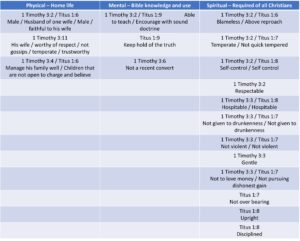
The qualifications are better described as qualities, and they are found in 1 Timothy 3:1-7 and Titus 1:6-9. First and foremost, a man must ‘desire’, want to become an elder; we can’t force this on anyone, 1 Timothy 3:1. Now notice that they are broken down into three categories.
1. Physical. 2. Mental. 3. Spiritual.
Remember, we’re not looking for perfection. And notice that each qualification is practical.
1. Male elder, older men, spiritually mature, a man with experience. Knowledge and wisdom, Titus 2:2.
2. Married means experience of marriage, this would include a widower, one wife, not two, in other words, not a polygamist.
3. Children who believe, are faithful, and show respect for their father, Titus 1:6, are unruly, in respect to do what their father says. Children means one or more.
If you have five children and four have faith in God, but one doesn’t, does this stop a man from serving as an elder? That doesn’t make sense. It’s the experience that’s important. Children are your responsibility whilst they are living under your roof, not after they leave home, Ezekiel 18:20.
1. Knowledge means being able to teach, being able to reason, hence, wisdom.
2. Knows the Word and can handle it properly.
3. Influence people by his use of the Word.
1. Applies to all Christians.
1. 1 Timothy 3:2 / Titus 1:6. Male / Husband of one wife / Male / Faithful to his wife.
Obviously, an elder has to be a male; otherwise, the text would say the wife of one husband, and he needs to be faithful to his wife, in other words, not cheat, etc. There are some ideas about the husband of one wife.
Some people believe that this means that the man can only have been married once, and so someone who has been divorced or whose wife has died wouldn’t qualify. But we need to remember not to put words in Paul’s mouth because the text doesn’t say that.
If a man has been divorced through no fault of his own and then remarries, why should he be disqualified from being an elder if he wasn’t responsible for the marriage breakup? Or if his wife dies, does this then disqualify him from being or continuing to be an elder?
If divorce is legal and dissolves the marriage so that the one divorced can marry another, or his wife dies, and he marries another woman, is the one remarried considered now to be ‘the husband of one wife’? It seems evident that legally, such a remarried person is the husband of only one wife. He is not considered to have two wives.
I believe this is speaking about a man who is not a ‘polygamist’, someone who has many wives, after all, this was the practice of many in New Testament times. The text doesn’t say that the man only has to have been married once, but it does say that he has to have only one wife. Remember, it’s all about having the experience of a marriage.
We should always try to get to the highest ideal, someone who has not been divorced, but we must never forget that what we did ‘before’ we were Christians or ‘during’ our Christian walk has been forgiven, and we should also remember that circumstances change in all our lives, which may well be out of our control.
A number of writers have concluded that the phrase ‘the husband of one wife’ means that the man in view is not a bigamist or polygamist, but is married to ‘only’ one wife. They stress that the force of the instruction lies in the concept of ‘only’ one and not multiple wives.
It would seem prudent to argue, then, that the phrase is not inserted solely to exclude polygamists or bigamists from the eldership. To clarify, however, the condition would exclude polygamists, but would carry as much positive force for a man to be married to one wife as it would negative force not to have more than one.
McGarvey, in his commentary, says the following.
‘That he should be the husband of one wife, forbids having less than one as clearly as it forbids having more than one’. (p. 56).
Only one wife his whole life? We have established, then, that the candidate for the eldership must be a man who is literally ‘the husband of one wife.’ Our work is not done, however, because questions still remain concerning the qualification.
Does ‘the husband of one wife’ mean that the candidate must currently be married to the only wife that he has had his entire life? If his wife dies and he remains single, is he still the ‘husband of one wife,’ since he was only married to one woman in his life? Or, if his wife dies and he remarries, is he no longer the ‘husband of one wife,’ since he has now been married twice to two different women?
First, let us state that the ideal situation is one in which a man has been married to one woman for his whole life and they are still together during the time of his eldership. This situation would meet every conceivable challenge of the phrase ‘the husband of one wife.’ Of course, stating the ideal does not exclude other possibilities that might be less than ideal but still potentially viable.
Let us then deal with the situation in which a man has been married, his spouse has died, and he is currently in his second marriage. Is this man a candidate for the eldership? Those who suggest that he is not often refer to 1 Timothy 5:9, where Paul discussed widows who were to be ‘taken into the number’ of the church. In that verse, Paul stated that only a widow who ‘has been the wife of one man’ should be taken in.
In light of this, some believe that having only been married to one person in one’s life has some type of spiritual significance, or at least offers a person some type of life circumstance that would be desirable for one who is an elder. Such an understanding seems to leave something to be desired based on the actual wording of 1 Timothy 3:2.
The qualification in 1 Timothy 3:2 states that a bishop ‘must be’ in the present tense. The Greek words ‘dei’ and ‘eivai’ combine to form the ‘must’ and ‘be’ so that each of the qualifications is one that must at the present be a part of the potential elder’s life or character.
For instance, it would do no good to have an elder who, at one time, was hospitable but is no longer such. Nor would it be good for a congregation to have an elder who, in the past, was able to teach but currently is not able to do so.
Ironically, the present tense force is conspicuously absent from 1 Timothy 5:9, and a widow could not be taken into the number of the church if she was married to a man who was living (for she would not be a widow).
Yet the ideal for an elder is for him to be currently married. Thus, it seems an unnatural and tenuous stretch to force the ‘parallel’ between 1 Timothy 3:2 and 1 Timothy 5:9 to mean that an elder cannot be remarried after the death of a spouse.
Glasscock, in his commentary, says the following.
‘First Timothy 3:2 does not say ‘an elder must be married only once’ nor does it say, ‘an elder cannot remarry’. (140:247).’
He further stated that ‘if Paul had wanted to insist that an elder must be married to one woman his whole life, the inspired writer could have written, ‘having had only one wife.’ Since Paul did not make such a statement when it was in his power to do so, it goes beyond the bounds of the phrase ‘the husband of one wife’ to insist that it means ‘having had only one wife’. (140:247).’
An understanding of the biblical teaching of marriage adds weight to the idea that a man can be qualified for the eldership, even if he has been married after the death of a spouse.
In 1 Corinthians 7:39, Paul stated: ‘A wife is bound by law as long as her husband lives, but if her husband dies, she is at liberty to be married to whom she wishes, only in the Lord.’ Marriage is a covenant that holds sway only as long as a person lives on this Earth in a physical, mortal body. Once a person’s spouse dies, he or she is no longer married to that person.
Jesus elucidated this fact in His discussion with the Sadducees. This particular Jewish sect did not believe in the resurrection of the soul. In order to trap Jesus, the Sadducees concocted a situation which they thought rendered the idea of the resurrection absurd.
They presented to Jesus the situation in which a woman married a man, he died, so she married his brother. Subsequently, his brother died, and she married the third brother. Eventually, she lived through seven marriages to seven brothers and finally died. The Sadducees then asked Jesus, ‘Therefore, in the resurrection, whose wife will she be? For they all had her’, Matthew 22:23-28.
Jesus explained to the Sadducees that they did not understand the resurrection or the Scriptures. He stated that ‘in the resurrection they neither marry nor are given in marriage, but are like the angels of God in heaven’, Matthew 22:30. From Jesus’ teachings, we learn that a marriage contracted on Earth has no force in the resurrection.
Thus, a person who was married to one wife on Earth, when she dies, is no longer married to that person. While she was his wife in the past, she cannot rightly be called his wife now, since the covenant of marriage is over at the point of the death of a spouse.
Glasscock summarised this idea in the following way.
‘Surely no one seriously believes that if a man’s wife dies, that he is still bound to her in marriage; thus if he marries a second time, he still has only one wife, that is, he is truly still ‘the husband of one wife’. (140:247).’
McGarvey, in his commentary, says the following.
‘It may be well to add that one living wife is clearly meant, and that there is no allusion to the number of deceased wives a man may have had. If my wife is dead, I am not now her husband./ (1950, p. 57).’
Therefore, if a man’s wife dies and he becomes a widower, the present tense force of being the ‘husband of one wife’ would seem to exclude him from being qualified for the eldership.
We must be careful to insist that such a situation does not make him any less of a Christian, any less spiritual, or any less valuable to the Lord’s cause. It simply is the case that a circumstance in his life has arisen that renders him no longer qualified to serve as an elder at a particular time.
To illustrate further, suppose a man was an exceptional teacher, but was in a tragic accident and lost his voice and his ability to communicate his thoughts properly. Could it be that such an accident would render him unable to teach? Certainly.
Since he is no longer ‘apt to teach,’ and would most likely not be in the physical condition to serve as an elder, would it be the best course for him to no longer be an elder? Yes. Is he less valuable to God, less spiritual, or in any way less ‘Christian’? Absolutely not.
It is simply the case that a circumstance in his life has rendered him unable to serve as an elder at a particular time in his life. The eldership is a functional role that requires a person to maintain the qualifications throughout their tenure as an elder.
On the other hand, if a widower were to remarry after the death of his wife (and the woman he remarried met the qualifications detailed for the wives of elders. 1 Timothy 3:11, the present tense force of being the ‘husband of one wife’ would allow him to be considered for the eldership.
Can a man who has been divorced and remarried be an elder? If a man who loses his spouse to death and remarries can be considered for the eldership, the natural question arises: What about a man who is divorced and remarried?
If the phrase ‘the husband of one wife,’ does not mean ‘having been married only once in his life,’ that would seem to admit the possibility that a man who has been divorced and is remarried to ‘one wife’ could be eligible.
Before delving into this, let us restate the ideal. The perfect situation is one in which there is a man who has been married once to the same woman, and she is living during the time he serves as an elder.
Is it possible, however, that a divorced man who is remarried may still be an elder? If a man can be married to a second wife (because he divorced his first wife scripturally, and not be considered by God to be committing adultery, then it follows that God must view the first marriage as dissolved and the covenant broken.
Therefore, it would still be the case that a man who divorced his wife scripturally and married another woman would/could be ‘the husband of one wife.’ It would appear logical that a man’s condition upon the death of a wife, or due to a scriptural divorce, would be the same, and a subsequent marriage would not disqualify him from being the ‘husband of one wife.’
To me, the really central question is this: is the ‘husband of one wife’ qualification a reference only to the present or does it stretch back to the remote past, including the pre-Christian past?
I think the presumption should be that this question would be fundamentally like, as opposed to unlike, all the other qualifications listed, since the text does not set it apart as being essentially different. And all the other qualifications, I think, of necessity apply to the present, which inevitably includes the recent past, not to the distant past.
Do we believe ‘husband of one wife’ means he must always, even as an unbeliever, have had no more than a total of one wife in his lifetime? If so, then wouldn’t we need to also extend the same understanding to the other qualifications so they include his distant or pre-Christian past?
Let’s test it, adding that same interpretive phrase to all the other qualifications, and see what it would mean. This would mean that any elder must: Have always, even as an unbeliever, been above reproach. Have always, even as an unbeliever, been sober-minded. Have always, even as an unbeliever, been self-controlled. Have always, even as an unbeliever, been respectable.
Have always, even as an unbeliever, been hospitable. Have always, even as an unbeliever, not been a drunkard. Have always, even as an unbeliever, not been violent or quarrelsome. Have always, even as an unbeliever, not been a lover of money. Have always, even as an unbeliever, managed his household well. This would make no sense.
Don’t we agree that a man can be an elder who once was: a drunk, a murderer, a violent man, lacked self-control, etc.? Of course, we believe he must have demonstrated clear change, and this change, by implication, must have been borne out over a significant period of time.
In the same sense that an elder should not be a recent convert, no matter how genuine his conversion, so he should not be, regardless of how long he’s been a Christian, a recently transformed drunkard, murderer, fornicator, etc., no matter how genuine his transformation.
2. 1 Timothy 3:11. His wife / Worthy of respect / Not gossips / Temperate / Trustworthy.
An elder’s wife has at least four requirements.
1. Semnos. This means honourable, honest or grave.
a. The word here means the same as with reference to the elders.
It means to be prudent, appropriate, dignified, quiet, of sound judgment, not giddy. Some versions translate the word ‘worthy of respect’. This can especially be shown by her dress, 1 Timothy 2:9-10.
b. A grave person is not one who is severe, stern, or unhappy.
She is admired by all. The wives of elders must not be foolish, unconcerned, and indifferent to the work of their husbands, but instead be serious about their husbands’ progress and be a good helper and companion.
2. Me Diabolos. This means not gossips, not slanderers or false accusers.
a. No form of slandering is pleasing to God.
Wives of elders, as well as all Christians, must be able to control their tongue and not be busybodies or tale-bearers of idle gossip.
b. The wives of elders may at times know sensitive information about members of the congregation, and one can imagine the kind of damage that it would do if it were told to members of the congregation.
c. Backbiters and talebearers are dangerous both to themselves and to the church, Proverbs 18:8 / Proverbs 26:20.
3. Nephalios. This means temperate, vigilant, and sober. Someone who is trustworthy. On an even keel.
a. This word means the same as with reference to the elders and deacons.
The wives of these men must be temperate, self-controlled, and self-possessed. They must ‘hold themselves in’ and not be frivolous and irresponsible.
b. A lack of soberness on the part of the wives will be a bad influence upon their husbands, their children, and their congregation, 1 Peter 1:13 / 1 Peter 4:7.
4. Pistos. This means trustworthy or faithful.
Faithful in all things, 1 Timothy 3:11.
a. The wives of elders must be faithful to God in all relations as Christians.
She must be faithful in worship, faithful in Christian living, faithful to her husband, faithful to her children and faithful to all others in the church.
b. A faithful wife can be a great blessing to an elder.
An elder’s wife must learn to share her husband with the duties of his work. Her willingness to serve will help him with his willingness to serve. She must be hospitable, and her home should be available. Also, notice that every qualification actually applies to all Christian women seeking to achieve their role in God’s plan.
3. 1 Timothy 3:4 / Titus 1:6. Manage his family well / Children that are not open to charge and believe.
Epimeleomai means manage, rule or be in charge. The husband has a specific role within the house, Ephesians 5:25-28, and His wife has a specific role too, Ephesians 5:22-24. His child or children have a specific role too, Ephesians 6:1-3. Children who are not open to charge and believe. Remember the use of the word children means it’s not a matter of age, it’s a matter of character, Proverbs 22:6.
How many children does an elder require? If I were to ask everyone in this room who has children to leave, who would go? Everyone who had either one child or a few children would go. So it doesn’t matter if the man only has one child.
Do the children have to be Christians? Elders don’t necessarily have to have Christian children. Pistos means trustworthy, faithful or believe. Pistis means faith, religious conviction.
Notice the wife is to be ‘faithful in all things’, 1 Timothy 3:11; this is not asked of the children. Remember, we’re dealing with the physical, the home, the whole context points towards being faithful to their father, not God, Titus 1:6.
His children behave well and show the proper respect, 1 Timothy 3:4. How does the parent deal with their kids when their kids misbehave or are involved in a sin?
Barrick, in his commentary, says the following.
‘When the adjective pistos is used to modify a noun, as it does in Titus 1:6, it always carries the meaning ‘faithful’ or ‘trustworthy/credible.’ In contrast, when the adjective is independent and functions as a substantive, it means ‘believing one’ or ‘believer’. (Barrick, ‘Titus 1:6’).’
Therefore, the meaning ‘faithful’ in Titus 1:6 would be more consistent with the use of the word elsewhere in the New Testament. Against this view, it has been argued that every time pistos is translated ‘faithful’ in the New Testament, it refers to believers who are faithful, and never unbelievers.
Therefore, it is said, ‘pistos’ must refer to children who believe regardless of the precise way it is translated. In response, the fact that pistos is not used elsewhere in the New Testament in reference to unbelievers does not mean that the adjective cannot be used in reference to unbelievers, which is what this argument needs to show in order to be compelling.
To the best of my knowledge, there is nothing inherent in the word itself that precludes it from being used to describe an unbeliever. Used in this way, it would describe an unbeliever who, though unregenerate, is faithful and obedient to the one in authority over him, e.g., the soldiers described in Matthew 8:9.
The view that ‘pistos’ means ‘believing’ raises some practical difficulties as well. For example, if a man has a two-year-old daughter who has not repented of her sins and believed in Christ, is that man unqualified to serve as an elder?
Most interpreters who say that ‘pistos’ means ‘believing’ in Titus 1:6 would answer No, but on what basis? If pistos means ‘believing,’ wouldn’t a child who has not exercised saving faith disqualify the father, since ‘believing’ does mean ‘believing’?
Some would respond by saying that only an unbelieving child who has reached the age of accountability would disqualify the father. Aside from the fact that Titus 1:6 says nothing about such an age, what exactly is that age? Many believers give testimony to having believed at a very young age, even as young as five, so is five the age of accountability? If not, why wouldn’t it be, since children seem capable of believing at such an early age?
In addition, it seems possible that identifying an age as the cut-off might establish something of a high-pressure countdown for an elder whose unbelieving child is approaching that age, i.e., ‘If my child doesn’t profess Christ by this March, I’ll need to step down from serving as an elder!’.
These difficulties are only compounded by the fact that so many children profess faith but do not truly possess it. It is often difficult to know for certain whether or not a child, especially one raised in a Christian home, is truly regenerate.
In many cases, elders would be deemed qualified because their children seem to be saved even though they are not regenerated. On the other hand, it is much easier to observe whether or not a child is obedient to his or her father.
These kinds of practical considerations, of course, are secondary to the exegetical ones discussed above, but they are worthy of our consideration. Overall, then, it seems to me that Paul’s intention in Titus 1:6 is to communicate not that an elder’s children must be saved for him to serve as an elder, but rather that his children must be faithful and obedient to their father, not accused of dissipation or rebellion.
Indeed, as Barrick notes, ‘a believing child is far better dispositioned to be obedient and submissive to the authority of his parents than an unbelieving child, and in this way the two views may end up overlapping to a great extent—but saving faith per se is no more in view in Titus 1:6 than it is in 1 Timothy 3:4. (Barrick, ‘Titus 1:6’).’
What do we make of an elder who has a number of believing children, walking faithfully with the Lord, but one who is not? If most of his children are believers, is he not a good manager of his household? Or does the one unbelieving child call into question his overall managerial ability? If it does, then why did any of his children turn out to be believers?
We need to let Paul himself explain what he means by faithfulness and obedience, and he explains it negatively in terms of public behaviour, ‘not open to the charge of being wild and disobedient’ rather than spiritual faithfulness to the Gospel.
Paul says that an elder’s ‘children (must be) believers and not open to the charge of debauchery or insubordination.’ On first glance, the answer looks obvious. Paul says that an elder’s kids must be believers. But note the footnote in the ESV, ‘believers’ can also be translated ‘faithful’.
It’s important to pay attention to footnotes in the translations of biblical texts, as they alert us when there are other equally valid translation options. The Greek word here is ‘pistos’, which can mean either ‘believing’ or ‘faithful’ in the pastoral epistles. For example, see ‘believing masters’ in 1 Timothy 6:2, and ‘faithful men’ in 2 Timothy 2:2.
Word studies alone can’t solve this; it depends on the context. But let’s be clear on the two big options. Paul either meant that 1. an elder’s children have to be ‘believers’, or 2. an elder’s children must at least be ‘faithful, submissive, and obedient’.
How do we decide? The Reformers rightly insisted that we allow Scripture to interpret Scripture. Here we have one author, Paul, writing separately to two young church planters, Timothy and Titus, talking about the same subject, elder qualifications. How do the two passages about family life compare?
When we look at the Greek, we see how similar the language is between 1 Timothy 3:4 and Titus 1:6. You can see the similarities even if you don’t know Greek. While 1 Timothy 3:4 says that an elder must ‘manage his own household well…keeping his children submissive,’ Titus 1:6, seems to go even further when it says that an elder’s children must be ‘pistos and not open to the charge of debauchery or insubordination.’
While some translations, like the King James Version, translate ‘pistos’ as ‘faithful,’ most major English translations translate it as ‘believing.’ Because of this, some people argue that the New Testament teaches that an elder’s children must be Christians. There are several problems with this view.
1. Considering how closely the two passages parallel one another, it is reasonable to suppose that the phrase ‘having faithful/believing ‘pistos’ children’ in Titus 1:6 means the same thing as ‘keeping his children submissive’ in 1 Timothy 3:4.
This would mean that the final part of Titus 1:6, ‘not open to the charge of debauchery or insubordination’ is an explanation of what ‘pistos’ means, faithful in their behaviour, submitting to their parents, and not being unruly, 1 Timothy 3:4. In other words, ‘pistos’ in Titus 1:6 probably means ‘faithful in behaviour,’ not ‘believing.’
2. 1 Timothy 3:5 explicitly grounds an elder’s qualification on the man’s managerial ability as displayed in how he runs his household, 1 Timothy 3:4. Yet, saving faith cannot be produced by any amount of godly parenting.
Obedience and submission, generally speaking, can. The man’s qualification as an elder rests on his ability to govern his home, of which his children’s behaviour is a reliable measure, not his children’s salvation, which he cannot bring about. Ezekiel 18:20.
3. All of the requirements for eldership listed in these passages, ‘being a one-woman man, being temperate, sensible, respectable, and so on,’ are matters of personal responsibility.
To require that an elder’s children have genuine, saving faith is to hold one person responsible for the salvation of another, which is nowhere taught in Scripture. This would assign to humans a role in salvation that belongs only to God.
4. The grounding question of 1 Timothy 3:5 explicitly connects the elder’s qualifications with his managerial skills in 1 Timothy 3:4.
There is something sanctifying about being the child of a believing parent, 1 Corinthians 7:14. It doesn’t guarantee salvation, but this relational reality sets the child apart in some way. A godly home with the Gospel at the centre doesn’t automatically produce a believing child, but God has designed things such that this is often the case.
In God’s providence, the modelling of belief and the aroma of the Gospel in the home are often the means of producing salvation by grace. None of this means, however, that there is a one-to-one correspondence between saving faith and good spiritual housekeeping. We see from both Scripture and experience that good and godly leadership doesn’t always prevent children, whether spiritual or natural, from falling away.
5. Even the best pastoral managers have unbelievers within their church or under their sphere of influence, Galatians 1:6!
It’s possible for a pastor to manage the church, ‘household of God’, well, even though not everyone in it is a believer. If this is so, then it seems that one can manage his family, ‘the smaller household’, well, even though not all within it genuinely believe.
6. Insisting that having believing children is a requirement to eldership leads to some uncomfortable questions.
What do we make of an elder who has a number of believing children, walking faithfully with the Lord, but one who is not? If most of his children are believers, is he not a good manager of his household? Or does the one unbelieving child call into question his overall managerial ability? If it does, then why did any of his children turn out to be believers?
7. All of the requirements for eldership listed in this passage, ‘being a one-woman man, being temperate, sensible, respectable, hospitable, a good teacher, not a drunkard, not a lover of money, and not a recent convert’, are actions of personal responsibility.
We would expect the requirement regarding his children to be in the same category. Requiring that his children have genuine saving faith is to require personal responsibility for the salvation of another, something I don’t see taught in Scripture.
The whole point of these qualifications, as found in 1 Timothy 3:4-5, 1 Timothy 3, and Titus 1, refers to the general submission and behaviour of the elder’s children. God has so designed the universe that the parental role of disciplinarian, model, authority, and servant-leader generally has a profound effect upon the behaviour of the children.
Paul doesn’t spell out what this looks like in every case, nor does he spell out all of the specifics of what will disqualify an elder. The general case, however, is clear. What mustn’t characterise the children of an elder is immorality and undisciplined rebelliousness, if the children are still at home and under his authority.
Paul is not asking any more of the elder and his children than is expected of every Christian father and his children. However, only if a man exercises such proper control over his children may he be an elder.
When it comes to an elder’s ‘home life requirements’, he needs to be the following.
1. Married to only one woman and not a cheat.
2. A husband who is faithful and respectful to his wife.
3. In turn, his wife needs to be a faithful Christian woman who is honest, self-controlled and can be trusted but not a gossiper.
4. In the home, he needs to be able to manage his household well.
5. His children need to be well behaved who listen to their father’s instructions.
And so it’s all to do with having experience in marriage and having the experience of family life with children. But the point of these requirements is simply this: if he can manage and rule his own household well, he will be far better equipped to manage and rule God’s household well.
In 1 Timothy 3:4, Paul says that an elder ‘must manage his own household well, with all dignity, keeping his children submissive.’ In the next verse, he explains why, ‘for if someone does not know how to manage his own household, how will he care for God’s church?’ 1 Timothy 3:5. The obvious answer to the rhetorical question is that he can’t.
In other words, if you can’t manage your household at home, you won’t be able to care for the household of God. If you regularly lose control of your kids, why should you be trusted to lead and protect a flock? Biblical logic right needs to reign here: ‘the married pastor is called to leadership in two families, his and God’s, and the former is to be the training ground of the latter’.
1. 1 Timothy 3:2 / Titus 1:9. Able to teach / Encourage with sound doctrine.
Didaktikos means able to give instruction; they must have knowledge of the truth. He has to have the ability to share it with others.
1 Thessalonians 5:12 “We request of you, brethren, that you appreciate those who diligently labour among you, and have charge over you in the Lord and give you instruction”. Those who ‘have charge over you’ would certainly include the elders.
It can be seen from Hebrews 13:7 and 1 Timothy 5:17 that, ‘at least some’ elders were ‘teaching and preaching.’ Therefore, it is evident that the elders who were presently serving in this work were doing both ‘teaching and preaching’ within the body.
A man who has already shown to possess the other qualifications for the work of elder, and also possesses this ability, and ‘desire’ to teach, would certainly be a man who would be reliable when it comes to teaching and living the word, ‘holding fast the faithful word’.
A saint in the congregation in which he serves would certainly be able to approach him with problems and questions about God’s truth. Could he ever make a mistake? Certainly!
Some of the most scripturally knowledgeable men in the church will tell you that they have been incorrect in some of the things that they once taught, but having studied these things further, they have come to a different understanding. But there is a vast difference in studying out of error and never knowing the Word.
2. Titus 1:9. Keep hold of the truth.
Antechomai means to hold oneself to, to care. The phrase ‘hold fast’ literally means to ‘hold on to,’ or to ‘cleave to.’ The word implies ‘support,’ therefore representing a man who rests his support upon the Word of God.
All Christians are to rest upon the Word of God, but it seems that Paul is simply instructing Titus to be certain that it is a faithful, godly, sound man who is set apart for this work. The overseer must be a man who ‘rests his entire faith and hope upon God’s Word,’ and therefore will not allow any false doctrine or false practices to happen.
In Titus 1:9, the Greek word parakaleo means encourage, to call near ‘as to receive or give help,’ to implore, entreat, ‘to urgently ask for mercy or help’, to exhort, ‘to urgently counsel, encourage or admonish’ to comfort.
Encouraging involves more than just ‘speaking’ or ‘teaching’. Exhortation involves a special urging or even imploring for someone to behave in such a way. I might encourage someone to pay more attention to Bible study and prayer, while not teaching you anything that you don’t already know. Perhaps exhortation is done most frequently from the ‘pulpit’ as the evangelist ‘exhorts’ the congregation to remain steadfast in what they have been taught.
The overseer is to be a man who is able to ‘exhort in sound doctrine,’ therefore relying on the written Word for his source of exhortation. Therefore, it is essential that he hold fast to the Word of God!
‘Refute those who contradict’.
The King James Version translates the word ‘convict,’ while holding to the context of ‘convincing’ one of error. It seems from the context that the ‘convicting’ or ‘convincing’ would involve both those who were doing the contradicting as well as those who were witnesses to the false teaching.
One who aspires to the work of an elder must be equipped and prepared to ‘refute’ any false teaching that may arise from within ‘or without’ the church. Therefore, it is essential that he hold fast to the Word of God!
3. 1 Timothy 3:6. Not a recent convert.
Neophutos means novice, young convert. This is common sense. In the Book of Acts, some were converted from Judaism, and so they were familiar with the law and the scriptures and were brought up in the Lord. They will be able to teach and oppose error, 1 Timothy 3:6.
A lot of Christians have dealt with the problem of their pride, 1 John 2:16-17. Yes, sin is often the result of worldly pride. It seems that even the devil was perhaps led into sin by his pride. So the warning given to Timothy in regard to the eldership deals with the temptation of pride.
A new Christian often holds on to his pride. A more mature Christian has often found reason not to be so proud. A new Christian has much to learn in this area. This is very true concerning the trials and hardships that we face in our Christian lives. Mature Christians teach us that it is the Lord upon whom we should rely, not ourselves. Pride comes before the fall, 1 Corinthians 10:12, and pride was the devil’s problem, and it was his downfall.
When it comes to the ‘mental requirements’ for an elder, we see the following.
1. He must have a good knowledge of the Bible, and he must be able to share those truths with others.
2. He must be able to encourage and convict those who are in error using those very same Bible truths.
3. And for obvious reasons, mainly pride, he can’t be a young, immature Christian.
1. 1 Timothy 3:2 / Titus 1:6. Blameless / Blameless / above reproach / free from accusation.
Anegkletos means subject to blame. It doesn’t mean they have to be sinless, but someone who is seen to be righteous. As with deacons, they are to be tested, 1 Timothy 3:10, which means is there anything to worry about?
Those who are leading spiritual lives set an example for other Christians, 1 Peter 5:3. They are to be blameless, Philippians 3:6, in the sense that they do what needs to be done when they sin, 1 John 1:8-10. What about past sins? We must remember that those sins have been dealt with in the past, 2 Corinthians 5:17. How are you above reproach? Follow the rest of the qualifications.
2. 1 Timothy 3:2 / Titus 1:7. Temperate / Not quick tempered.
Nephalios means temperate or vigilant, someone who is trustworthy. On an even keel. Me Orgilos means not quick-tempered, slow to anger, James 1:19-20.
3. 1 Timothy 3:2 / Titus 1:8. Self-control / Self-control.
Egkrateia means self-control, sober-minded, someone who can think clearly, someone who can balance judgment, 2 Peter 1:5-7.
4. 1 Timothy 3:2. Respectable.
Kosmios means respectable, orderly, well-behaved, and always considerate.
5. 1 Timothy 3:3 / Titus 1:8. Hospitable / Hospitable.
Philoxenos means hospitable, a lover of guests, given to hospitality, Romans 12:13, loving strangers, Hebrews 13:1-2. To care for and protect a guest.
6. 1 Timothy 3:3 / Titus 1:7. Not given to drunkenness / Not given to drunkenness.
Me Paroinos means not staying near wine, the behaviour that wine would lead to, not near wine. It is more than obvious that an elder is not to be given to drunkenness, as is evident from the fact that drunkards will not even inherit the kingdom of heaven, 1 Corinthians 6:10 / Galatians 5:19-21.
7. 1 Timothy 3:3 / Titus 1:7. Not violent / Not violent.
Me Amachos and Me Plektes mean not to be brawlers but peaceable. Not violent but in control of his temper, doesn’t settle problems with his fists.
Me Pugnacious means not quarrelsome but peaceable. Violent in public or privately. Me Orgilos means not quarrelsome, not easily angered, 2 Timothy 2:24.
8. 1 Timothy 3:3. Gentle.
Epieikes means gentle, able to endure ill-treatment, forbearing, long suffering, appropriate, considerate, modest, mild, Ephesians 4:2.
9. 1 Timothy 3:3 / Titus 1:7. Not to love money / Not pursuing dishonest gain.
Me Aischrokerdes means disgraceful gain. A man who wants to be an overseer is not to be greedy, money-grubbing, money-hungry and miserly, Hebrews 13:5 / Colossians 3:5 / 1 Timothy 6:8-10 / 1 Corinthians 5:11, but is instead to be generous, unselfish, charitable, giving and considerate.
Therefore, the instruction isn’t that a man seeking the work of an overseer cannot be ‘rich,’ but that he is not one who makes riches his guide or purpose in life. As we read in 1 Timothy 6:17-19, he is to fix his hope on God. A man who desires this work must possess this characteristic, which will be evident by the works of his life, Matthew 6:19-21.
10. Titus1:7. Not overbearing.
Me Authades means not self-pleasing, not arrogant, self-willed, imposing your will on others, Matthew 20:25-28.
11. 1 Timothy 3:7 / Titus 1:8. Good reputation with outsiders / Good reputation with outsiders.
Marturia means reputation, evidence needed. Philagathos means promoter of good, loves what is good. Well thought of by those who aren’t in the church. The way they dealt with things they did wrong in their lives.
His primary function will be ‘shepherding’ those who are of the flock; he will as well be dealing with those who are not Christians. It is of great importance that the church is able to reach those who are outside of the church. Every single non-Christian is a prospective convert. Every lost soul is a potential saint.
Leaders that don’t have a good reputation, i.e. ‘good character, an example of Christ-like behaviour’ with those whom the church is attempting to reach will have little or no success in soul winning. However, one who exemplifies the nature of Christ and His church will have much greater success in reaching those who are seeking the Lord.
Another reason that this man’s ‘reputation with those outside the church’ is important is that this characteristic shows his consistent behaviour as a saint, whether among saints or among sinners. One who lives the devoted Christian life lives his life for God at all times.
An elder is judged by Christians by the word of God, but judged by the world by his conduct. Lagios means holy, separated. This person is separate from sin, Matthew 5:16 / Acts 2:47 / Acts 5:13.
12. Titus 1:8. Upright.
Dikaios means good character, just, equitable, even-handed, a fair-minded man. Basically, one who is ‘just’ is one who ‘obeys the rules.’ He can be said to be a man who ‘observes what is right.’
Of course, this would be true in the context of ‘right conduct,’ as it relates to obedience to God. An elder who is ‘just’ and ‘impartial’ will certainly do everything in his power to see that righteousness is observed and the flock obeys their Lord.
13. Titus 1:8. Disciplined.
Egkrates means strongly in control of himself, or self-controlled, 1 Corinthians 6:12 / 1 Peter 4:7.
Now these are the ‘spiritual requirements’ for a man who is willing to serve as an elder, but remember these requirements are required of all Christians.
1. We all need to be ‘blameless’ in the sense of being free from accusation.
2. We all need to be ‘slow to get angry’ and ‘trustworthy’.
3. We all need to show ‘self-control’ in our thinking.
4. We all need to be ‘respectable’ and considerate of others in our behaviour.
5. We all need to practice ‘hospitality’ and love the stranger who comes into our company.
6. We all need to ensure that were ‘not getting drunk’ and loving alcohol.
7. We all need to be a peaceable people and not a people who are ‘violent’.
8. We all need to be ‘gentle’ with the people around us, no matter who they are or what they’ve done.
9. We all need to ensure that ‘money isn’t’ the be-all and the end-all in our lives.
10. We all need to make sure that we’re ‘not overbearing’ and pushing our will upon others.
11. We all need to strive to ‘be holy’ and ‘love what is good’ so we all have a ‘good reputation’ inside and outside of the congregation.
12. We all need to be of good character, where we are ‘upright’ because we follow the will of God.
13. And finally, we all need to be ‘self-disciplined’ in order for us to be in full control of ourselves and our actions.
We’ve finished studying the ‘qualifications’, or maybe we should say the ‘qualities’ that an elder must possess, but as we move on, I want you to think very practically, very biblically, because the role of an elder has huge responsibilities not only for a congregation but especially for those who desire to become an elder.
In the New Testament, the basic emphasis on an elder’s work is this, ‘an elder is a shepherd’.
1. He spiritually leads and guides the men and women who belong to God.
2. The primary, God-given objective of the elders is to move every person in God’s family closer to God.
Who is to be an elder’s example? 1 Peter 5:4 makes it quite clear that elders, the shepherds of the congregation, are under a ‘Chief Shepherd’. The Chief Shepherd is Jesus Christ, who will return and give the unfading crown of glory. If the Chief Shepherd is their example, what does that mean?
1. That means an elder is a man of compassion, ‘just as Jesus was’.
2. That means an elder is kind as he seeks to help those who are weak and make mistakes, ‘just as Jesus was’.
3. That means an elder has a heart filled with love for struggling people, ‘just as Jesus had’.
An elder serves the God who gave us Jesus. A godly elder never wants to ‘turn a person off’ in his or her feelings for God. A godly elder wants to ‘turn every person on’ in his or her feelings for God.
He wants every Christian to find more hope in the promises, not less. He wants every Christian to believe in Jesus more, not less. He wants every Christian to trust God more, not less. He wants every Christian to live daily life with greater confidence, not less. These are some specifics that each of us needs to understand and remember.
1. There are no perfect men, so we’re not looking for perfection in a man.
2. We’re looking for godly men that we can respect.
3. We’re looking for godly men who are spiritually mature.
4. We’re looking for godly men whom we can trust.
5. We’re looking for godly men of integrity and character.
All the qualifications we’ve looked at are all about the ‘character of the man’; they are not to be looked at like some sort of checklist. Is he respected for his mature spiritual character within the church?
Do his values stress the spiritual, not the material? Is he a family man who knows how to love and work with people? Does he possess the spiritual maturity in order not to not be deceived by unspiritual thinking? Does the community respect him?
Has anyone got any concerns about appointing elders? Some people may have bad experiences working with elders, but this shouldn’t stop us from doing God’s will.
Maybe a congregation doesn’t have any qualified men or men who aren’t willing to become an elder because of the huge responsibilities which come with it, or maybe they don’t have enough qualified men. Maybe some people are afraid of change, but again, we should have nothing to fear if it’s God’s will for His church.
Some people are afraid they might lose their influence in the church, but again, having elders in appointment shouldn’t stop you from having a positive influence in the church; in fact, the elders should encourage you to keep doing that.
What if we choose the wrong men? Well, we need to remember that it’s the Holy Spirit through the criteria He laid down in God’s Word who actually does the appointing.
Some people may be afraid that the elders will become the big decision makers for the church. Let’s see what Acts 15:1-2 says on this. Representatives went to Jerusalem to settle the issue created when Jewish Christians told a congregation of people who were not Jews that they couldn’t be saved unless they were circumcised and accepted the customs of Moses. Everyone met in Jerusalem to discuss this issue.
At the meeting, some converted Jewish Pharisees took the inflexible position that non-Jews who became Christians had to be circumcised and had to observe the Law of Moses, Acts 15:5.
After a lot of discussion, this was the decision: Christians who were not Jews didn’t have to follow Jewish practices and customs from the Law of Moses. This is one of the most important spiritual decisions ever made in the church. I want to point out something for you to think about that is clearly in the text.
1. This was not a private discussion that excluded the congregation, Acts 15:12.
2. After the decision was made, the whole church participated in a decision to spread the news, Acts 15:22.
Did the congregation in Jerusalem have some of the twelve apostles in its leadership? Yes. Did the apostles dictate to the church what to do? No. Did the congregation in Jerusalem have elders in its leadership? Yes.
Did the elders dictate to the church what they were to do? No. Did the congregation participate in the decision about what action to take to inform non-Jewish congregations? Yes.
The action decision included the apostles, the elders, and the whole church. Every baptised member of the congregation has a role in making an extremely important decision, although we have to be careful with young converts for obvious reasons. We’ve spent a few weeks studying the topic of elders, and it’s now time to put what we’ve studied into practice.
So let me ask you, is your church ready to appoint elders? Or is there something stopping you? It is biblical that you participate in this decision, and it’s biblical that we all share the responsibility of appointing elders. Remember that there is no example in the Bible about how churches go about appointing elders or deacons.
For an example of how to go about appointing deacons and an example of an elders nominating form, please click on  the icon below