
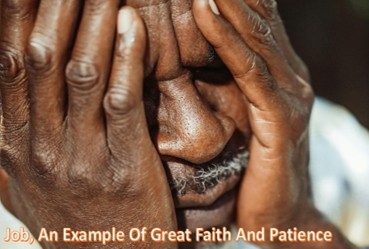
The book of Job seems to be chronologically out of order. We really are not absolutely sure where it belongs in Bible history. It makes no mention of Israel. The Exodus is never mentioned.
The fact that Job offered sacrifices for his family, Job 1:5, would indicate he lived in the Patriarchal age. His living in the “East”, Job 1:3, might imply a time even before Abraham. Thus, the book could be the oldest book of the Bible. The book has been placed along with books that are written in verse. Why?
Sometimes prose is incapable of expressing deep emotions. Men for centuries have expressed their strongest feelings with the aid of figurative language and the rhythm of poetry. Since the book deals with suffering, it seems the author could best express the sufferings of Job in poetry.
Most of us who read the book fail to recognise it as poetry because it does not rhyme. But it was characteristic of Hebrew poetry that it had neither rhyme nor a metrical pattern. We are also not certain who the author was, either.
Job is presented as a very successful man with great material wealth. He had seven thousand sheep, three thousand camels, five hundred yoke of oxen, five hundred female donkeys, and a large household, consisting of seven sons and three daughters, Job 1:2-3.
He was also “blameless and upright, and one who feared God and shunned evil,” Job 1:1. He also had a wonderful and loving family and everything we say it takes to have “a good life.”
Job offered sacrifices to the Lord, Job 1:5, indicating he was a very devout religious man and was concerned for his children. It is said that Job “was blameless and upright; he feared God and shunned evil,” Job 1:1 / Job 1:8.
Suddenly, Satan enters the scene. Satan tells God that Job would remain righteous as long as it was profitable for him to do so, Job 1:9-11 / Job 2:4-5, and God was making it profitable by blessing him with so much. To refute Satan’s charge, God permitted a test where Job’s children and possessions would be taken away from him, Job 1:12-19.
Catastrophic events destroyed all his possessions and his children, Job 1:18-22. Job refuses to be critical. We are told that he “shaved his head. Then he fell to the ground in worship,” Job 1:20. He said, “The Lord gave, and the Lord has taken away; may the name of the Lord be praised,” Job 1:21.
Probably not many of us today could stand such a shock of losing all we have in this world, including our own flesh and blood children. Would we praise God? Satan did not give up. He said, “Touch his bone and his flesh, and he will surely curse You to Your face!” Job 2:4.
To prove Job’s integrity, God allows Satan to afflict Job with painful boils from the soles of his feet to the crown of his head, Job 2:7. Job sat in the midst of ashes and scraped his sores with a piece of pottery, Job 2:8. His wife asked him. “Do you still hold fast to your integrity? Curse God and die!” Job 2:9. His wife is very angry with God, not unusual for some.
The book questions the reasons for suffering, especially the suffering of people who love God. Job wrestles with the age-old question of “Why does God allow bad things to happen to good people?” How can one reconcile the sufferings of the godly with the love of God?” Does suffering contradict God’s love?
The Sadducees of Jesus time believed that for one to be poor or in bad health was a sign of sin and that God was punishing them. If a man served God, he would receive earthly rewards. Even today there are those who hold to certain aspects of this theory.
Job’s three friends, Eliphaz, Bildad, and Zophar, insisted that he was suffering punishment for his sins, Job 4:7-8 / Job 5:17 / Job 22:5. Job insists that he has done nothing seriously wrong, Job 10:7 / Job 27:5-6 / Job 31:6 / Job 31:35 / Job 33:9. He was not being self-righteous in denying sin in his life. Job’s sufferings were severe. He knew he was innocent of sin, yet he suffered. Why?
Job’s chief agony was not so much his accumulated losses and sufferings, not even his being misunderstood by his friends, but that God hid His face from him and gave him no answers to his misery, Job 13:24 / Job 23:3-9 / Job 30:20. Three friends of long standing come to help but are shocked at his physical condition, Job 2:11-13.
While they were sympathetic and felt he must have sinned to bring on all his misery, they really lost confidence in Job and began to accuse him of sin, Job 4:7-8 / Job 8:3-6 / Job 11:14-15.
The debate goes on for some time, with three cycles of discussion between Job and his friends. They reason he must have sinned, but feel he will not admit it, Job 4:7 / Job 8:5-6 / Job 11:14-15.
While Job contends he is innocent, he feels that, for some unknown reason, the innocent suffer, Job 9:22–24. Even if God has been unfair and unjust, there will be a final vindication, Job 19:25-27.
Elihu next appears as a young man “with all the answers,” Job 32:6 / Job 32:8-9. Often, young men seem to feel they know the answers, while men of more mature years remain baffled. Essentially, his reasoning was the same as the three friends. I would seem that he was only adding insult to injury.
Finally, God spoke to Job in a series of questions in Job 38-39. They serve the purpose of restoring a stronger faith in Job. Job is given an examination. In this examination, he is asked a number of difficult questions which made Job realise how little he really knew about God, Job 42:1-6, His plans, purposes and ways.
This examination made Job see that his faith had really been buried in his own self-concern, and he needed some way to rise up and get a glimpse outside himself, Job 42:5-6.
After further examination concerning the hippopotamus and crocodile, Job 40:15-24 / Job 41:1-34, Job was completely humbled before God, Job 42:1-6. He made a marvellous confession in Job 42:1-6.
Job came to realise that God has a great overall plan for all humanity, and that Job was only a small part of God’s total plan. God had not forgotten Job. He was very much aware of him.
God keeps every individual in mind constantly, as seen when he asked Satan, “Have you considered my servant Job? There is no one on earth like him; he is blameless and upright, a man who fears God and shuns evil,” Job 1:8.
Job, as well as those of us who live today, cannot expect God to change his overall plan to suit our personal desires. When we are confronted with suffering, we must live and walk by faith.
Job admits he does not know he can’t always expect an answer for everything, Job 42:3. The whole problem of suffering must dissolve into a faith that God is, and that He cares, and that He has a plan which includes each of us.
When we get into the motives of God, questioning them, then we are getting into deep water that is way over our heads. If you notice closely, God never did give Job an answer to his question of why he suffered.
There are certain things that God does not choose to reveal to us. We must learn to be satisfied with what God has revealed and trust him in those things which he has not revealed, Romans 8:28.
In the end, Job is restored to his former estate and is commended by God, Job 42:10, while his friends are rebuked for their unsatisfactory consolation of a suffering man, Job 42:7-9.
He died at the age of one hundred and forty years, Job 42:16-17. Job is a model of spiritual integrity, a person who held fast to his faith, without understanding the reason behind his suffering.