
Jeremiah was born in the little city of Anathoth, just north of Jerusalem in the territory of Benjamin, Jeremiah 1:1. It was one of the priestly cities, Joshua 21:18. His father, Hilkiah, served as a priest, Jeremiah 1:1.
Jeremiah was called to be God’s spokesman to the people at an early age of about twenty in the 13th year of King Josiah’s reign over Judah, about 627 B.C., Jeremiah 1:2-10.
He hesitated on the grounds of his youth, but when God said, “Behold, I have put my words into your mouth,” Jeremiah 1:9. God also told Jeremiah, “Before I formed you in the womb I knew you, before you were born I set you apart; I appointed you as a prophet to the nations, Jeremiah 1:5.
Thus, Jeremiah began his work as a prophet, which lasted for forty years, down to the very last days of the nation when the city of Jerusalem was destroyed in 587 B.C.
He continued to preach to the close of his life in Egypt. His work began about sixty years after the death of Isaiah in Jerusalem in the thirteenth year of Josiah, king of Judah, Jeremiah 1:2.
Under this king, Judah attempted its third and last reform. For forty years, Jeremiah was to be God’s messenger to Judah, Jeremiah 1:4-10. He lived through the reign of the last five kings of Judah.
He saw his nation pass from a happy and prosperous condition into a state of iniquity. Finally, he saw the invasion of the Babylonians and the destruction of the city, Jeremiah 39 / Jeremiah 52 / Lamentations.
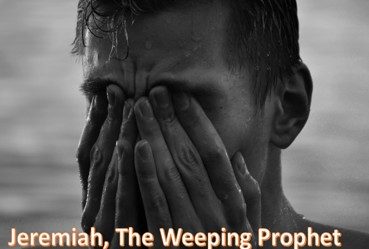
Jeremiah is known as the “weeping prophet,” Jeremiah 9:1. He has been called the most miserable prophet, the most pessimistic priest and the most unpopular preacher that the world has known.
He was very unpopular with the people, Jeremiah 11:19-21 / Jeremiah 18:18 / Jeremiah 20:1-2 / Jeremiah 20:7-10 / Jeremiah 38:6. At one point, he is certain that his people would “put me to death,” Jeremiah 26:15.
Yet, Jeremiah is one of the most noble and sterling characters to be found in the scriptures. He has been labelled “the greatest of the great prophets of Israel.” Some say that Moses and Paul of Tarsus are the only men who can stand beside Jeremiah.
God gave Jeremiah a two-sided commission. “I have set you this day over the kingdoms, to root out and to pull down, to destroy and to throw down, to build and to plant,” Jeremiah 1:10. This commission was both negative and positive, destructive and constructive. He preached doom but predicted restoration.
In addition to diagnosing the sickness, he also prescribed a remedy. Jeremiah lived during one of the most vital and tragic periods in the history of Israel. Because of the negative nature of Jeremiah’s ministry, he was destined from the very beginning to be a prophet of doom.
He was even forbidden to marry so he could devote himself fully to the task of preaching God’s judgment, Jeremiah 16:1-13. A prophet of doom cannot be a happy man. All of Jeremiah’s life was wrapped up in the knowledge that God was about to bring an end to the holy city and cast off His people.
Jeremiah is often called “the weeping prophet” because he wept openly about the sins of his nation, Jeremiah 9:1. He was also depressed at times about the futility of his message, Jeremiah 20:14.
As the years passed and his words of judgment went unheeded, he lamented this unfortunate state: “O Lord, You induced me, and I was persuaded; You are stronger than I, and have prevailed. I am in derision daily; everyone mocks me,” Jeremiah 20:7.
Jeremiah did not weep and lament because he had a weak character, nor did he proclaim evil because he had a dark and gloomy personality. He cried out because of his love for his people and his God. This characteristic of the prophet is actually a tribute to his sensitivity and deep concern.
Jeremiah’s laments remind us of the weeping of the Saviour in Matthew 23:37. “O Jerusalem, Jerusalem, the one who kills the prophets and stones those who are sent to her! How often I wanted to gather your children together, as a hen gathers her chicks under her wings, and you were not willing!”
He indicts his people on two counts. “My people have committed two evils; they have forsaken Me, the fountain of living waters and hewed out cisterns for themselves, broken cisterns, which can hold no water,” Jeremiah 2:13. The sum and substance of this proclamation is clear. They had left God and had sought a more exciting place to drink from.
The sin of Judah is quite plain. They had courted idolatry openly while clinging to a kind of legal observance of the Law. God rejected their service by saying, “The burnt offerings are not acceptable nor the sacrifices sweet unto me,” Jeremiah 6:20. Also, he said, “You have forsaken Me and burned incense unto other gods,” Jeremiah 1:16.
We are also aware that Jeremiah wrote the book of Lamentations. As the title suggests, this book expresses lament, grief, sorrow and anguish. It can rightly be called the masterpiece of anguish of all the literature of the world. It is actually a group of funeral hymns written shortly after the fall of Jerusalem when the people were carried away into Babylonian captivity.
One is impressed with the fact that these poems were written by an eyewitness, by one who stood in the midst of the ruins of the city and who saw the overthrow of the city by the Babylonians. The scene was so fresh that it had lost none of its ugliness and horror in his mind.
During the latter part of the reign of Zedekiah, the last king, Jeremiah was put into confinement, Jeremiah 37:15-21. Later, he is placed in prison, where he predicted the certain return of the Babylonians, Jeremiah 37:6-10.
Jeremiah’s sufferings reached their climax during the siege of Jerusalem. Here, he was accused of disloyalty and siding with the Chaldeans. In spite of his denial, he was cast into prison, where he would have perished had it not been for the intervention of one of the royal eunuchs, Isaiah 37:12-38:13.
The king seemed to be favourably inclined toward the prophet and consulted with him secretly, Jeremiah 37:17 / Jeremiah 38:14-16. In one of these secret meetings, Jeremiah obtained a milder imprisonment in the guardhouse, which was a part of the royal citadel, where he was given “a loaf of bread daily from the baker’s street, until all the bread in the city was gone,” Jeremiah 37:17-21.
As Jeremiah predicted, Jeremiah 25:11-12, the nation of God would eventually be punished because of its sin and disobedience to God. Nebuchadnezzar, king of Babylon, took the city in 587, 2 Kings 25:1-7 / Jeremiah 39:1-7 / 2 Chronicles 36:12.
Jerusalem was destroyed, and the leading citizens were taken to Babylon, 2 Kings 25 / 2 Chronicles 36 / Jeremiah 52. Jeremiah was freed from his prison and given a choice of either going to Babylon or remaining with his own people, Jeremiah 40:1-6. He chose the latter and went to be with Gedaliah, who had been appointed governor of Judea, Jeremiah 40:6.
However, Gedaliah was murdered, Jeremiah 41:1-10 / 2 Kings 25:25–26. After the death of Gedaliah, Jeremiah advised the recognised leaders of the people to remain in the land of Judah, Jeremiah 42:7-16.
The people refused to heed his advice and went to Egypt and took Jeremiah with them, Jeremiah 43:4-7. While in Egypt, he still sought to turn the people who had so long rebelled against the Lord to turn back to the Lord, Jeremiah 44.
Thus, he continued his preaching in Egypt, Jeremiah 43-44, warning his people that God would punish them. Their answer was, “As for the word that thou hast spoken unto us in the name of the Lord, we will not hearken unto thee,” Jeremiah 44:16.
Their rejection must have been difficult for Jeremiah to hear. However, there was one consolation. Jeremiah knew and had already prophesied that those in Babylonian captivity would be allowed to return to Jerusalem after seventy years.
It was a sign that God had not completely given up on His people but would make it possible for them to be reunited with Him again. There is no record of what happened to Jeremiah during these last years of his ministry while in Egypt. There is a tradition that the Jews stoned Jeremiah to death.
Another tradition says he escaped from Egypt and went to Babylon, where he lived out his life in peace. Throughout the centuries, including the Christian age, the voice of Jeremiah still cries out,
“The harvest is past, the summer is ended, and we are not saved, Jeremiah 8:20. Modern man, too, has hewed out cisterns of their own, thinking it will render them independence of the “fountain of living waters.”