
Around 606 B.C. Nebuchadnezzar, king of Babylon, came into control of Palestine. Then, after a battle with the Egyptians, he returned home. During his absence, Judah rebelled against Nebuchadnezzar under Jehoiakim, 2 Kings 24:1. So, troops were sent to Judah in December 598 B.C. Jehoiakim was bound in chains and later killed, 2 Chronicles 36:6.
It was during the reign of Jehoiakim that Daniel and his three friends, Shadrach, Meshach, and Abednego, were taken captive to Babylon, Daniel 1:1-7. Ezekiel was also taken at this time, Ezekiel 1:1-3 / Ezekiel 3:15.
His son Jehoiachin took control, but he and his mother and the leading citizens were carried to Babylon along with many of the vessels of the temple and other treasures, 2 Kings 24:15. He lived in captivity for thirty-seven years, 2 Kings 25:27-30 / Jeremiah 52:31-34.
His brother Zedekiah came to the throne and ruled from 597 to 587 B.C, 2 Kings 24:17-18. He was a weak ruler. Zedekiah sided with Egypt, Ezekiel 17:15 / Jeremiah 37:5-7.
Babylon again fought Egypt, with the victory going to the Babylonians, 2 Kings 24:7. In July 587 B.C., the Babylonians breached the walls of Jerusalem, 2 Kings 25:4 / Jeremiah 39:2.
Zedekiah, the last king of Judah, tried to escape but was captured near Jericho, Jeremiah 39:4-5 / Jeremiah 52:7-8 / 2 Kings 25:4-5. He was blinded and taken in chains to Babylon, where he later died, Jeremiah 52:11.
A month later, the temple, palace and private houses of Jerusalem were burned, 2 Kings 25:9 / Jeremiah 52:13. The walls of the city were broken down, and 832 of the Jewish inhabitants were carried to Babylon, Jeremiah 52:29.
Many Jews escaped to Egypt. Jeremiah was still in Jerusalem at the time, but would be forced to go to Egypt, Jeremiah 43:1-7. This left only the poor classes of people to remain behind.
In all, Nebuchadnezzar was twenty years in taking and destroying Jerusalem. 2 Kings 25:1-9. The reason for this delay was that he would have preferred to receive tribute (taxes) rather than to have a destroyed and desolate city, which would furnish no income.
Very little is known of the early life of Daniel. It appears he was a member of the royal family, Daniel 1:3, which probably means he was born and lived in Jerusalem.
It is also obvious that he had good training. He was very young (around fifteen or sixteen) when Nebuchadnezzar took him captive to Babylon in the third year of the reign of Jehoiakim, Daniel 1:1.
While Daniel was very young, he was determined to serve the true God, even in the midst of an idolatrous nation. Taken captive to this heathen city, the future must have looked very gloomy with no future for him.
In the midst of this gloom, a message came that he had been selected to be an officer in the king’s court, Daniel 1:3-5 / Daniel 1:18-20. This position of high honour he no doubt gladly accepted.
However, Daniel is faced with a great crisis when he must eat the special diet supplied by the king, Daniel 1:5. To do so would be to violate God’s command not to eat certain meats.
The decision to choose between glory, honour, prestige, power and God’s righteousness has always been a difficult choice. His decision is found in Daniel 1:8. “But Daniel purposed in his heart that he would not defile himself with the portion of the king’s meat, nor with the wine which he drank.”
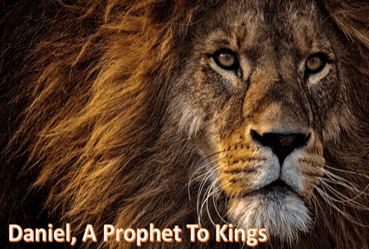
The sterling character of Daniel stands out again when, later during the reign of Darius, a Persian king, Daniel was faced with another crisis. The king was persuaded to pass a decree that for thirty days no one should present a petition to any god or man, Daniel 6:7-9.
If he did, he was to be cast into a den of lions. But Daniel continued his custom of facing Jerusalem and praying unto God three times a day, Daniel 6:10, as if there had never been a decree forbidding him to do this.
An accusation was brought against Daniel. “Daniel, who is one of the exiles from Judah, pays no attention to you, O king, or to the decree you put in writing. He still prays three times a day,” Daniel 6:13. While the king would have liked to have rescued him yet, because of his decree, Daniel was thrown into the den of lions, Daniel 6:16.
The king went early the next morning and cried, “Daniel, servant of the living God, has your God, whom you serve continually, been able to rescue you from the lions?” Daniel 6:20.
The answer came back, “O king, live forever!” Daniel 6:21. What a great lesson! We should not fear man, the world, or Satan, only “Fear God and keep his commandments,” Ecclesiastes 12:13.
One of the most amazing prophecies in the Old Testament is found in the second chapter of Daniel. About 600 B.C. Nebuchadnezzar dreamed a dream and forgot it, Daniel 2:5.
Daniel, with the help of God, recalled it and gave the interpretation, Daniel 2:27-28. In the dream, there was a great image whose form was terrible, Daniel 2:31. The head was of fine gold, his breast and arms were of silver, his belly and thighs of brass, his legs of iron, his feet were part iron and part clay, Daniel 2:32-33.
A rock smote the image upon the feet, and the entire image was crushed and vanished, Daniel 2:34-35. The rock became a great mountain and filled the whole earth, Daniel 2:35.
The interpretation and fulfilment of this prophecy is truly amazing. The image represented four kingdoms. The king who had the dream was the head of gold; thus, Babylon was the first of these kingdoms, Daniel 2:38.
A second kingdom inferior to the first would arise later to take its place. Proud Babylon bowed its head in 536 B.C. to rise no more to power. The second kingdom was to be the Medo-Persian Empire under Cyrus and Darius, Daniel 2:39 / Daniel 5:28 / Daniel 30-31. It was built upon the ruins of the old and was represented by the breast and arms of the image.
Later, a third empire would arise. This was the belly and thighs of brass, Daniel 2:32, and was the famous Macedonian Empire under Alexander the Great, Daniel 2:39.
The last kingdom was represented by the legs and feet of the image, the Roman Empire, Daniel 2:31-33. It was this last kingdom that the stone came into contact with.
Daniel said, “In the time of those kings, (Roman Caesars, the God of heaven will set up a kingdom that will never be destroyed, nor will it be left to another people. It will crush all those kingdoms and bring them to an end, but it will itself endure forever,” Daniel 2:44.
This was the kingdom of God, the church. While earthly kingdoms have vanished, the kingdom of God still exists today. It will always exist for the “gates of Hades will not prevail against it,” Matthew 16:18.
Rome persecuted Christians, yet, in time, they passed from the scene to become ancient history, whereas God’s people still continue today. The superiority of God over the kingdoms of men has always been evident.
One of the most dramatic events in the life of Daniel is found in Daniel 5. Belshazzar, the king, makes a great feast, Daniel 5:1-4. Suddenly, the finger of a man’s hand wrote on the wall, Daniel 5:5.
All of the wise men were called in, but no one could read the writing, Daniel 5:8. Daniel is called and interprets it as a warning of doom to Belshazzar, Daniel 5:25-28. The warning is fulfilled when Belshazzar is slain, Daniel 5:30. Darius the Mede then took the kingdom, Daniel 5:31 / Daniel 6:1.
Another great event is in Daniel 3. Nebuchadnezzar erects a golden image ninety feet high in the plain of Dura, Daniel 3:1, and requires that his subjects, upon penalty of death, must worship it, Daniel 3:5-6. Certain Chaldeans inform the king that Shadrach, Meshach, and Abednego have not worshipped the golden image, Daniel 3:8-12.
In rage, the king commands that the three of them be cast into a furnace heated seven times hotter than ordinary, Daniel 3:19. The commands are carried out, but in the furnace, the king sees the three men plus another person unharmed, Daniel 3:25. Their confidence was in God, who would deliver them, Daniel 3:17-18.
In close connection with the coming of the kingdom, Daniel pictures the coming of Christ, the Prince of Peace, the King of the kingdom, the Saviour of man, Daniel 7:13-14. Christ is distinctly set forth as the head of a fifth and everlasting kingdom, Daniel 2:44 / Daniel 7:13-14.
Daniel was placed in a high position in Babylon, and he used that position to magnify God. Very few men could occupy such a high position and still be loyal to God, but Daniel did. Moses, Joshua, Esther and others were also able to accomplish this.
Daniel foretells the future of Zion, the coming of the Messiah and His church, which would bring to mankind the saving gospel leading to eternal life. Daniel’s life spanned a very important period of ancient history. During his lifetime, he saw his beloved nation overrun by the Babylonians and carried into Babylonian captivity.
He saw this great kingdom fall to the Persians. He served during this time of captivity under many of the kings of Babylon and Persia. He also lived to see a remnant of the Jews return to their native land after seventy years of captivity.