
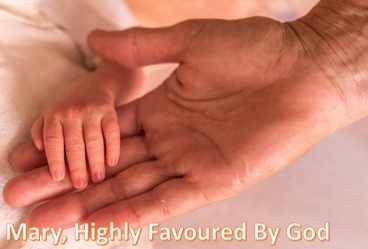
The story of Mary begins in an obscure village in Galilee called Nazareth, about fifty-eight miles north of Jerusalem. She is betrothed to a man named Joseph of the house of David, Luke 1:27.
A ranking angel, Gabriel, was sent by God to tell her she had “found favour with God”, Luke 1:30, and would conceive and bring forth a Son, and he was to be called Jesus. This must have been a frightening experience for Mary. Luke 1:31.
She is perplexed and asks, “How can this be, since I do not know a man?” Luke 1:34. Gabriel tells her that the Holy Spirit would come upon her, and thus she would conceive a child, Luke 1:35.
Of all the women in Palestine God could have chosen, we might think it would be someone of prominence, a princess, the wife of a high priest, a well-educated person or a person from a prominent family but instead He chose a young peasant teenager.
Nathanael echoed the common belief of that day when he said in John 1:46, “Can any good thing come out of Nazareth.” The belief of that day was that the Messiah would be born of a king, not a peasant.
When Mary went to visit her cousin Elizabeth, she exclaimed, “Blessed are you among women, and blessed is the child you will bear,” Luke 1:42. No less than Gabriel, one of the ranking angels, announced to Mary, “Greetings, you who are highly favoured, the Lord is with you,” Luke 1:28.
But why did God choose Mary? Part of the answer may be found in the response Mary made to Gabriel. All this would be difficult for Mary to comprehend, for she knew she was a virgin. It would not be long until it would be obvious she was pregnant, and people would begin to talk.
Mary’s faith in God drove her to say, “Behold the maidservant of the Lord; let it be to me according to your word,” Luke 1:38. It is this humble submission to God without questioning why she was being asked to take on this most unusual responsibility. Humble submission is a trait that God greatly delights in.
Many great Bible characters that were called upon to meet great challenges tried to back away from what God wanted them to do, but Mary was submissive, although the announcement made to her by Gabriel must have been mind-boggling. At this early stage in her life, she would not have comprehended all that would be involved.
Mary was the type of woman who put her faith into action. She not only says, “Lord, your will be done,” Luke 1:38, but she also “hurries” to see God at work in the life of her relative Elizabeth, Luke 1:39-45.
The journey to Judea was not a simple walk to the next town; it was a difficult journey requiring at least three days. Thus, we begin to see why God chose her above all the other Jewish women.
Mary’s knowledge of the scriptures also impresses us. The burst of praise from her lips, recorded when she went to visit Elizabeth, reveals an intimate knowledge of God and the Holy Scriptures. Luke 1:46-55 has been labelled “The Song of Mary.”
We may wonder how this young woman could speak such insightful words. This was a woman who deeply loved God, to whom was given a special understanding of what he was doing. As Mary journeyed from Nazareth to visit Elizabeth, she would have had time to think about what she had heard from the angel.
For the next thirty-three or more years, she would enjoy unparalleled rejoicing interspersed with indescribable sorrow. She would suffer the shame and humiliation of being pregnant out of wedlock, Matthew 1:19.
She would give birth to her son in a stable, Luke 2:6-7. She then would be forced to flee to a strange country to protect her son from an insane king, Matthew 2:13. She would watch him grow up, hearing strange things that came from his mouth, but she “kept these sayings within her heart,” Luke 2:19.
Later, she would watch him in his public ministry, wondering how he had become such a great teacher, John 2:1-11. Ultimately, she would stand under a Roman cross watching him agonise in pain and suffering for sins he had never committed, John 19:25-27. She would know the agony and grief of the dark hours following his death.
Next to Jesus himself, Mary may have paid a greater price for the salvation of man than any other person who has ever lived. Her reward came when the stone was rolled away from the tomb, and it was discovered that Jesus had arisen from the tomb, Matthew 28:6. No doubt Jesus spoke to her during the forty days before his ascension to heaven, comforting her, Acts 1:3.
In Luke 2:51, it is said that during Jesus’ childhood, he was subject to his parents and that he “increased in wisdom and stature, and in favour with God and man.” He would have learned many of these personal traits from his mother. She evidently taught Him well. We must keep in mind that he was human just as much as you and I.
Joseph and Mary, in all probability, were very young parents. According to rabbinical writings, a boy should be married long before he reached twenty (sixteen was considered an ideal age) and girls after they reached the age of twelve or as soon as betrothal could be arranged. This arrangement usually took place between the parents of both parties.
C. S. Lewis said the following.
“I trembled at the thought that God entrusted His Son into the care of two teenagers. However, God knew he could turn the rearing and training of His Son over to these young parents.”
From one little incident given to us, it seems clear she was one who was ready to serve. She was present at a wedding in Cana where Jesus had been invited, John 2:1. Her concern about there not being enough wine indicates she was serving in some capacity, John 2:3.
There were both miraculous and normal things that happened to her and Jesus, something which no doubt astonished her and made her proud of Jesus, but she never bragged or sought personal glory. She was one who “kept these sayings within heart,” Luke 2:19. Again, we see the characteristic of humility in Mary.
The Bible informs us that she was a Virgin, Luke 1:34 / Matthew 1:18 / Isaiah 7:14. The conception of Jesus was by the Holy Spirit, Matthew 1:18. However, she did not remain a virgin the rest of her life, as Catholic doctrine contends. We know that Jesus had at least four brothers and two sisters, Matthew 13:55-56.
Also, there was no bodily assumption into heaven. This is an assumption that is nowhere to be found in scripture. Neither are we taught to pray through her as an intercessor.
It has been argued that a mother has a special way with a son, and thus, by praying to Mary, she can be more persuasive with Christ than when we pray through Christ. Paul writes in 1 Timothy 2:5, “For there is one God and one Mediator between God and men, the Man Christ Jesus.” This eliminates Mary as our intercessor.
The veneration of Mary, calling her the “Mother of God,” and “Queen of Heaven,” plus making images of her, bowing before a statue of her, etc., is totally contrary to what the New Testament teaches about her. When Jesus ascended back to heaven, Mary was no longer his mother. He was now her Lord and Saviour, and she was His servant.
The fact that she was chosen by God to bring His Son into the world and that she raised him from childhood to manhood shows that she was an extraordinary person, but she was never elevated to the position the Catholic Church claims for her. The doctrine of Mariology is nowhere to be found in God’s word.
John took her into his home as if she were his mother after the Lord’s death, John 19:26-27. Tradition says that in later years, when he moved to Ephesus, she went with him. Nothing is said in scripture about how long she lived or what she did in the remaining part of her life. There is no information about her death.
Returning to Nazareth from Jerusalem after being sought for three days by his parents when he was a young boy, we are informed that he was subject to them, Luke 2:51. We do not hear any more about Joseph. It is assumed he died before Jesus’ public ministry.
The virgin birth of our Lord has elevated womanhood more than any other event in the history of mankind. Motherhood is given a place of dignity, honour and respect that had been greatly lacking. God used a plain, simple, virtuous mother to bring the greatest blessing to come to this world.