

Although Isaac wasn’t aware of Rebekah’s deceitful plans, it seems that he is right with God and Jacob again, and so, he lets his son go to get a wife, Genesis 28:1.
Constable, in his commentary, says the following.
‘Isaac evidently realised that his desire to give the blessing to Esau was not God’s will, so having given it to Jacob, Genesis 27:27-29, he blessed him further, Genesis 28:1-4.’
Isaac now blesses Jacob and commands him not to marry a Canaanite woman, Genesis 28:1. He is to go to Paddan Aram, the house of Rebekah’s father, Bethuel, Genesis 28:2. He is to find a wife from among the daughters of Laban, Rebekah’s brother, Genesis 28:2 / Genesis 27:46.
The blessings and promise of land and a seed are passed on to Jacob, Genesis 28:3-4 / Genesis 12:1-3. These blessings and promises are being passed on as God promised. First to Abraham, Genesis 12:2-3 / Genesis 15:5 / Genesis 17:7-8, then to Isaac, Genesis 17:19 / Genesis 26:3-4, and finally to Jacob, Genesis 28:13-14 / Genesis 35:11-12.
Jacob is sent on his way to Paddan Aram, to Laban, son of Bethuel the Aramean, Rebekah’s brother, Genesis 28:5. This was a journey of around four hundred and fifty miles. Sadly, this was the last time Jacob was going to see Rebekah, his mother, alive.
Coffman, in his commentary, says the following.
‘Sin always drives the sinner out. Adam and Eve sinned and went out of Eden; Gehazi sinned and lied to the prophet, and went out a leper white as snow; Judas betrayed the Lord and went out and hanged himself; Peter profanely denied the Lord and went out into the darkness weeping bitterly; here Jacob had sinned and lied to his father and went out to rest in the wilderness with a stone for a pillow.’
When Esau learned that his father had blessed Jacob and had sent him away to find a wife and commanded him not to marry a Canaanite woman, Genesis 28:6, and that Jacob had obeyed his parents and gone to Paddan Aram, Genesis 28:7 / Genesis 28:2 / Genesis 28:5, Esau appears to be unhappy about it.
For Esau, it seems like he always had a difficult time pleasing his father; he simply didn’t understand that it was because of his behaviour. He liked to keep company with ungodly people, especially ungodly women, and because of this, he couldn’t live in faith as his father did, Genesis 28:8.
Esau adds to his wives by marrying others, but notice that it seems he’s trying to get back into his father’s good books by marrying a non-Canaanite woman named Mahalath, who was the daughter of Ishmael, Genesis 28:9 / Genesis 26:34.
Coffman, in his commentary, says the following.
‘The behaviour of both these grandsons shows what a colossal mistake Abraham made when Hagar became a second wife.’
After a trip of around five hundred miles, Genesis 28:10, Jacob is about to experience something miraculous, something he simply wasn’t expecting. I would imagine he’s feeling isolated, scared and tired from the long journey. In a certain place, he stops for the night because it’s getting late, Genesis 28:11.
He takes a stone, using it as a pillow and falls asleep, Genesis 28:11, and whilst sleeping, he dreams of a stairway resting on the earth but reaching heaven, Genesis 28:12.
Jacob also sees the angels of God ascending and descending on it, Genesis 28:12. The stairway symbolised a connection between heaven and earth. The encounter Jesus had with Nathanael, mentioned in John 1:47-51, is interesting.
‘The greater thing’ to be seen, mentioned in John 1:50, is better explained in John 1:51. This probably refers to the story of Jacob, Genesis 28:12, perhaps what Nathanael is reading under the fig tree. Both involve the idea of communication between heaven and earth.
In John 1:51, we see that Jesus takes the place of the stairway. Nathanael sees that Jesus is the link between heaven and earth, the One through whom God’s will is fully revealed to man, the One alone through whom we have access to God, John 14:6 / 1 Timothy 2:5 / Romans 5:2.
However, this would have been a method of drawing attention to the role of Christ as a mediator between God and man. The idea of heaven being open to all men and communication allowed between God and man via the Son, not an earthly entity. Jesus Himself is the ladder, giving access to God.
For a Jew, such as Nathanael, to declare anyone King in this manner was the greatest statement of faith he could ever make, John 1:49 / 1 Timothy 6:15 / Revelation 17:14 / Revelation 19:16. The idea being portrayed was one of total and immediate spiritual dependence on the one accepted as King, that is, Christ.
This stairway is the access to heaven, Genesis 28:12. Jesus uses this event to share the same important truth, John 1:51. Jesus is the Way; He doesn’t show the Way, John 14:6. Jesus is our access to heaven. God has provided us with access to heaven through Jesus and Jesus only.
The angels who seem to act as messengers between God and man, or guardian angels, Hebrews 1:14, are ascending and descending, Genesis 28:12. Jesus says they are ascending and descending on Him, John 1:51. We would think that they would be descending and ascending. In other words, coming down from heaven to earth, but they’re not, Hebrews 13:2.
In Jacob’s dream, he sees the LORD standing above the stairway and God identifies Himself as the LORD, the God of his father Abraham and the God of Isaac, Genesis 28:13. Later, in Genesis 31:11-13, we see that this is the angel of the Lord, the preincarnate Christ.
Haynes Jr, in his commentary, says the following.
‘A study of these passages reveals that the Angel of the Lord appeared in human form, Genesis 18:2 / Genesis 22:1-18 / Hebrews 13:2, and performed normal human functions, Genesis 32:24 / Numbers 22:23 / Numbers 22:31, yet he was an awe-inspiring figure, Genesis 32:30 / Judges 6:22 / Judges 13:22, exhibiting divine attributes and prerogatives including predicting the future, Genesis 16:10-12, forgiving sin, Exodus 23:21, and receiving worship, Exodus 3:5 / Judges 13:9-20.’
God promises Jacob that He will give him and his descendants the land on which he is lying, Genesis 28:13. Jacob’s descendants will be like the dust of the earth and spread out throughout the earth, and everyone on earth will be blessed through him and his offspring, Genesis 28:14.
God promises to be with him and protect him wherever he goes, and He promises to bring Jacob back to the land. He will not leave him until this promise is fulfilled, Genesis 28:15.
Constable, in his commentary, says the following.
‘Jacob was the second person in the Bible to hear the assurance ‘I am with you’, Genesis 28:15. Isaac was the first, Genesis 26:3 / Genesis 26:24. This was a promise that God later repeated to Moses, Exodus 3:12, Joshua, Joshua 1:5, Gideon, Judges 6:16, regarding Immanuel, Isaiah 7:14 / Matthew 1:23, and to all Christians, Matthew 28:20 / Hebrews 13:5.’
The purpose of the event was to reassure Jacob that through him the promises made to Abraham would be continued, Genesis 12:1-3 / Genesis 12:7 / Genesis 13:14-16 / Genesis 15:18 / Genesis 17:8 / Genesis 24:7, but more importantly to remind him that God is present wherever he goes, Psalm 139:7.
God speaks words of comfort and repeats the covenant promises to Jacob and this was going to be a life-changing experience for Jacob, Philippians 1:6. Jacob, after he awakes, is thinking, the LORD is in this place, even though he wasn’t aware of it, Genesis 28:16. He then proceeds to worship God and puts emphasis on this place, saying, ‘this is the house of God’, this is the gate of heaven’, Genesis 28:17.
Notice the three things which Jacob did after his dream.
1. Jacob set up the stone he used for a pillow and anointed it with oil to memorialise the location, Genesis 28:18.
Over the years, all kinds of theories have come about concerning this stone. Some suggest it was taken to Jerusalem; some suggest it was taken to Spain; others suggest it was taken to Ireland, and still others claim it was taken to Scotland, upon which the Kings of Scotland sat to be crowned. Even today in Scotland, they claim this stone is kept at the now-ruined Scone Abbey in Scone, near Perth, Scotland.
2. Jacob changed the name from Luz to Bethel, Genesis 28:19.
A little later, the angel of God, the preincarnate Christ, when He’s speaking to Jacob, calls Himself the God of Bethel, Genesis 31:11-13. Bethel was later to become a high place for idolatry, 1 Kings 13:32 / Hosea 10:15 / Amos 4:4.
3. Jacob made a vow to return to God a tenth of those blessings that would come his way by the blessing of God, Genesis 28:20-22.
Interestingly, this is only the second time that tithing in the Old Testament has been mentioned, the other being in the instance of Abraham’s tithes to Melchizedek, Genesis 14:20 / Hebrews 7:2.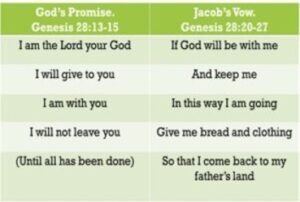
Notice that Jacob made a vow to God after the event. Notice the difference between God’s Promise, Genesis 28:13-15, and Jacob’s vow, Genesis 28:20-27. It’s possible that he didn’t fully trust God up to this point. Maybe it’s now a case of seeing is believing, Philippians 4:13 / Nahum 1:7.
God is teaching him and will continue to teach him lessons on humility. Please note that God is still willing to accept him, even after his worldly prayer. What a merciful and loving God we serve.