

What we will see in this chapter is that law and death are contrasted with life and love.
Those in sin are under sentence of death. Those in Christ are declared to be justified, Romans 8:1. Notice the difference between Romans 7, life in the flesh and Romans 8, life in the Spirit.
The force of the word ‘I’ in Romans 7 is great. It is mentioned no less than twenty-three times in eleven verses, whilst ‘me’ is mentioned six times and ‘my’ three times.
So in just eleven verses, Romans 7:14-24, Paul’s personal self, as he saw it at the time, is mentioned no less than thirty-two times, nearly three times per verse. Contrast the word ‘I’ with the ‘Spirit’ who is mentioned nineteen times in Romans 8.
In Romans 8:1-17, Paul divides people into two categories: those who let themselves be controlled by their fleshly desires, and those who follow after the Holy Spirit. He gives a strong exhortation to cause us to choose the right path.
‘No condemnation’, Romans 8:1, means freed from sin’s guilt and enslaving power; the law of sin and death no longer has control, Romans 7:23. Whether he may or may not again come into condemnation is not a matter of consideration here.
Notice the law of the Spirit of Life, Romans 8:2. The Holy Spirit prescribes conduct. Tells us how we ought to live. When we follow the course of conduct laid down by the Holy Spirit, we are freed from the old bondage to sin, with the inevitable consequence which that bondage would otherwise bring.
‘Law of the Spirit of life’, Romans 8:2. The law is revealed by the Spirit, which is capable of producing life. It is Christ’s law as to the source, and the Spirit’s as to the agent of making it known. It is the ‘law of life’ because it is the principle or rule by which spiritual life is obtained.
Notice, also, ‘made us free’, Romans 8:2. This means that following the guidance of the Holy Spirit, as to our conduct, we have been set at liberty. When the conqueror of a nation announces new laws, he automatically makes the old laws ineffective and renders them invalid, out of date.
For example, when over two hundred years ago, the American Declaration of Independence was drawn up and became the law of the United States of America, the old laws of the British Parliament no longer had any validity, authority or power.
‘Made me free,’ Romans 8:2, this shows, again, that he was not in Romans 7, talking about his conflict as a Christian because he would not say in one breath, ‘I am carnal, sold under sin, sin dwells in me, bringing me into captivity to the law of sin’, Romans 7:14 / Romans 7:20 / Romans 7:23, etc., and in the same breath say, ‘I am free,’ His conflict was a thing of the past, not of the present.
‘The law of sin and death’, Romans 3:2. The law of sin resulting in death, which was in the members. From Romans 8:3, the law could not do it. In other words, it could not deliver him from the conflict, but the other could. If the law of sin and death refers to the Law of Moses, Paul would be saying that the Law of Moses could not deliver us from the Law of Moses.
Paul argues that we were under the old dominion of sin, but sin, as we have seen, has been dethroned. We have a new master, and sin’s power and sin’s law have ceased to be valid. We are now under the law of the spirit of life, because whilst sin brought death, the Spirit brings life in Christ, Romans 8:2.
But notice the new life is only in Christ, Romans 8:2. All the blessings are said to be in Christ. In Him we have redemption and the forgiveness of sins, Colossians 1:14. In Him we are children of God, by faith, Galatians 3:27.
In Him we have all spiritual blessings, Ephesians 1:3. We have the redemption that is in Christ Jesus, Romans 3:24. In Him we are a new creation in Christ Jesus, 2 Corinthians 5:17.
Poole, in his commentary, says the following about the words ‘in Christ’.
‘This phrase imports that there is a mystical and spiritual union betwixt Christ and believers. This is sometimes expressed by Christ being in them, and here by their being in Christ. Christ is in believers by His Spirit, and believers are in Christ by faith.’
Quinn, when answering this question, says the following.
‘A first, most reasonable question for those interested in eternal salvation, as well as in the other spiritual blessings of God, would be, ‘How does one get into the relationship described as being ‘in Christ”?’
No Scripture says that we ‘believe’ into Christ or that we ‘repent’ into Christ, though both of these things are prerequisites. There is a specific moment in which the Scriptures teach that a believing, repentant individual is ‘in Christ.’ We do not have to guess about it. We know the precise point.
The Lord God, in His word, places that moment at baptism! Though many would reject this, saying a believer is in Christ before he or she is baptised, we must instead take the Lord’s word for it.
He has told us, through the inspired word given from heaven to Paul, that, ‘Do you not know that all of us who have been baptised into Christ Jesus have been baptised into His death? Therefore we have been buried with Him through baptism into death, in order that as Christ was raised from the dead through the glory of the Father, so we too might walk in newness of life,’ Romans 6:3-4.
And ‘For all of you who were baptized into Christ have clothed yourselves with Christ,’ Galatians 3:27. So we learn that every spiritual blessing is found ‘in Christ’ and that we are baptized ‘into Christ.’ This means we must be baptised to gain access to the spiritual blessings in Christ!’
‘The law was powerless’, Romans 8:3. The Law of Moses could not make one free from the law of sin and death. Any law by itself cannot provide redemption. ‘It was weak through the flesh’, Romans 8:3; it was without strength because it was of carnal and fleshly things, Hebrews 7:18-19 / Hebrews 8:6-8.
Poole, in his commentary, says the following.
‘The law is weak to us, because we are weak to it: the sun cannot give light to a blind eye, not from any impotency in itself, but merely from the incapacity of the subject it shines upon.’
‘In the likeness of sinful flesh’, Romans 8:3. His Son was in the same flesh through which men sin. He was in the same kind of flesh as belonging to the rest of sinful mankind. ‘And account of sin’, Romans 8:3, ‘Or, by a sacrifice for sin’, Footnote, KJV, ‘As an offering for sin’, Footnote, ASV.
‘Condemned sin’, Romans 8:3. The fact that He was given for it was a condemnation of it. His death showed how wrong, terrible, and extremely evil sin is and thus condemns it.
Christ was given as a sacrifice that the righteousness which the Old Testament sought after might be accomplished in us. It fulfils in us exactly what the law was unable to accomplish.
‘Who do not walk according to the flesh,’ Romans 8:4. Who do not live a worldly life, devoted to the flesh. Their actions are not governed by fleshly dictates and appetites. ‘But according to the Spirit’, Romans 8:4. Their actions are governed by the teachings of the Holy Spirit.
Paul explains this more fully in the following verses. The flesh and Spirit both direct and cause behaviour, Romans 8:5. Everyone is following one or the other. Only those who are directed and controlled by the Spirit have deliverance. Those who mind and walk after the flesh are under condemnation.
Those who live according to the flesh have the wrong ‘mindset,’ Romans 8:5-6. The carnally minded have material, fleshly interests, Matthew 16:23 / Philippians 3:19 / 1 Corinthians 3:3.
‘The things of the Spirit’, Romans 8:5, means those who live according to the Spirit set their minds on those holy and right things revealed by the Spirit. They are spiritually-minded.
Paul speaks about the carnal mind, the fleshly mind, and the mind of the Spirit. To be carnally minded is death, but to be spiritually minded is life and peace, Romans 8:6.
‘Carnally minded is death’, Romans 8:6, means to be fleshly minded, having one’s mind ruled and controlled by the earthly, material things, results in death. Our physical appetites can distinguish between the pleasant and the unpleasant, but they cannot distinguish between the right and the wrong.
So, our fleshly appetites, our desires, often prompt us to do those things which are not according to the will of God. We disobey God, and that means that we are in rebellion against God, Romans 8:7. So, the flesh is hostile to God, and to allow the body to rule is to do that which God has forbidden.
‘Spiritually minded is life and peace’, Romans 8:6, means that having one’s mind ruled and controlled by the Spirit results in life and peace. Its end result is spiritual life, freedom from sin’s penalty, and peace, that is, tranquillity of heart and mind, which comes to those who are in the right relationship, those who are justified with God.
‘Carnal mind is enmity against God’, Romans 8:7, is hostile toward God, showing hatred of God. The fleshly and spiritual minds are hostile to one another, Galatians 5:17 / Galatians 5:24. ‘Not subject to the law of God’, Romans 8:7, means the carnal mind is not obedient to the will of God because it is governed by the dictates of the flesh.
‘Nor indeed can be’, Romans 8:7, that is, the carnal-minded cannot be subject to the law of God while attending to the flesh. It cannot submit to or obey God and remain carnal. Once it chooses to obey God, it ceases to be fleshly and becomes spiritual.
Remember that Romans 7 involved the inward conflict Paul had when he lived under the law. He now shows that he was freed from that conflict. In Romans 7:1, he writes, ‘now’, as distinguished from the time when he projected himself back under the law.
We must daily centre our minds on spiritual things, Colossians 3:1-2 / 1 Peter 1:13. The very best way to be spiritually minded, that is, minding things of the Spirit, is by having our minds renewed by the Word of God, Romans 12:2 / 2 Corinthians 4:16.
We must pray that the Lord will give us our daily food, Luke 11:3, as well as our spiritual food, Matthew 4:4. Spiritual nourishment is far more important, John 6:27.
Their every interest and desire is against the will of God, Romans 8:8; thus, they are under the control of the flesh and not the Spirit. ‘Not in the flesh’, Romans 8:9, means not under the control of the flesh, but under the control of the Spirit.
Notice Paul mentions the ‘Spirit of God’, Romans 8:9. He either refers to the Spirit which inhibits the Father or the one sent by Him, the Holy Spirit. No one knows which.
The indwelling of the Holy Spirit is a fact plainly taught in the New Testament, Romans 8:9 / Acts 2:38 / Acts 5:32 / Galatians 4:6 / 1 Corinthians 3:16 / 1 Corinthians 6:19 / 2 Corinthians 1:21-22 / 2 Corinthians 5:5 / Ephesians 1:13-14 / Ephesians 4:30. Thus, there is no difference among Christians as to the fact of the indwelling.
Paul mentions the ‘Spirit of Christ’, Romans 8:9. This identifies in this verse, as well as the first part of Romans 8:10, Christ’s Spirit. Christ dwells in the Christian just as the Spirit does.
Notice they ‘do not belong to Christ’, Romans 8:9. This means he is not a Christian. Without Christ’s Spirit within one, he does not belong to and is not in union with Christ.
Newell, in his commentary, says the following.
‘Many sincere people are yet spiritually under John the Baptist’s ministry of repentance. Their state is practically that of the struggle of Romans Seven, where neither Christ nor the Holy Spirit is mentioned, but only a quickened but undelivered soul in struggle under a sense of ‘duty,’ not a sense of full acceptance in Christ and sealing by the Holy Spirit.’
‘The body is dead because of sin’, Romans 8:10, because of sin, the body is doomed to natural death and, hence, is accounted as already dead. ‘But the Spirit is life because of righteousness’, Romans 8:10.
The life-imparting Spirit is dwelling within you because of justification. The Holy Spirit gives life through the Gospel system, that is, justification to those who are indwelt by Christ.
The verse is showing that if Christ is in us, though our bodies must die because of sin, the life-imparting Spirit is dwelling in us because of our justification. Using the Spirit, note, Holy Spirit, ‘S’ in upper case, throughout this text is more consistent.
Notice Paul uses the word ‘if’, Romans 8:11. This tells us that the rewards are conditioned on Deity indwelling. ‘The Spirit of Him, through His Spirit’, Romans 8:11, means there is no reason to change to the Holy Spirit in this verse.
The Scriptures teach that the Spirit of the Father, as well as the Holy Spirit, dwells in us, 2 Corinthians 6:16 / 1 John 4:4 / 1 John 4:13 / 1 John 4:16 / Ephesians 4:6 / Philippians 2:13.
‘Will also give life to your mortal bodies’, Romans 8:11 / John 5:28-29 / 1 Corinthians 15:52-53. We have faith that as God raised up Jesus, we will be as well, 1 Corinthians 6:14 / 2 Corinthians 4:14.
He now gives an exhortation drawn from what has been previously said. ‘We are debtors, not to the flesh’, Romans 8:12, that is, we do not owe the flesh anything.
‘To live according to the flesh’, Romans 8:12, means to live after the flesh is enmity against God and will end in everlasting death. We owe absolutely no allegiance to the fleshly rule.
We are debtors to the Spirit, to live after the Spirit. Notice Paul said, ‘will die’, Romans 8:13. This means if you live according to the flesh, you must pay the consequence of eternal death, Galatians 3:3.
‘By the Spirit’, Romans 8:13, means through the instruction, enlightenment, and direction of the Spirit’s revelation. ‘You will live’, Romans 8:13, means you will have eternal life. When you put to death the deeds of the body, those sinful things done in the body, you will receive eternal life.
‘These are sons of God’, Romans 8:14, the true sons of God are the ones led by the Word of the Spirit. If we are led by the Spirit of God, we truly are His children. We are led by the Spirit through the Word of the Spirit.
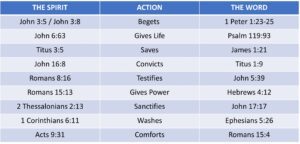
We must, through the instruction, enlightenment, and direction of the Spirit’s revelation, put to death the deeds of the body, those sinful things done in the body, so that we can be blessed with eternal life. We must bring an end to those sinful deeds of the body. By all means, we must break all sinful habits, for the end of that way of life is eternal death.
Adoption in New Testament times was the public recognition that this was your real son. They would say the words, ‘I adopt thee’ three times. These were children who were brought up by someone else.
Bruce, in his commentary, says the following.
‘In the Roman world of the first century AD, an adopted son was a son deliberately chosen by his adoptive father to perpetuate his name and inherit his estate; he was no whit inferior in status to a son born in the ordinary course of nature.’
‘Spirit of bondage again to fear’, Romans 8:15, we have not received the spirit of slavery to once more fill us with fear. ‘Spirit of adoption’, Romans 8:15, means we have not received the disposition of slaves serving out of fear, but that of adopted sons. It is called the ‘Spirit’ of adoption because the Holy Spirit revealed the process, the means by which we become sons of God.
‘By whom we cry out, ‘Abba, Father,’ Romans 8:15. ‘Abba’ is an Aramaic word that means ‘father’ but expresses the love and trust a child has toward his father. The Greek word ‘father’ expresses an intelligent understanding of the relationship.
The two together express the love and intelligent confidence of the child. We, as adopted children, cry out intimately and intelligently to our heavenly Father, Matthew 6:9.
Two witnesses are involved, both bearing witness to the same fact, ‘we are children of God,’ Romans 8:16. The Holy Spirit has given His testimony, and our spirits testify that we have done those things. Thus, the two witnesses agree or bear witness together, 1 John 2:5 / 1 John 5:13.
One can know that he is a child of God when he has the testimony of both spirits, the Holy Spirit revealing what he must do, and his own spirit revealing that he has done it, Deuteronomy 17:6.
The Holy Spirit has revealed the plan of salvation, and when our spirits testify that we have obeyed the plan, both spirits are testifying that we are children of God.
Also, when the Spirit reveals the kind of character which constitutes a child of God, and our spirits reveal that we have that kind of character, both bear witness that we are children of God.
‘Then heirs’, Romans 8:17. Since we are sons, we are privileged to share in the favours and will be partakers of the inheritance. Notice we are ‘joint heirs with Christ’, Romans 8:17, this means we are His brethren, Hebrews 2:11, and shall inherit with Him, Revelation 3:21.
‘If indeed we suffer with Him’, Romans 8:17 / Philippians 3:10, thus, again, our glorification is conditional. ‘That we may also be glorified together’, Romans 8:17, we must suffer with Him in this life so that we can be glorified with Him in eternity.
When our faithfulness to Him leads to suffering, let us rejoice and patiently endure because, someday, we will be glorified together with Him, Acts 5:40-42 / 1 Peter 4:11-16 / 2 Timothy 2:11-12 / Matthew 5:10-12.
The remainder of Romans 8 may be viewed as six reasons why Christians should endure suffering.
1. Because of the glorious reward, Romans 8:18.
2. The body will be redeemed, Romans 8:19-23.
3. We are saved by hope, Romans 8:24-25.
4. The Spirit helps in our weaknesses, Romans 8:26-27.
5. All things work together for good, Romans 8:28-30.
6. God is for us, Romans 8:31-39.
The Book of Romans is much more than an explanation of God’s redeeming grace. It is a letter of comfort, encouragement, and exhortation addressed to you and me.
‘Are not worthy to be compared’, Romans 8:18, means the duration and severity of the suffering, when compared to the reward, will be as nothing, 1 Corinthians 15:19 / 2 Corinthians 4:17. ‘Revealed in us’, Romans 8:18. It will fill and overwhelm us. We will be part of that glory.
Morris, in his commentary, says the following.
‘The glory will be revealed, not created. The implication is that it already exists, but is not apparent.’
The second reason for enduring suffering is that Christians eagerly await the redemption of the body. This section is one of the most difficult in the book of Romans.
There are many different interpretations of the meaning of ‘creature,’ ‘the whole creation,’ and ‘we ourselves.’ Paul is dealing with the present suffering and future glory.
Suffering is temporary, but man is eternal. The suffering Christian will someday be delivered from this present state and transformed into a glorious state. ‘Earnest expectation’, Romans 8:19, means eagerly watching with suspense.
When Paul speaks of ‘the creation’, there are four possibilities.
1. ‘The creation’, in terms of all created things, including inanimate objects.
2. ‘The creation’, in terms of intelligent beings, is humanity.
The same as ‘whole creation’ in Romans 8:22.
3. ‘The new creation’, in terms of the spiritual creation of God, the Christian.
4. ‘The creature’, in terms of the physical makeup of man, the body.
As we will see, the second one seems to be the correct meaning in this text. ‘Waits in eager expectation for the sons of God to be revealed.’ ‘Revealing of the sons of God’, Romans 8:19, NIV. The emphasis is on man’s hope of immortality.
MacKnight, on this verse, said the following.
‘The earnest desire of mankind hath ever been to obtain that glorious endless life in the body, by which the sons of God shall be made known.’
‘For the creation’, humanity, rational beings. ‘Subjected to futility’, ‘Subject to vanity’, Romans 8:20, KJV. This means it’s subject or liable to suffering, sickness, pain, sorrow, and death.
‘Not willingly’, Romans 8:20, means not by their own choice or will. ‘Because of Him’, Romans 8:20, that is God. In the beginning, when man sinned, God pronounced curses upon him and thus brought him under futility, Genesis 3:17.
‘Subjected it in hope’, Romans 8:20, means in hope of the ultimate deliverance from corruption. Even when God pronounced the curses upon man in the beginning, He gave him hope of deliverance. Man was thus subjected to hope.
‘The creation itself’, Romans 8:21, several translations, including the ASV, NASV and the NIV, connect the ‘in hope’ of Romans 8:20, with Romans 8:21, giving them the following rendering.
‘For the creation was subjected to futility, not of its own will, but because of Him who subjected it, in hope that the creation itself also will be set free from its slavery to corruption into the freedom of the glory of the children of God.’ NASV.
‘Bondage of corruption’, Romans 8:21, means that which the body is in, mortality. ‘Glorious liberty of the children of God,’ Romans 8:21, means eternal life, characterised by glory, honour, and immortality.
From the very beginning, sinful man was given hope that God would provide deliverance from the bondage of corruption and mortality to a glorious liberty, immortality, Genesis 3:15.
What does Paul mean? It is wise when encountering a difficult verse of Scripture to put it in its proper context, that is, by reading what goes before it and what follows.
When we do this with this verse in Romans 8, we find that the chapter proclaims the believer’s confident hope in a manner that stands in glorious contrast with the bleak hopelessness which runs through Romans 7, especially in Romans 7:7-24.
Remember Romans 7, which is a chapter on law and death deals with law, all kinds of law. But Paul is particularly concerned with the law of sin, and he describes the despair of the man who, he describes as ‘captive to the law of sin’, Romans 7:23.
The despair of the man is clearly heard in the cry in Romans 7:24. ‘Wretched man that I am! Who will deliver me from this body of death?’ The word ‘wretched’ is ‘talaiporos’, which describes one who has been reduced to weariness by hard labour.
The latter part of the word, ‘poros’, is the word for ‘callus’, bringing to mind hands roughened with exhausting toil, and we find it again in the word ‘porosis’, for ‘hardness’, or ‘callousness’, in Mark 3:5.
The man’s wail of agony strikes us with even greater force when Philip Dodderidge, quite accurately, uses the phrase, ‘this dead body’, because it suggests that Paul is very probably alluding to an extremely gruesome form of punishment which, in ancient times, was known to have been inflicted on those guilty of murder.
There is a great deal of evidence to show that the murderer was sometimes bound to the corpse of his victim, hence the question in that verse. In the following lines, Virgil, the Greek poet, describes this punishment as it was imposed by one particularly cruel Greek King.
‘The living and the dead at his command were coupled, face to face and hand to hand; Till, choked with stench, in a loathed embrace, The lingering wretches pined away and died.’
If you think that this was horrid and uncivilised behaviour, let me remind you that, in the reign of Richard 1st, the famous ‘Richard the Lionheart’ beloved of film producers, a law was passed relating to the Crusades, which governed those who sailed to the Holy Land.
It stated, ‘He who kills a man on shipboard shall be bound to the dead body and thrown into the sea; if a man is killed onshore, the slayer shall be bound to the dead body and buried with it’.
So, no matter how we look at them, the words of Paul vividly depict the hopelessness and misery of the sinner, who finds himself bound to a burden from which he sees no release.
Remember Romans 8, is a chapter of grace and life! And so, in total contrast, Romans 8 declares the liberty that the Christian has in Christ. ‘There is no sentence to be served!’ literally, ‘no penal servitude’ for those in Christ Jesus! Romans 6:1-2.
We have received the Spirit who adopts us and who bears witness with our own spirit that we are the children of God. This means that we have become joint-heirs with Christ, providing we are prepared to suffer with Him in order to share His glory, Romans 8:15-17.
This thought of suffering then leads Paul to acknowledge that, at this present time, suffering is a common experience in life, Romans 8:18. But he quickly tells us it is nothing, not worth mentioning! A view of the glory which is to come. At present, we, who already possess spiritual life in Christ, are waiting for what he describes as ‘the redemption of our bodies’. Romans 8:23.
It is about this consummation of the divine plan of redemption that he writes in Romans 8:19-23. At the present time, ‘the creation waits with eager longing’. I use this rendering of Romans 8:19, because I believe it is easier to understand than the one we find in the A.V.
The word ‘creation’ is defined by Thayer as ‘the sum and aggregate of all created things’. It refers to the whole of nature, everything we see around us, and all that lives.
The world of creation is waiting for something to happen ‘with eager longing’. This last phrase is the translation of just one word, and it is a word that presents a very vivid picture. Its meaning becomes clear when we break it up into its three constituent parts, which are ‘apo, kara, dokia’. That is ‘apokaradokia’.
The word ‘apo’ means ‘away’, ‘kara’ means ‘head’ and ‘dokia’ means to ‘watch’. Put the three parts together, and we have a picture of someone, stretching out his head, straining his neck, to watch, in eager expectation of some great event.
Now, we know that when God made everything, it was ‘very good’, and the perfect man lived in a perfect environment, Genesis 1:31. But, says Paul, creation is ‘groaning’ up to this present time, Romans 8:23. That word reveals that this is not the world as God meant it to be, and it is waiting for a change, and ‘agonizing’ as it waits.
Yet, it is a hopeful agony, similar to that of a woman who is expecting the birth of her child, Romans 8:22. She endures suffering in anticipation of the joy that is to come. We see this from Paul’s use of the word ‘travail’ in Romans 8:22. For what are we waiting? What is it for which creation is waiting so eagerly?
Look again at Romans 8:19, and Romans 8:21. All creation is ‘longing for the revealing, ‘apokalupsis’, ‘revelation’, of the sons of God,’ which means the Lord’s Return.
To ‘obtain the glorious liberty of the children of God’, Romans 8:21, which will complete the redemption of believers at His Coming. I use the phrase, ‘complete the redemption’, because we already enjoy a partial redemption as forgiven children of God. But there is a ‘salvation’ yet to come. Romans 13:11, and we are now awaiting ‘the redemption of our bodies’, Romans 8:23.
According to Genesis 3, when God imposed punishment on all three involved in that first sin, Adam, Eve and the Serpent, He made it clear that the consequences of their disobedience were not limited to themselves alone. The earth itself was affected, Genesis 3:17-18.
Because of them, the ground itself was cursed and would no longer produce freely, as it had previously done. Furthermore, what had been a pleasant occupation would now become ‘toil’, and Adam was told, ‘By the sweat of your face you shall eat bread’, Genesis 3:19.
Yet, there was a glimmer of hope. The message of the Bible is one of ‘Generation, Degeneration and Regeneration’, and it records that God spoke of a time when the effects of sin would be cancelled forever. The destruction of sin and Satan himself would come through ‘the seed of the woman’, Genesis 3:15, who would make possible mankind’s redemption.
God had warned Adam that disobedience would affect him in two ways, Genesis 2:17. The penalty imposed on disobedience would be death, both spiritual and physical. The Hebrew text reads, ‘dying, thou shalt die’. The first and immediate consequence of their sin was that they died spiritually.
The root meaning of the word ‘death’ is ‘separation’. Spiritually, Adam and Eve died instantly. They were separated from God by their sin, and, banished from the Garden, we understand that they no longer had fellowship with Him or free access to Him, Genesis 3:23-24.
Furthermore, the process of physical death commenced. Sickness and suffering, which they had never experienced before, affected their physical bodies. They began to age, until, as God had warned them, they died and their bodies returned to the ground out of which they had been formed, Genesis 3:19.
But, thanks to the grace of God, His plan of Redemption includes salvation on two levels, so to speak. First, it embraces the instant restoration of man’s spiritual relationship with God because it makes possible a new, vibrant life, which brings him back into fellowship with God.
Second, it promises the cancellation of the effects of sin on man’s physical body, when, at the resurrection, ‘this mortal shall put on immortality’, 1 Corinthians 15:53, as Paul writes to the Christians at Corinth, in that glorious 1 Corinthians 15 chapter.
It is for this that both believers in Christ and Creation itself are waiting. At the Second Coming, the redeemed soul of the believer will be united with his raised and renewed body, 1 Peter 3:13. It is for this glorious day, which is surely coming! That even ‘creation groans’, Romans 8:22, stretching out in eager anticipation!
As mentioned earlier, adoption in New Testament times was the public recognition that this was your real son. They would say, ‘I adopt thee’, three times, Romans 9:4. Children were often brought up by someone else in Roman culture.
‘Not only so’ ‘Not only they’, KJV, all of mankind, ‘but we also’, Christians as well, Romans 8:23. ‘Who have the firstfruits of the Spirit’, Romans 8:23, the first fruit was the first of the harvest. It promised more to come.
So it is with Christians. They have received the first fruit of the Spirit with the promise of greater blessings yet to come, 2 Corinthians 1:22 / 2 Corinthians 5:5 / Ephesians 1:13-14.
‘Even we ourselves groan within ourselves’, Romans 8:23. Christians are not exempt from the groanings and travail that characterises the whole human family. We cannot escape the consequences of the fall, but, as shown by the next verses, we have hope, which causes us to patiently wait for our redemption.
‘Eagerly waiting for the adoption, the redemption of our body’, Romans 8:23; thus, he defines the ‘adoption’ here. It is the resurrection of our bodies from the grave, John 5:28-29 / 1 Corinthians 15:51-54 / Philippians 3:20-21 / 1 Thessalonians 4:16-18.
In view of the resurrection and the full rewards of the sons of God, let us continue to be faithful to God regardless of whatever hardships, adversities, troubles, difficulties, or persecutions we might face, Romans 8:18.
Paul gives the third reason why Christians should endure suffering. ‘Hope’, ‘saved in this hope’, Romans 8:24, we are saved by it because it influences us to obtain the glory.
We desire and anticipate the rewards of the future; this is what hope is, and we are thus sustained in trials, sufferings, and hardships. When the object of hope is seen, hope ceases, and realisation takes place.
‘Who hopes for what he already has?’ Romans 8:24, but we ‘eagerly wait’, Romans 8:25, thus, we wish for that day to hasten its coming, 2 Peter 3:12. We not only want it to come, but we want it to come quickly, Revelation 22:20.
‘With perseverance’, Romans 8:25, means in view of the coming reward, we continue to run the race with patience. Because of the coming glory, we patiently endure whatever suffering is imposed upon us.
Morris, in his commentary, says the following.
‘It is the attitude of the soldier who, in the thick of battle, is not dismayed but fights on stoutly whatever the difficulties.’
Paul continues with the fourth encouragement to Christians to patiently endure suffering until the crown is won. The Holy Spirit helps us in our weaknesses. ‘Likewise’, Romans 8:26, as our hope does. Thus, hope enables us to bear our ills.
‘The Spirit also helps in our weaknesses’, Romans 8:26, means the Holy Spirit likewise helps us in our infirmities and weaknesses. We don’t know how we should pray, but the Spirit does, Romans 8:26. ‘With groanings which cannot be uttered’, Romans 8:26, means the Holy Spirit intercedes in groanings which cannot be framed into human speech.
We often lack the ability to use the correct words when we pray. It is not that the Spirit is there working for us separate and apart from our wills, but the Spirit intercedes for us as we pray to the Father. In this verse, we see the following.
1. The fact stated, ‘The Spirit also helps in our weaknesses,’ Romans 8:26.
2. The weakness revealed, ‘We do not know how to pray as we should’, Romans 8:26, NASV.
3. The help given, ‘The Spirit Himself makes intercession for us,’ Romans 8:26
4. The means used, ‘With groanings too deep for words,’ Romans 8:26, NASV. Let us take advantage of this blessing.
Romans 8:27 shows how the Spirit is able to make intercession for us. The Spirit appears before God on our behalf. God the Father knows what is in the Holy Spirit’s mind.
This shows, as well as many other passages in the Bible, that the Spirit is a person. The Greek word for ‘intercession’, the same as in Romans 8:26 and Romans 8:34, means ‘to go into the presence of another for the purpose of supplication.’
Thus, the Spirit is able to make intercession for us. He goes into the presence of the Father, and the Father knows what is in the Spirit’s mind. ‘Because, according to the will of God,’ Romans 8:27 means the Spirit makes intercession in accord with what God desires for His saints.
Paul tells us in Romans 8:28 the fifth reason for enduring suffering. God is in control and will work all things, even pain and suffering, to the good of those who love Him.
‘We know’, Romans 8:28, we know from God’s promises in His Word, and our own experience and observation. ‘All things work together for good’, Romans 8:28; all things have some advantage to the saint.
All things have some good in this life, but even more so in the final outcome. God does it through His providence, often in ways known only to Him. ‘To those who love God’, Romans 8:28, God blesses, in a special way, those who love Him. ‘Called according to His purpose’, Romans 8:28, His children.
‘Those who have been called’, Romans 8:28, NIV. This shows that God has a definite plan in calling, 2 Thessalonians 2:14 / 2 Timothy 1:9. The word ‘purpose’ is a keyword in understanding the verses which follow.
“For those God foreknew he also predestined to be conformed to the image of his Son, that he might be the firstborn among many brothers and sisters. And those he predestined, he also called; those he called, he also justified; those he justified, he also glorified.” Romans 8:29-30
What does the text say? Predestined, foreordained means marked out beforehand, Romans 8:29. The word, predestined is only found in Romans 8:29 / Ephesians 1:5 / Ephesians 1:11 / Acts 4:28 / 1 Corinthians 2:7. Predestination is simply the purpose, but by no means implies the inevitable accomplishment of that purpose.
You decided while your child was still at school that he would follow the trade of a builder. You ‘predestined’ your child to that trade. You ‘mark them out’ beforehand to be a builder.
That decision or purpose was in ‘your mind’ and is predestination. But that child marked out for that trade may later choose something else, because your will is not the only factor involved.
God foresaw that certain persons would, when the opportunity was presented, become His children. He foresaw that some, by their own choice, would obey. ‘He also predestined’, Romans 8:29, means He predestined that a certain group or class would be saved.
He predestined that these must be conformed to the image of His Son, Romans 8:29 / Colossians 3:10 / 2 Corinthians 3:18. This is similar to Ephesians 1:3-5. He predestined this group to be the adopted.
‘That He might be the firstborn’, Romans 8:29. The Son has first honour and distinction in all things pertaining to God. Paul is viewing the whole process of redemption. God has often spoken of things that were not, as though they were. The called, justified, and glorified are all thus viewed in His purpose, Romans 8:30.
‘He also glorified’, Romans 8:30. Paul is revealing it as an accomplished fact. What took place on purpose back in eternity is viewed as having taken place. The final glorification for the righteous comes after the judgment, Matthew 25:31-34.
Thus, Paul views the whole process of redemption from beginning to end. God foreknew His children, that is, foreknew that some would become His, and predestined them to be conformed to the image of His Son.
Those whom He predestined, He also called, called them by means of the Gospel, and those whom he called, He also justified, set them free from sin by means of the death of Christ, and those He justified, He also glorified, gave them eternal life. Their present state of glory prepares them for the ultimate glory which is yet to be revealed.
Note the contrast between Romans 7 and Romans 8. In Romans 7, we have those outside of Christ, haunted by sin. In Romans 8, we are told that we are in Christ, freed from sin. Romans 8:31-39 can be viewed as the sixth encouragement to endure suffering. What shall we say regarding these blessings to Christians?
Because of everything God had done for us, God is for us, not against us, Romans 8:31. ‘Who can be against us?’ Romans 8:31 means who can be against us to defeat our glorification?
If God is for us, it matters little what men might try to do to us, Romans 8:32 / Luke 12:3-4 / Hebrews 13:5-6. We are safe from the storms and trials of life, not in the sense that we can escape them, but we have the power on our side to overcome them, Romans 8:31.
In Romans 8:32, we have an allusion to the Old Testament concerning Abraham and Isaac. The words ‘spared not’ are the translation of the Greek ‘pheidomai’. The only time it is found is in the New Testament.
The Septuagint Translation, in Genesis 22:12 says, ‘now I know seeing thou hast not withheld thy son, thine only son.’ The word describes the supreme example of sacrifice, and it is used to illustrate God’s Own sacrifice, the offering of His Own Son, for the sins of the world.
‘Take, feel the knife going into Abraham’s heart!’ ‘Your SON!’ ‘Your ONLY son!’ ‘ISAAC!’, Not Ishmael, as the Muslims claim, ‘Whom thou LOVE!’ Genesis 22:2.
Three days to Mount Moriah, already aware of what God required him to do, Genesis 22:4. Time to let it sink in! Time to change his mind! Do you think he told Sarah where he was going, and WHY? Do you think Abraham went with an unbroken heart?
This was a real sacrifice. He was not expected, or asked, to enjoy the sacrifice, which was designed to be a demonstration of obedience, regardless of the cost to oneself.
This story is used by Paul to stress the fact that God Himself paid the highest price to make salvation possible. He ‘spared not’, ‘did not hold back from’ the sacrifice of Jesus, Romans 8:32, even though every consideration would have weighed against going through with it, every consideration, that is, except Love for Mankind! This was the proof of God’s love.
This being the case, he reasons, ‘How then shall He not, with HIM, freely give us all things?’ He asks, Can you not see that God is willing to give you everything else?
Notice the three phrases used here! With him, i.e. along with Him. Along with the gift of Jesus/HE is the Gift of God, which includes all others and guarantees all others.
A logical argument from the greater to prove the lesser. Certainly, if God has given us that great, most precious gift, He will not hold back any of the lesser things we might need, Romans 8:32.
‘All things’, Romans 8:32, for example, He will freely give us all the things that He intends for His children. Paul says, ‘all things are yours,’ Romans 8:32. Maybe a few illustrations will help us understand what all things mean.
a. The ‘make weight’, the ‘extra’ added after the scales have gone down!
b. Gold watch, and the box in which to keep it!
c. The millionaire who gives £100,000 for ‘Famine Relief’ will not refuse to give a beggar a pound to buy a cup of coffee!
2. Freely give. Sense the difference between the agony in ‘spared not’ and the willing, joyous generosity in ‘freely give’!
3. All things.
All other things. Only ‘good’ things? Romans 8:28 / Romans 8:37-39. Why don’t we receive the ‘all things’ that God is willing to freely give us? Because even God is unable to put anything into hands and hearts that are closed!
The saddest part of being lost is the fact that one is lost for sins for which the penalty has already been paid. Romans 8:33 asks, How could anyone lay a charge against, or condemn, God’s elect?
‘God’s chosen’, Romans 8:33, the source of the election is through God alone, the means of the election is through the Gospel, and the receiving of the election, that is, the obtaining of it, is through our obedience to the Gospel.
‘It is God who justifies,’ Romans 8:33; thus, who has the right to say they are not justified? God has justified them, Jesus died for them, and the Holy Spirit intercedes for them; thus, what right does anyone have to speak against them?
‘Who is he who condemns?’ Romans 8:34. Again, when God justifies one, no one has a right to condemn him. If he does so, is he not opposing and fighting against God? The elect has Him who died, was raised, and now reigns to intercede for them.
In other words, who would dare to speak against those who have this Wonderful, Mighty One on their side? These verses refer to the blessings and security of the obedient believer. They do not address whether or not the believer can, through his own choice, lose the blessings and security.
Four things are said about Christ that one would need to remove or deny in order to charge or condemn the ones God has justified.
1. He died to pay man’s sin debt, 1 Peter 2:24 / 1 John 2:2.
2. He rose from the dead, for our justification, Romans 4:25 / 1 Peter 3:21.
3. He is now at the right hand of God, ruling on His throne, Hebrews 10:11-14 / 1 Peter 3:22.
4. He makes intercession for us,
He pleads our case before the Father, Hebrews 4:14-16 / Hebrews 9:24. The same word is used of the Spirit in Romans 8:26-27. And so, no mortal man has a right to condemn us.
Let us rejoice in the Lord. The purpose of this paragraph in Romans 8:35-39 is to show that no existing power in heaven or on earth can change or modify the love Christ, as well as the Father, Romans 8:39, has for us.
This section refers to Christ’s love toward us, not our love toward Him. The hard things which we suffer will not cause Him to stop loving us, but our love toward Him may stop as a result of them, Matthew 24:11-12. Note the following things which can’t separate us from His love in Romans 8:35.
1. ‘Tribulation’. Outward affliction.
2. ‘Distress’. Inward affliction.
3. ‘Persecution’. Literally means ‘to drive out, drive away, and then to pursue after.’
4. ‘Famine’. Hunger.
5. ‘Nakedness’. In need of clothes.
6. ‘Peril’. Afflictions of any kind.
7. ‘Sword’. The danger of bodily harm, death.
When in terrible suffering, we should not think that Christ has forsaken us, 1 Corinthians 4:11 / 1 Corinthians 15:30. Paul quotes Psalm 44:22, in Romans 8:36, to show that there is nothing peculiar in God’s people suffering. Psalm 44 is a long Psalm dealing with the sufferings Israel had faced.
‘More than conquerors’, Romans 8:37, means we can abundantly and overwhelmingly conquer every obstacle. ‘Him who loved us’, Romans 8:37, tells us that we conquer only because Christ loves us first.
Through Christ, who loves us, we can overcome all the trials and hardships of life. Paul himself is an example of such conquering, 2 Timothy 4:6-8. Rely on the Lord! Philippians 4:13.
‘For I am persuaded’, Romans 8:38, means he was totally convinced both by experience, 2 Timothy 4:17, and revelation, 2 Corinthians 12:7-10, that nothing in heaven or on earth could separate us from divine love.
‘Neither death nor life’, Romans 8:38, are the two fundamental facts of our being. ‘Angels’, Romans 8:38, if they attempted to do so. ‘Principalities’, Romans 8:38, this word means, ‘beginning, government, rule.’ Here it refers to the wicked angels, as in Ephesians 6:12. It is also used of the holy angels, Ephesians 3:10.
‘Powers’, Romans 8:38, authorities of all kinds, heavenly or earthly.
‘Nor things present, nor things to come’, Romans 8:38, means neither present difficulties nor future happenings.
‘Nor height nor depth’, Romans 8:39, means neither can anything within the dimensions of time or space. ‘Nor any other created thing’, Romans 8:39, means any other created things which are not here mentioned; no person or thing whatsoever.
‘Shall be able to separate us’, Romans 8:39, thus, the absolute security of the believer so far as God is concerned. No outside forces can separate us from the love of God; however, we ourselves can depart from His love. Thus, we must keep ourselves in His love, Jude 20-21. This statement principle also refutes the doctrine of an infallible church. Christ will never depart from His church; however, His church can depart from Him.
If God justifies us, who or what can condemn us? Romans 8:33-34. If He unites us with Himself, who or what can separate us? Romans 8:35-36. If we are more than conquerors in Him, who can defeat us? Romans 8:37. The grand climax, Romans 8:38-39, is that nothing, no outside force, can separate us from the love of Christ.
Please note that these verses are speaking about God’s love towards us. He loved us so much that He sent Jesus to die for us, John 3:16, regardless of whether we accept that love or not.
God’s love is unconditional, but salvation is conditional. These verses don’t say we can never lose our salvation; they say we can never stop God from loving us, even if we do fall away.
We can lose our salvation by not remaining faithful to Him, 2 John 1:9 / Revelation 2:10, and by falling from His grace, Luke 8:13 / Galatians 5:4 / Hebrews 3:12 / Hebrews 6:4-6 / 2 Peter 2:20-22.
Romans 9-11 present the ‘Vindication of God’s choices.’ Paul defends and maintains God’s right to choose. It was offensive to the Jews that God had rejected fleshly Israel and accepted the Gentiles; thus, Paul reveals the basics of God’s rejection and acceptance.