
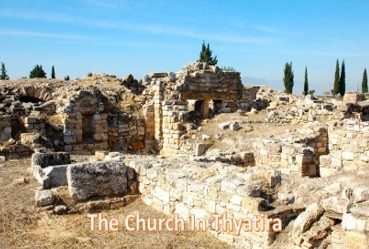
Jesus writes to the church in Thyatira, Revelation 2:18. Thyatira was a town long recognised as a garrison town, and it was the gateway to the important areas of Asia Minor.
It had no real religious significance, but it was a town of trade unions of every kind, and we know from Acts 16:14 that Lydia, the seller of purple garments, lived there.
Metalwork flourished there, especially working with bronze. We know nothing about how the church was established, but it is possible, like some of the other churches, that Paul or some of his students, according to Acts 19:10, may have established the church there. It may also be possible that Lydia went back home to establish the church.
The town of Thyatira lay in the mouth of a long valley, which connected the valleys of Hermus and the Cuicua River. Today, there is still a railway that runs down the valley. And because of the great roads of the trade routes from Syria to Pergamum, it would have had some sort of strategic importance.
There must have been some sort of settlement there because in 290 BC its name emerged in history, and it was discovered as a military centre. If Thyatira fell, Pergamum lay open to attack. There was no hill to erect a lookout point, and this resulted in a town being fated to fight, be knocked down and built up again.
It was a great commercial centre because of its roads, and the valley brought trade from all over the world, and it was most famous for its wool trade and the dyeing industry.
Purple dye was very expensive, and it came from a little shellfish called a Murex. The dye was extracted from the throat. The Roman writer Pliny said that 1lb of purple dye cost around £100, and so Lydia must have been a wealthy woman, dealing in one of the costliest substances of the ancient world, Acts 16:14.
Thyatira was the centre for temples of Artemis and Apollo, but they were not especially famous. It’s interesting that though this was the smallest of the churches addressed in the book of Revelation, it’s the longest letter written.
Straight away, Jesus introduces Himself as the Son of God, Revelation 2:18, which means that He is the Saving One. He describes Himself as One who has eyes like blazing fire, Revelation 2:18 / Revelation 1:14 / Revelation 19:12, which means that He is the searching One, Daniel 10:6.
He says He has feet like burnished bronze, Revelation 2:18 / Revelation 1:15, which is symbolic of judgment, Daniel 10:6 / Exodus 27:1-6 / Numbers 21:4-9.
Like we have seen in all the letters we’ve looked at so far, and like we will see in the letters to come, He knows what’s going on in each church, Revelation 2:19. Here is a congregation who were very active in doing good. Here is a congregation that is very loving in seeking one another’s highest good.
Here is a congregation that had confidence in their faith and was motivated by their faith, Revelation 2:19. Here is a congregation that is very active in their service for the Lord and each other.
They were very good in areas of benevolence; they took care of the poor and needy among themselves and around them, Revelation 2:19. They were a very patient church, Revelation 2:19, even in the midst of trials and sufferings.
And they were a church that was doing more now than they ever had, Revelation 2:19. They were making progress as a church; individually, they were growing in Christ, and non-Christians would certainly know they were Christians.
Jesus acknowledges that there’s a problem: ‘you’re too patient, and you’re too gentle in love with certain people.’ Jesus says your patience and love have led you to become tolerant of this woman called Jezebel, Revelation 2:20. Jezebel followed a similar line to that of the Nicolaitans, Revelation 2:15, and the Baalamites, Revelation 2:14, as we saw in the earlier letters.
And we can imagine some Christians saying, ‘What’s wrong with being a part of a trade union and attending the feasts which offered sacrifices unto the gods?’ It’s harmless, they would declare, especially as Paul wrote in 1 Corinthians 10, when you know that an idol is nothing. So, who is this, Jezebel? Well, there are three possibilities.
1. She is called that woman Jezebel, Revelation 2:20, and in Greek her name means wife, although we can’t be sure.
Some people believe that she was the wife of one of the elders and that she was a productive source of trouble, undoing all the work her husband did.
2. It has also been suggested that she is to be identified with the famous Oracle called the Sambathe.
It is possible that Sambathe may have been a Jewess. It was said that she was a Jewess who tried to destroy the Christians.
3. Some believe it was Lydia who found Christianity clashing with her business.
She wanted the church to compromise and attend some heathen festivals.
The original Jezebel was the daughter of the King of Sidon, and Ahab, the king of Israel, had taken her for his wife, 1 Kings 16:3. Her sin was that she brought her own gods to Israel, namely Baal and Astarte.
She obviously claimed to be one of God’s people; after all, she calls herself a prophet, Revelation 2:20. The problem here was that Jezebel was seducing the Christians from the worship of the true God and was teaching them to eat things offered to idols and commit fornication, Revelation 2:20, just as her predecessor had corrupted Israel, Numbers 31:13-16.
In other words, whoever this lying woman was, she was making the church suffer. Jesus is telling us that if we are too patient with people and too loving of people because we don’t want to upset them, then a congregation can die of compromises, Revelation 2:20.
Now, is it possible to be too patient with someone? Is it possible to be too loving to someone? If you take a moment to read 2 John, and if you read between the lines, especially 2 John 10-11, you will read about an elect lady who was so kind and so gentle and so loving that she had to be warned against welcoming false teachers into her home. And so, it is possible to be too patient and too loving.
Concerning Jezebel, Jesus’ patience and love for her are running out. Jesus says He has given Jezebel time to repent, but she isn’t willing to, Revelation 2:21.
Remember, she claimed to be one of God’s people and calls herself a prophet, Revelation 2:20. But she is actively involved in sexual immorality and won’t repent, 2 Corinthians 7:10.
Jezebel refuses to repent, and because of her unwillingness to do so, Jesus goes on to declare her sentence. Jesus says, ‘I will cast Jezebel on a bed of suffering,’ Revelation 2:22, which, figuratively speaking, means she will be afflicted with disease.
Remembering that she is practising sexual immorality, and the chances are this might be some kind of sexually transmitted disease, but again, we don’t know for sure.
Jesus also says that he ‘will make those who commit adultery with her suffer intensely,’ Revelation 2:22. In other words, anyone who is participating with Jezebel in her sexually immoral living will also suffer the consequences with her.
And if they don’t stop participating in Jezebel’s ways, they will die spiritually for eternity, Revelation 2:22. But why? Why did Jesus want to discipline them? Well, to put it simply, the Lord was going to make an example of them to teach others what happens when truth is compromised and sin is tolerated.
Clarke, in his commentary, says the following concerning ‘I will strike her children dead’, Revelation 2:22.
‘That is, I will certainly destroy her offspring and memory, and thereby ruin her designs. Jezebel’s two sons, being both kings were both slain; and after that, all the seventy sons of Ahab; 2 Kings 10:1; in all which the hand of God was very visible. In the same manner God predicts the destruction of the heretics and heresies referred to. Revelation 2:16.’
Notice what Jesus says here: he’s not disciplining them just for the church in Thyatira’s benefit, but for all the churches’ benefit, Revelation 2:23. The One with the eyes like fire, Revelation 1:14, fire like a furnace, Revelation 19:12, fire like that in the forge used by the metal workers of Thyatira.
Jesus, with such eyes, sees all. The searing look burns its way through all appearances. It lights up the dark places, and it sees down into the very heart, Revelation 2:23.
We can deceive many people and even ourselves at times, but we cannot fool or deceive God, Galatians 6:8-9. God knows our minds’ innermost thoughts and feelings, and He knows our hearts’ desires. Jesus is going to repay each of them according to their deeds, Revelation 2:23.
The Lord, who knows all things, was going to make an example of those who are participating in Jezebel’s sexual immorality to teach other churches what happens when truth is compromised and sin is tolerated.
The church in Thyatira was tolerating this false prophet called Jezebel. She was a false teacher who was encouraging the members of this church to commit fortification which would ultimately lead them away from Christ.
Whoever she was, she was working from within the church. She was teaching immorality as a practice of Christianity, teaching that it was okay to eat meat offered to idols.
Remember that for many people, being a Christian involve exclusion from many social activities, economic opportunities, possibly even buying meat, and family ties.
She was likely teaching that when you become a Christian, you don’t need to give up all these things because God would not expect you to. She would teach that fornication was okay because it was practised in idolatrous worship. And so, by her attitude and life, she was teaching rebellion against God’s will by her active campaign to convert others to her will.
False teachers don’t come in with a sign on their heads, saying, ‘I’m a false teacher!’ They take their time, they make close friendships within a congregation, and slowly but surely begin to preach and teach their own ideologies, 2 Peter 2:1-2.
Jesus has dealt with Jezebel and dealt with those who are involved in her practises, but what about those who aren’t involved and remain true to Jesus?
To the faithful saints in Thyatira, the faithful saints who don’t learn or even listen to her teaching. To the faithful who don’t learn or listen to her teaching on Satan’s so-called deep secrets, Revelation 2:24.
Barnes, in his commentary, says the following concerning ‘Satan’s so-called deep secrets’, Revelation 2:24.
‘The allusion here is not to any trials or sufferings that Satan might bring upon anyone, or to any temptations of which he might be the author, but to his profound art in inculcating error and leading people astray. There are doctrines of error, and arguments for sin, to originate which seems to lie beyond the power of people, and which would appear almost to have exhausted the talent of Satan himself.’
To the saints who had not delved into her wickedness, Revelation 2:24, Jesus says, ‘He’s not going to impose any other burden on them, but they should hold on until He comes,’ Revelation 2:25.
To you and me, those words may not mean much, but to the citizens of Thyatira, they carried some weight. When this city was being threatened by an attack, they would have to try to hold off the enemy until the city of Pergamum was ready. Thyatira was a weak city, but it had to make the best of it. And so, Jesus says to these weak saints, try to live courageously until He comes, Revelation 2:25.
Our God knows all things, and He sees all things, 1 Corinthians 2:9-10, and when Jesus writes to the church in Thyatira, He sees His followers and understands what’s happening within that church. And so, because He sees and knows each of them individually, He knows that the faithful need some sort of reassurance concerning their destiny.
To those who are victorious and continue to do His will until death, he will give authority over the nations, Revelation 2:26. The authority Jesus offers the overcomer is the authority that He had already received from His Father, Revelation 2:27 / Matthew 28:18.
But what kind of authority is this? When is this kind of authority going to be given? We are already enjoying this authority. As Christians, we are fellow heirs with Christ right now, Romans 8:17 / 2 Timothy 2:10-12.
Paul says the world and all things already belong to the Christian right now, 1 Corinthians 3:21-23. John says that the prayers of the saints affect the world and cause God to send judgments on it, Revelation 8:3-5.
The very fact that Paul and Peter urge us to pray for kings and all that are in authority proves that the prayers of the saints affect world leaders, 1 Timothy 2:1-6 / 2 Peter 3:3-4 / 2 Peter 3:8-13.
We have already received that authority because we are at present reigning with Christ, and we use it all the time in our prayers to God, Romans 5:17. In other words, we not only share in Christ’s sufferings but we also share in Christ’s judgment.
When Jesus is talking about ruling them with an iron sceptre, Revelation 2:27 / Psalm 2:9, we need to understand that every time the words ‘rule with an iron sceptre’ are mentioned, they always mean shepherd. The rod of iron is said by some to be a staff with an iron top since this was often the weapon of a shepherd.
Barnes, in his commentary, says the following concerning Revelation 2:27 / Psalm 2:9.
‘The allusion in the Psalm, Psalm 2:9, is to the Messiah as reigning triumphant over the nations, or subduing them under him; and the idea here, as in the previous verse, is, that his redeemed people will be associated with him in this dominion. To rule with a scepter of iron, is not to rule with a harsh and tyrannical sway, but with power that is firm and invincible. It denotes a government of strength, or one that cannot be successfully opposed; one in which the subjects are effectually subdued.’
Notice that the weapon is not a sword; that’s because the metalworkers in Thyatira would quickly grasp the meaning of the word iron. And the potters would quickly grasp the meaning of the broken pieces of pottery, Revelation 2:27 / Psalm 2:9.
Ramsey, in his commentary, says the following.
‘At this time Rome was the only Power on earth that exercised authority over the nations, and ruled them with a rod of iron, and smashed them like potsherds. But the Christian, victorious through death, will be stronger than Rome and conquer Rome.’
Jesus is not through comforting the faithful. What comes to your mind when you think of the morning star? Revelation 2:28. You may be forgiven for thinking that the morning star is the guarantee that the night will end. If I were to say to you, I pray we all receive the morning star, what would you think?
You may think this is a little strange, but actually, it isn’t as strange as you think. Jesus is the morning star; that’s what He calls Himself, Revelation 22:16. Peter says the day star arises in our hearts and so floods us with light, 2 Peter 1:19.
Don’t misunderstand me here; this promise doesn’t mean we don’t already have Jesus because we do. John is speaking in terms of having a new appreciation of Jesus.
Paul speaks of the Galatians needing Christ to be formed in them again, Galatians 4:19. Some of the Galatians had gone from Christ, but many had not. It was as if they had to come to know Jesus all over again.
The faithful Christians in Thyatira had the morning star, and faithfulness unto victory would see them gaining a deeper and more intimate relationship with their Saviour. This would be true if they were faithful until they saw the upcoming threat pass, and it would also be true if they died in their faithfulness.
Lenski, in his commentary, says the following.
‘In the following three letters, this admonition is placed at the end instead of at the beginning, thus dividing the seven into two groups of three and four; but, ‘We are unable to say just why they are so divided.’
We have to listen carefully to what the Spirit says, Revelation 2:29. We must listen carefully to everything which is being taught in our assemblies. Yes, we may be a living, loving, steadfast, working church, but we need to be careful that that isn’t only on the surface.
The Lord is concerned with the heart, and He tells us if we are faithful, do what we need to do and hold fast, then because of our faithfulness, victory will be ours.
If we continue to make Christ our own, He will help us fall in love with Him all over again. If we continue to follow His way and do what He says, we will enjoy eternal life with Him, Matthew 7:24-27 / John 14:15. The only burden Jesus puts on us is to be faithful, which is no real burden at all.