
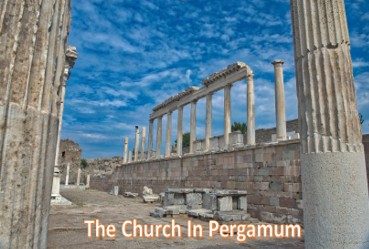
Pergamum was the capital of the Roman Province of Asia. It was a royal city, the grandest city of its time, and it was the cultural city of Asia. When we think of Pergamum, we think about the University of Asia Minor, with its huge and famous library.
Its library of over 200,000 parchment rolls was surpassed only by Alexandria, and we know that parchment was actually invented here. They gloried in their knowledge and culture; it was a city of fashion. It was one of the great religious centres in the eastern world; it was the centre of emperor worship.
Being the Roman capital of Asia and the centre of emperor worship explains the reason for much of the persecution and death of Christians during its time. Because it was located inland and on a rocky hill, this prevented it from becoming a commercial centre.
And so there it sat, like a throne, on top of a hill, surveying the valley around it; it was a throne indeed. But who sat on that throne? Well, Rome did. Pergamum was the seat of the state religion; it was where the original Augustan Temple was built.
But who else sat on the throne? Zeus did. One of the most famous altars in the world was there at Pergamum. Up on a ledge jutting out from the hillside, eight hundred feet up, sat the huge altar, from which smoke ascended endlessly from the sacrifices offered there.
Barclay, in his commentary, says the following.
‘No one could fail to see it,’ since ‘it would look like nothing so much as a great seat or throne’.
Who else sat on that throne? Asklepios did. Asclepius, the god of healing, was here. Thousands of sick people from near and far would visit the temple site. ‘Asklepios the Saviour’ was on the tongue of eager worshipers day after day.
Just like the church in Smyrna, we know nothing of its beginning, but from Acts 19:10, we can say that it was probably Paul or some of his students who established the church there.
Just as we did with the church in Smyrna, the lessons we are going to learn are not found in its beginnings but rather in its present state, or condition, as we find it written here in Revelation.
Notice that Jesus is the One who has the ‘doubled-edged sword,’ Revelation 2:12. It’s not the sword of the Spirit, as we usually understand it to mean; it’s not the word of God like Paul uses it in Ephesians 6:17. This is the Greek word ‘rhomphaia’, and it means a weapon of war and judgement, and we see it being used in Revelation 19:11-16.
It is the sign of authority, and if you possessed this sword, that meant you had the right to use it. The Romans carried a short broadsword, and it had a distinct curved sabre-type blade. When the Romans were given governing powers, they were given the power to inflict capital punishment; this was called ‘the right of the sword.’
But who then had the power of life and death? Asklepios, their god of healing? Who was supposed to be able to raise the dead or kill the living? Zeus, the supreme god of the Greek world? No!
Was it the Romans? John 19:10-11. The Roman governors were divided into two classes: those who had the right to the sword and those who did not. In other words, Rome had the power of life over death; others didn’t.
Here, Jesus says that He has the right to the sword; He has the power of life and death, and He has the power to judge and the power to carry it out, Revelation 2:12.
This again reminds us that we should never be afraid of anyone who tries to persecute us for being Christians, but we should always be afraid of the One who made it possible for us to become Christians in the first place, Matthew 10:28.
Jesus knows this church as He does the others; He knows each of us individually, and He knows what’s happening in His church. But what does He know about the church in Pergamum?
Jesus knows where you and I live. He knows our address and postcode, Acts 10:5-6. The Christians at Pergamum had a permanent earthly dwelling, and it should be encouraging for us to know that the Lord knows our address, even to the street. And although the Christians were very active in Pergamum, Satan was very active too.
And if I learn anything from this, it’s simply this: it is possible for Christians to be Christians where Satan is strongest. Jesus knows where everyone lives, but He also knows where Satan lives. Pergamum is where Satan’s throne is, Revelation 2:13. In other words, this was a church in difficulty because this was where Satan was politically active.
That word, ‘throne,’ is the Greek word ‘thronos’, which basically means a seat for a royal king who has power. In other words, anyone who sits on the throne holds dominion or exercises authority.
The idea is that this is a city where Satan rules, or the city ruled by Satan, and he is influencing everything within it. We can see that Satan influenced everything because there was pagan worship, the worship of Asclepius, the god of healing and medicine, emperor worship, and the persecution of Christians.
But despite all the persecution and evil which was happening around them, they remained true to Jesus, Revelation 2:13. And sometimes that faithfulness to Jesus meant death.
We don’t know anything about this person named Antipas, but we do know that he was faithful even in death, Revelation 2:13. History says nothing about him, but legend says that he was roasted to death; he was never ashamed to die a Christian.
He witnessed for Christ at Pergamum, and he died for the cause. And won’t it be wonderful when we die to have the eternal pleasure of fellowship with this unknown hero?
And so, this church, which was caught up in a whole world of different religions and persecuted time and time again, held on to their faith; they stayed true to the name of Jesus, Revelation 2:13 / Acts 4:12 / Acts 5:41 / Matthew 10:2.
These Christians were like you and me; they were baptised in the Name of Jesus, Acts 2:38. Baptised into the name of the Father, Son and Holy Spirit, Matthew 28:19-20.
In other words, our journey began in the Name of Jesus; we became Jesus’ possessions, and just like these Christians, we too should never give up what belongs to Jesus, and that is our souls.
The Christians in Pergamum hung on in there despite the temptations, despite the persecution. And so, after the Lord makes them aware of the things that were right, He then brings to their attention the things that were not right.
One of the saddest words in the English language is the word ‘but’, and we use it all the time, don’t we? I love you, but!’ ‘I loved the meal, but!’ ‘I enjoyed the worship, but!’ Jesus says, ‘I know where you live and I know the temptations and persecution you are facing, and I’m so proud of you for hanging on in there, but!’
Jesus is practising what He preached, Matthew 18:15, and He is being honest with them; He is being gentle with them, like we should be when someone is involved in something they shouldn’t be, Galatians 6:1.
Jesus says there were some in the church who were trying to teach others to sin. They were encouraging others to eat sacrificed meat and encouraging others to commit fornication, Revelation 2:14.
There were some who held the teaching of Balaam, Revelation 2:14, but let me ask you: why should Jesus reprimand the church because ‘some’ hold this teaching? Well, simply because there must have been some kind of unlawful silence by the church in regard to the matter, there must have been a lack of discipline.
Paul rebukes the Corinthians for not disciplining the ungodly man in their congregation, 1 Corinthians 5:1-13, but this congregation weren’t obviously rebuking anyone for holding on to this teaching. But what is the teaching of Balaam?
Remember, Balaam wasn’t wrong in everything; he wanted to die the death of the righteous. He knew, by the word of God, what Israel would do to Moab and the rest. But he also loved gain, and he urged on idolatry mingled with fornication.
Baalism was a compromise of morals, and for people in this city to eat things sacrificed to idols meant engaging in the feasting and various other wicked things of the wicked idolatrous temples, including fornication, Revelation 2:14.
In other words, the teaching or the doctrine of Balaam was a perversion of the Christian doctrine of liberty, Galatians 5:13. Peter talks about the way of Balaam in 2 Peter 2:10-15. He says the way of Balaam is really the way of covetousness and refers to anyone who hires themselves out to do religious work merely for personal gain.
It’s the selling of our spiritual gifts for personal gain out of covetousness. Jude tells us the error of Balaam in Jude 11. Balaam thought that he could get God to curse His people and bypass His covenant promises because of their evil.
Seeing their evil, Balaam supposed that a righteous God must curse Israel, but he was blind to God’s faithfulness to His promises. And so, since Balaam found out he could not curse Israel, he realised he could cause them to corrupt themselves by getting them to marry the beautiful women of Moab, Numbers 25:1-3.
Picture the scene: these women came into the camp of Israel and caught the eyes of the men of Israel. They invited them to their sacrifices full of immorality and idolatry, and before you know it, the men are eating at the tables of false gods, sleeping in the beds of pagan women, and bowing themselves down to worthless idols.
But did this really happen? Yes, it did, Numbers 31:13-16. In other words, Balaam was the first person to introduce the doctrine of ‘once saved, always saved’. Jesus says the church in Pergamum was tolerant of compromise, and they had become compromisers.
Baalism taught them to go out among those who practice idolatry and just get along with them. In other words, he wanted God’s people to compromise for practical reasons.
We need to understand that coming out of idolatry often causes problems. A great part of social life was the idol feasts, and so, because of this, many Christians often lost their jobs, trade, friends, and family. And so, to a degree, we can see why they may want to compromise.
You can imagine that these teachers were encouraging some Christians to attend some feasts, just eat a little meat, and just burn a little incense. Trying to convince others that owning an idol is nothing, after all; a man must live and feed his family.
You can imagine them asking vulnerable Christians, ‘How can we defeat Satan unless we know what Satan is doing?’ And before you know what’s happening, they became tolerant of evil, idols and fornication, 1 Corinthians 8-10.
The teaching of Balaam wasn’t the only false teaching which was happening in Pergamum; they also had the problem that the church in Ephesus had with ‘some that hold the teaching of the Nicolaitans,’ Revelation 2:15.
Remember what Revelation 2:6 says, “You hate the practices of the Nicolaitans, which I also hate.” Do you see the difference? What had only been the practices in the church at Ephesus have now become doctrine in the church in Pergamum.
It never ceases to amaze me how quickly a tradition or a practice becomes doctrine. We don’t know what the doctrine of the Nicolaitans was, so we must take into consideration the background context.
In the context of Revelation 2:6, we see in Ephesus that they came from within the church; they were bad people who were trying to improve and modernise Christians.
In the context of Revelation 2:15, we see in Pergamum that they were proud and they were trying to get Christians to conform to worldly standards, adjusting their Christianity to the world, advocating loose living.
In the context of Thyatira in Revelation 2:20, we see similar teaching, where they say evil is good and Christians need to know the deep things of Satan. Do you see the real problem Jesus has with this doctrine?
He says there are more serious problems that He sees: through the Nicolaitans, the world was changing the church, instead of the church changing the world, Matthew 5:13-16 / 1 John 2:15.
The church was not aware of the dangers and the results of their actions and their compromising attitude. And so, Jesus says to them, ‘You are tolerant in three areas.’
1. They are tolerant of the teachings of Balaam.
In other words, they were practising compromise; they were practising ‘once saved, always saved’.
2. He tells them they are tolerant of the teaching of the Nicolaitans.
In other words, they were the compromisers in the practice of evil itself.
3. And finally, they were tolerant of a lack of disciplinary action.
They should have dealt with the false teaching quickly and properly.
The call to repentance did not come to the false teachers but to the church, and Jesus tells this church to repent of its worldly ways, Revelation 2:16. In other words, there were some changes which had to be made; they had to change their attitude and become intolerant of compromise. They had to change their conduct because of their acceptance of their wrong way of life.
And please don’t tell me that Jesus never gets mad, because He does. He’s not talking about His final coming; He’s talking about coming in judgment against these ungodly sects, Revelation 2:16.
Remember that Jesus says that He has ‘the right to the sword,’ Revelation 2:12. He has the power and authority to exercise judgment. And so, what He is saying is that the church needs to make some changes too or else they too will suffer in His coming, Revelation 2:16.
Jesus says, ‘Are you listening? Do you hear and understand what the Spirit is saying?’ Revelation 2:17. He says, ‘Repent, listen carefully, remain faithful and die faithfully’, and He says, ‘If you do these things, you will be victorious, and you will be given some of the hidden manna,’ Revelation 2:17.
What is this hidden manna? Well, the first mention of manna is found in Exodus 16:4, where we find that manna was the food God provided to the Israelites when they wandered for forty years in the desert.
What else do we know about it? According to Exodus 16:31, we know “It was white like coriander seed and tasted like wafers made with honey.” And if you remember, according to Exodus 16:31-32, God wanted some manna saved and preserved for future generations to remind them of the Lord’s covenant of faithfulness, and so Moses placed a portion of manna in the Ark of the Covenant, Exodus 16:32-34.
Somewhere between the time Moses first placed it in the Ark and the dedication of Solomon’s Temple, the manna disappeared along with Aaron’s rod, 1 Kings 8:9. So, where did the manna go? Did God or an angel remove it and take it back to heaven?
We simply don’t know; however, some Jewish legends claim that Jeremiah hid it before the Babylonian captivity and that it would remain there until the Messiah showed up.
That’s one question we don’t have the answer to, but we do have the answer to this question. Who is this manna? The manna is Jesus Himself, who claimed to be the true manna, the real manna which came out of heaven, John 6:31-65.
Paul says that Christians were sustained by an invisible source, hidden manna, Colossians 3:1-4. What manna was to the Israelites, Jesus was to the Christians and much more.
The saints were already feeding on that hidden manna, of course, but the promise assures them of continued sustenance from Jesus, whatever the course of events.
Jesus says that these Christians couldn’t partake of the heathen feasts, but they could feed on something better. In other words, if you have to give up earthly pleasures, heavenly joys will be yours.
What else were the Christians in Pergamum promised if they repented, listened carefully, remained faithful, and died faithfully? Jesus says they will be given a ‘white stone with a new name written on it,’ Revelation 2:17.
The colour white symbolises innocence; it stands for purity, justice, nobility, victory, and joy, and so Jesus recognises their innocence. In Biblical times, white stones were given to people who were tried and acquitted.
They were given to a slave freed with citizenship. They were given to an athlete overcoming opposition. They were given to warriors coming back victorious. They were given to clients as being worthy of the privilege of sharing freely in their master’s abundance.
All these declare what Christians have and what they will receive if they remain faithful. Then there was the white stone that friends shared with each other, which guaranteed a warm reception anytime and anyplace they met.
Jesus says it will have a “new name written on it and known only to the one who receives it,” Revelation 2:17. The idea behind a new name indicates a new relationship, new hopes, and triumphs, and only the owner of the stone would know the name written on the stone.
In the Bible, a name was very important; you can see this in the many places where the name spoke of the events surrounding the birth of a child. You can see it in the many cases where names were changed to indicate a change in the circumstances or status of the one renamed. For example, Abram becomes Abraham, Genesis 17:1-5, and Jacob becomes Israel, Genesis 32:22-31. Simon becomes Peter, John 1:42, etc.
A ‘new name’ means a new relationship or status into which the child of God entered by virtue of some new experience with his Master, Isaiah 62:2 / Acts 11:26. But it was ‘his’ name, and nobody else would know it, Revelation 2:17. It was his trial, and it was his experience with God; it was his victory.
In other words, it’s personal to the individual Christian. The Lord knows where we are and what we are doing. Antipas was the example for the Christians in Pergamum, Revelation 2:13, and he is still our example today.
He certainly thought it was all worth it. Jesus says He wants faithfulness from every Christian, and that’s because it will only be the faithful who will be rewarded, Matthew 25:23.