
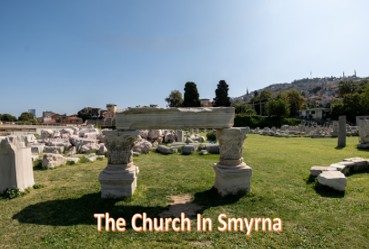
We know what the church in Ephesus was like and how it started, but concerning the church in Smyrna, we know absolutely nothing about its beginnings.
In all probability, the church in Smyrna was established around 55-56 A.D. after or during Paul’s third missionary journey. It was possibly Paul who established this church, but it would seem more likely to have been established by some of his students from the lecture hall of Tyrannus, as Acts 19:8-10 tells us.
Because we don’t know anything about its beginnings, we need to take some lessons from its present state. This city, which was famous for its loyalty and faithfulness, became the host of a church commended by the Lord for the same faithfulness.
We find people with convictions even before they became Christians. The city of Smyrna was called the ‘Glory of Asia.’ It was proud Smyrna, deeply religious Smyrna, heathen Smyrna. Smyrna was the centre of Caesar worship and the leading city of emperor worship for many years.
Smyrna built a shrine to ‘Roma’ as early as 195 B.C., and as the Republic spread, the worship of Rome became more widespread. According to the historian Balsdon, in July 44, four months after the assassination of Julius Caesar, ‘an unexpected comet appeared in the sky. It was a prodigy, accepted by the people as evidence that Julius Caesar was now in heaven, a god, Divus Julius.’
And since the spirit of the empire was reflected in the leaders, it was easy enough for people to begin to believe the supreme leaders were the embodiment of the spirit of the empire.
The emperors began to be viewed with awe, and one Roman writer tells us, ‘from the time of Augustus a new form of Roman cult makes its appearance, the worship of the emperor.’ He goes on to say that in the east, ‘the line drawn between God and man was not too distinctly drawn’.
It wasn’t this way in Rome; the Romans were too stubborn for such nonsense. When Augustus accepted the name, there immediately sprang up a cult around him. Herod the Great, for example, built a temple and shrine to him, but no emperor, however, was consecrated to godhood until after his death.
And as time went by, a priesthood was formed to serve in the emperor worship and in the process of time, it became necessary that the citizens or subjects show their loyalty to the state by the worship of the emperor. And so, Smyrna won a contest, a contest to see who would erect a shrine to the deified Tiberius.
The Christians lived in a heathen town which embodied not only the eastern gods but also the gods of Rome. The Roman gods were of the more dangerous kind; their servants could bring down punishment upon the heads of the Christians for not submitting to those gods.
But Smyrna also has Jews, lots of them, hostile and vocal Jews, Jews of the sort who would take the lead in the execution of Polycarp, who was a disciple of the apostle John. They were not faithful Jews but the sort who lived in the days of Antiochus 4th Epiphanes, the kind that didn’t worship God but worshipped survival.
The city of Smyrna was about thirty-five miles from Ephesus, and it was a city of about 100,000 people in John’s day. It was called the ‘crown city’ because it was surrounded by hills that resembled a crown. It possessed a safe harbour where ships from all over the world came to buy and sell goods.
Several things made this a special city in its day; for example, the production of myrrh. The substance came from a shrub-like tree; when the leaves were crushed, a very fragrant odour came from them.
Myrrh was used as a fragrance by the living and as an embalming agent for the dead. And if you remember, myrrh is mentioned in association with the life and ministry of the Lord, Matthew 2:11 / Mark 15:23 / John 19:39.
The word ‘myrrh’ means bitter, and so it came to be associated with suffering and death. And so, straight away, we can see that Smyrna was a planned city, a free city, and a beautiful, wealthy pagan city.
The leading god of Smyrna was ‘Dionysus’, who was the god of wine. Smyrna was famous for its vines; each year, the death and resurrection of ‘Dionysus’ was acted out in public plays. But the Christians knew the difference between myth and solid, indisputable historical fact.
Jesus identifies Himself as ‘the first and the last’, and we should be familiar with that title because it’s a name which was applied to God in the Old Testament, Isaiah 44:6 / Revelation 1:4 / Revelation 1:17 / Revelation 2:8 / Revelation 19:6 / Revelation 21:6 / Revelation 22:13.
And so, straight away John, reminds these Christians and says, ‘Come what will, Christ is with us,’ Isaiah 9:6-7. Smyrna, which claimed to be first in the world, John assures the saints there that Christ is first and last, Revelation 2:8, and there is no competition, and so there is no room for human pride.
Now those words ‘who died and came to life again’, Revelation 2:8, should read ‘became dead and came back to life again’. So, what is John talking about? He’s talking about the resurrection of Jesus.
He says the risen Christ is He who experienced death, and who passed into death, through death and out of death, and who came to life again in the triumphant event of the resurrection, overcoming death, and who is alive forevermore, Revelation 1:18.
Jesus experienced the very worst that life had to offer, but He has conquered the worst that life can do. He experienced death so that we don’t need to be afraid of it anymore, 1 Corinthians 15:55.
And it’s because of this that only Jesus can demand such loyalty from His followers and be able to reward those who are loyal to Him. The church in Smyrna was a crushed congregation.
Don’t underestimate that word ‘afflictions’, Revelation 2:9. He’s not saying that being a Christian in Smyrna was a headache. He’s not saying it’s an inconvenience. He’s saying that because you’re Christians, you’re under all sorts of pressure, grinding, crushing pressure.
Remember, the Roman Emperor Domitian was ruling at this time, so they were experiencing the crushing load of the Roman forces trying to destroy Christianity.
Don’t underestimate that word ‘poverty’ either, Revelation 2:9. This is not just being poor; it means they were absolutely destitute. In other words, they were poor and unable to help themselves.
They were poor, perhaps, because they were from a poorer class to begin with, but most likely because of robbery, job rejection, and business boycott as forms of persecution. But despite the already existing pressure from Roman worship, the slander of the Jews, and their extreme poverty, these lovely people were faithful.
Jesus says to these faithful Christians in Smyrna, ‘You guys aren’t poor; you are all tycoons.’ You guys are filthy rich, Revelation 2:9. In other words, what these Christians lacked in the world, God would make up for them in heaven, Matthew 6:24.
Should we be intimidated by others when they have a go at us for being Christians? It does not always pay to be a Christian, but it is better after you die. When times are hard, and you become poor, be faithful. Why?
James says that God has a currency which is eternal riches, and so be faithful when poverty strikes, James 2:5. Paul says, don’t worry when times get hard, for the Lord knows who are His, 2 Timothy 2:19-21.
The Lord knows each and every one of us intimately, Luke 12:7, and He knows everything He needs to know about the church in Smyrna. He knows they are facing persecution; He knows they are facing poverty.
Think about this in practical terms: because they were Christians, they were denied jobs because of their relationship with Jesus Christ. And Jesus knows this, and He knows that they faced the prospect of being sent to prison.
And if all that wasn’t trouble enough, he tells them that there was even more trouble ahead. But despite all the tribulation, thanks be to God, Smyrna was a consistent church.
Notice the word ‘slander’. It should be the word ‘blasphemy’ which is used, Revelation 2:9. The word ‘blasphemy’ is the Greek word ‘blasphemia’, which means reviling, but here it is used not primarily to direct blasphemy against God but reviling against believers.
In other words, Satan is tempting the saints to blaspheme in the name of Christ. Although there is no rebuke for this church, there certainly are a few words of caution.
Jesus says, ‘I know about the slander of those who say they are Jews and are not, but are a synagogue of Satan’, Revelation 2:9. Notice that word ‘say’. They ‘say’ they are Jews.
These guys wouldn’t have recognised Abraham if he had appeared wearing a name badge. This very same Jesus had spoken to an audience of Jews, and if you remember, He recognised their racial status but denied their relationship with Abraham, John 8:57-59.
The Lord doesn’t only know you and me intimately; he also knows everyone else intimately, too. My point is that these people were proud to be Jews; they were proud of their synagogues, and all the while, Jesus says that they were a synagogue, and the Devil dwelt in them.
Notice that this church had a positive testimony. The Lord didn’t have a rebuke for this church as He did for many of the others. And so not only did they have a positive testimony, but they also had a very powerful testimony.
How do we know that? Simply because in spite of all the wickedness which was going on around them, and in spite of all the affliction that they were put through, they remained faithful.
And so, because of this, they received comfort from Jesus Himself. Jesus comes to them as ‘The first and the Last, He that was dead and is alive,’ Revelation 2:8. He is reminding them that ‘He knows’ what they are facing because He has faced tribulation and suffering as well.
Satan was doing the tempting, but God, at the same time, is proving, testing, and trying them, Revelation 2:10. Why? Jesus doesn’t want them to lack anything; we must accept that difficulties come for a reason. They come to help us grow and become mature as Christians, James 1:2-4.
Jesus says that God will let His people suffer, 2 Timothy 3:12, but it’s not all doom and gloom because Jesus reminds us that He has overcome the world, John 16:33. They were about to feel the pressure increasing; they were about to join the long list, the long, glorious list of those who were imprisoned for righteousness’ sake.
Jesus knows His people and those who are not His, and this would include the devil himself. He tells them that ‘the devil will put some of you in prison,’ Revelation 2:10.
He tells them that not too long from now, some of you, not all of you, but some of you, will be put in prison. Now, if that isn’t frightening enough, under Domitian, if you were being put in prison, that meant that you were going there just before being put to death.
They were about to be tested for ‘ten days’, Revelation 2:10. Now, this is not literal; this is the Hebrew way of saying for a short time. Daniel, for example, was tested for ten days, Daniel 1:12-16, and Jacob was tested by Laban ten times, Genesis 31:7.
The Bible Hub says the following concerning the ten days.
‘The number ten in Scripture can represent fullness (as with the Ten Commandments or the ten plagues in Exodus). Thus, ‘ten days’ may highlight a short but complete season of testing. The number ten in biblical numerology often signifies completeness or divine order. In the context of ten days, it can represent a complete cycle of testing or a divinely appointed period for a specific purpose. This is evident in both Daniel’s dietary test and the persecution of the church in Smyrna, where the ten days serve as a complete period of trial leading to a greater revelation of God’s power and faithfulness.’
It’s not hard to see the origin of ‘testing, and you will suffer persecution for ten days,’ Revelation 2:10. By the time we get to the New Testament, it had become the expression for a period of trial by hardship.
And so, Jesus cautions them and says, ‘Don’t be afraid, but be faithful, even to the point of death’, Revelation 2:10. In other words, don’t worry about whether they kill you, because you will be at home.
When times are really tough, nothing can separate us from the love of God; persecution can’t, and death can’t, Romans 8:34-39. Jesus is looking for total, lifelong commitment to Him in faith and, with such faithfulness, secures the ‘crown of life,’ Revelation 2:10 / James 1:12.
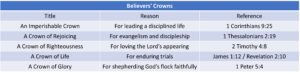
The crown was, among the Romans and Greeks, a symbol of victory and reward. The crown or wreath worn by the victors in the Olympic Games was made of leaves of the wild olive. In the Pythian Games, the crown was made of laurel. In the Nemean Games, it was made of parsley, and in the Isthmian Games, it was made of pine.
The Romans bestowed the ‘civic crown’ on anyone who saved the life of a citizen, and it was made of the leaves of the oak. But these crowns died because they were made of leaves and things. This crown, the crown which Jesus gives, lasts. Why? Because it is made of life, Revelation 2:10 / 1 Peter 5:4.
Another wonderful lesson that we can learn from the Book of Revelation is that persecution can have great spiritual value, Revelation 2:10. Jesus said of certain Christians in Revelation 2:10 that they would have to endure persecution for a period of time, but if they were faithful ‘even unto death,’ then He would give them ‘the crown of life.’
Through their persecution, these people learned great spiritual lessons and were forced to think about what was really important. That same lesson is true for us today as well.
When we face trials or tribulations, or when things happen to us that are difficult, we can gain spiritual wisdom and insight as we allow such things to be of benefit to us, Romans 8:28. True, we don’t often think about it like that, but that is what Scripture teaches, James 1:2-4.
Our trials can help us and can have real spiritual value; it’s as though we are being tested in the fire. Impurities that we do not need in our lives will be seen, and we can be refined by those tests, 1 Peter 1:7.
Paul said, ‘We must go through many hardships to enter the kingdom of God,’ Acts 14:22. Trials and tribulations help us see what really matters. In 2 Timothy 3:12, we are told that ‘and all who desire to live godly in Christ Jesus will suffer persecution.’
I hope that these main points will give us a better insight into the Book of Revelation by helping us understand to whom it was written, why it was written, and that its main application is that we must never give up, regardless of what happens to us in this life. We must be faithful to God, and in the end, we will have the hope of eternal life.
Remember, despite the fact that this letter and the others are written to a specific church, it applies equally to the other churches and, in fact, to all the churches. All the churches are to hear what the Spirit has to say, Revelation 2:11.
The expression ‘second death,’ Revelation 2:11, is found three other times in the book of Revelation, Revelation 20:6 / Revelation 20:14 / Revelation 21:8. J.H. Thayer defined the ‘second death’ as ‘the miserable state of the wicked dead in hell’.
This condition is characterised as the second death because it follows physical death. It is designated as death because it is the terminal separation from the Lord, Matthew 25:41 / 2 Thessalonians 1:9.
The first death speaks about what all humans will face one day, when we die naturally. What is the second death? The second death is the ultimate and eternal separation from God.
In other words, Jesus is saying to these faithful Christians in Smyrna and to us today that it’s so much better to die the first death in faithfulness to Christ than to die that second death, Revelation 2:11.
Think about it: Jesus says, because He is alive after death, Revelation 2:8 / Revelation 1:18, so it will be with the Christian; we can escape hell if we remain faithful. Jesus says, I know about all the afflictions and poverty we experience, which are only temporary.
He says, ‘Nothing will separate us from Him,’ Romans 8:35-39. In fact, Jesus says the faithful lose nothing but gain everything worth gaining, and that is Jesus Himself, Philippians 1:21.