
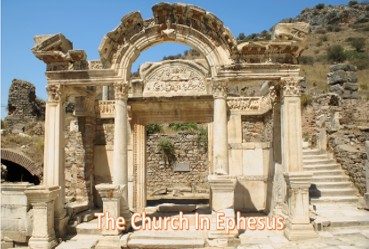
Jesus Himself is the author of this letter to the Ephesians. Ephesus was a large and important city on the west coast of Asia Minor where the apostle Paul founded a church, Acts 18:19-21. And there were a number of factors which contributed to the importance of Ephesus.
1. The first factor was economics.
Ephesus was the most favourable seaport in the province of Asia and the most important trade centre west of Tarsus.
2. Another factor was size.
Ephesus was the largest city in the province, having a population of perhaps 300,000 people.
3. A third factor was culture.
Ephesus contained a theatre that seated an estimated 25,000 people.
4. The fourth, and perhaps most significant, reason for the importance of Ephesus was religion.
The temple of Artemis or Diana, at Ephesus, is ranked as one of the Seven Wonders of the Ancient World. If you were around in Biblical times and thought of Ephesus, your mind would automatically think about the city where you would find the ‘temple of Diana.’
In Acts 19, we find in Ephesus a silversmith by the name of Demetrius who made a living out of idol making, Acts 19:24, and he was causing all sorts of trouble for Paul and the other disciples, Acts 19:25-26. And we have recorded in Acts 19:27 that Diana was loved and worshipped by people from all over the world.
The original temple of Diana crumbled into dust many centuries ago, but when it was rebuilt, it became one of the Seven Wonders of the World. And it was to this temple that Alexander the Great came too.
He wanted his name carved on one of the one hundred and twenty-seven pillars, and so he offered all the riches of his eastern campaign for the privilege, but the city fathers turned down the offer.
And so even the mightiest mortal on earth at the time couldn’t even buy the privilege to have his name on a pillar in the temple of a god. No wonder, years later, the apostle Paul would write to the Ephesian church and tell them in Ephesians 2:19-22 that they were the temple, not of any old god but of Almighty God Himself.
The history of Christianity at Ephesus began around A.D. 50, perhaps as a result of the efforts of Priscilla and Aquila, as we read in Acts 18:18. Paul came to Ephesus in about A.D. 52, establishing the church and staying there for at least three years, as Acts 20:31 tells us.
And it was during that time that Paul wrote 1 Corinthians and was faced with many opportunities to share the Gospel but also faced many problems, as Acts 18:23-41 tells us.
We also know that it was in Ephesus that Paul baptised believers who apparently came to know the Gospel through disciples of John the Baptist, Acts 19:1-5, and he opposed the strong influence of magic, Acts 19:11-20.
But by the time that John penned these words in Revelation 2:1-7, the church at Ephesus was busy working for the Lord but had no sincere love for Him. They had all the church programs but had no passion.
They were a busy church with great statistics, but they were a church that was drifting away from their heartfelt devotion to Christ. Ephesus was a busy church with high spiritual standards. The work had been difficult, but they had not collapsed.
Looking from the outside, in every way, this church is what we would call a successful church. And from the outside, people would look in and think that this is a church that deeply loves their God.
As we get into the text, we will soon see that Christ is more concerned about what we do with Him, rather than what we do for Him. And so, to everyone else, this was a greatly successful church, but to Christ, who is now walking amongst them, this church is in the process of falling.
Notice how it begins: it is addressed to the angel of the church, but in Revelation 2:7, it is addressed to the ‘churches’. John is either telling us that churches have guardian angels who have some sort of spiritual responsibility for a church, or he is simply showing us that the angel is the personification of the church.
Kercheville, in his commentary, says the following.
‘The seven stars in Christ’s right hand are the human messengers that have come to John to receive this revelation. These human messengers represent the local church they are from and are pictured in the Lord’s powerful right hand, protected and safe. They are instructed to write the words of Christ about their churches.’
John reminds them straight away that ‘Jesus holds the seven stars in His right hand’, which is figurative language meaning the life or death of the church resides within Jesus, Revelation 1:20 / Ephesians 1:22-23. Jesus walks among the seven golden lampstands, Revelation 1:20 / Exodus 25:31-37.
Coffman, in his commentary, says the following.
‘This indicates the active, constant, and persistent energy with which Christ is concerned with the welfare of every church and every Christian.’
Remember that Ephesus was a great city for debating; everyone loved to debate with anyone about life and religion. And so, both Paul and John are both saying that Christ is the absolute authority. There is no room for debating the facts about what Jesus is about to say to this church.
Notice how Jesus begins to deal with their reputation; he begins by talking about all the things which are right with this church. They had a lot going for them, and the Lord lets them know that He has seen all the good they are doing in His Name, Hebrews 4:13.
1. He commends their service and says, ‘I know your deeds,’ Revelation 2:2.
Jesus recognises that this church, over the years since it was planted, has accomplished many great things for the glory of God. They have been working hard, and Jesus has seen their efforts.
This was no Sunday morning-only church; they were actively serving the Lord wherever and whenever they could, using their own expenses and personally sacrificing all they could for the glory of God. They had their benevolence programmes and youth programmes, and they persevered.
In other words, despite all the opposition they were receiving, they continued to work. The people in Ephesus did not appreciate these Christians or their zeal for the Lord, and they opposed them publicly and physically, Acts 18-20.
But these Christians endured the opposition and the persecution, and they continued to serve the Lord faithfully in spite of everything thrown against them. And so not only does He commend their service.
2. He also commends their separation, Revelation 2:2.
There are times when the church needs to stand for truth. These Ephesian Christians were quick to defend the truth in so many ways. John tells us in Revelation 2:6 that they rejected the works of the Nicolaitans.
Who are those guys? The Nicolaitans are identified by Irenaeus and Hippolytus, two early church fathers, as a sect which grew out of Nicolas, who is mentioned in Acts 6:5.
They were the ones who apostatised from Christ. However, they originated, they were known as perverts, with low morals, a sect that was loose-thinking and practised loose living. And thankfully, the Ephesians couldn’t bear them.
The Ephesians also exposed deceivers who claimed to be apostles, Revelation 2:2. All in all, we would say that they were morally and doctrinally approved. The Ephesians dealt with their opposition quickly and stood for what they knew was right.
And despite all the opposition and all the trials that come from being followers of the Christ they have hung in there and didn’t grow tired of it all, Revelation 2:3.
And so outwardly, the church at Ephesus looks great; the Ephesian Christians think that everything is going well, and they are doing everything they are supposed to be doing.
And people on the outside and possibly even other churches of the Lord are looking at the Ephesian church and thinking, ‘Wow, I wish we were more like that church.’
And they wish that, until the reality check comes from Jesus. After offering this church some words of commendation, Jesus now gives them some words of condemnation.
There is nothing like bursting your spiritual bubble, is there? You can’t help but almost hear the disappointment in the words of Jesus. Jesus says that while they look good on the surface, there are problems in the heart that must be dealt with.
Notice how Jesus wants them to know that this is a personal matter. It seems that Jesus is grieved by the problems He sees in this church. Jesus looks at these people whom He loves and for whom He died and tells them that they simply do not love Him as they used to, Revelation 2:4 / Matthew 22:37.
The church of Ephesus was active in the Lord’s work, but they were serving out of a sense of duty and not out of a fervent love for Him. They had become like Martha, who laboured, but not out of love, Luke 10:38-42 / 1 Corinthians 13:1-3.
The Ephesians’ first love was Jesus Himself and His church, but because they were so obsessed with being doctrinally pure, they were actually departing from loving Jesus and His brotherhood in the process. It is also possible that the Ephesian church had forsaken their first love in terms of their eagerness and joy, Jeremiah 2:2.
Remember that Jesus has not come to hurt the Ephesian church; He has come to help them. He offers words of commendation, words of condemnation, and now He is going to speak a word of correction. He’s going to tell them how they can fix what is wrong in their congregation.
There are lots of things we have to remember in this life, but here Jesus says, ‘remember’ or ‘consider how far you have fallen’. Here is a church which was flying high in its own eyes, but Jesus says, Remember how far you have fallen’, Revelation 2:5.
He wants them to remember that moment when they first came to know Him. He wants them to reflect on what He did for them. He wants them to recall all the excitement and emotion of those early days with Him.
He wants them to look back to on time when their love for Him motivated everything they did. He wants them to recognise that although they thought they were flying, they had actually fallen. If we don’t love Jesus and His people as we did before, the cure is repentance, Revelation 2:5 / 2 Corinthians 7:10.
Change your mind about it and let that change of mind result in a change of conduct. The word ‘repent’ is the Greek word ‘metanoeo’, and it means ‘a change of mind that leads to a change of action’.
But what exactly is it they have to repent of? Well, it’s quite simple. Jesus says they need to repent of their coldness and fall back in love with Him all over again, Revelation 2:5.
Notice that repentance leads to action: the Ephesian church was to do the things they first did. In other words, their good deeds were to be motivated by love again.
Remember that Jesus saw all their good deeds, but they were serving without love. But now, He says, I want you to continue in those good deeds, but with the motivation of love behind them.
He says to the church in Ephesus, ‘If they don’t repent, then He will come and remove their lampstand,’ Revelation 2:5. He’s not talking about the second coming here, because His coming totally depends on whether or not they will repent.
In other words, if they do repent, He won’t come and remove their lampstand, but if they don’t repent, He will come and remove their lampstand. If the congregation at Ephesus doesn’t remember, repent, and do something about it, then destruction will come upon them.
McGuiggan, in his commentary, says the following.
‘This coming depends upon whether or not they repent; if they repent, he will not come and remove their candlestick.’
Ignatius, who was one of the apostolic church fathers, says the following.
‘The church in Ephesus must have listened to and obeyed Jesus words for a while anyway.’
But where is the church in Ephesus now? There’s no church there now, and there hasn’t been for a long time. We can only imagine what goes through the minds of all those visitors who have been to Ephesus today.
They would say, ‘Let’s go to Ephesus, you know that place where Christians used to meet.’ And as they walk around the place, they stumble across a baptistery which is all dried up and covered in leaves. What a sad picture that is, isn’t it? Jesus visited Ephesus and removed the church; the candlestick; it’s gone, Revelation 2:5 / Matthew 23:27.
As mentioned above, the Nicolaitans are identified by Irenaeus and Hippolytus, two early church fathers, as a sect which grew out of Nicolas, who is mentioned in Acts 6:5.
They were the ones who apostatised from Christ. However, they originated, they were known as perverts, with low morals, a sect that was loose-thinking and practised loose living. And thankfully, the Ephesians couldn’t bear them.
Jesus says He hates the practices of the Nicolaitans just like the Ephesians do, Revelation 2:6. Although the phrase ‘love the sinner, hate the sin’ is nowhere found within the Scriptures, we do find the principle being taught throughout the Scriptures.
In other words, love the sinner but hate the sin; hate the deeds but love the people, John 3:16 / John 8:10-11 / Jude 1:22-23. Someone once said, ‘I love the sinner by telling them how much God hates their sin.’ It’s all about getting the balance right, Revelation 2:14-15.
In both our love for the sinner and our hate for the sin, we must be careful to act in a way that honours God, Philippians 4:5. We must also be careful to speak with gentleness and respect, 1 Peter 3:15.
Jesus uses this phrase ‘whoever has ears, let them hear’ very often: Matthew 11:15 / Matthew 13:9 / Matthew 13:43. Here, He emphasises that they must listen to the Spirit, Revelation 2:7.
One of the main words in the Book of Revelation is the word ‘victorious,’ or as other translations have it, ‘overcome.’ This word is used about eleven times in the Book of Revelation: Revelation 2:7 / Revelation 2:11 / Revelation 2:17 / Revelation 2:26 / Revelation 3:5 / Revelation 3:12 / Revelation 3:21 / Revelation 15:2 / Revelation 21:7.
In essence, when Jesus uses the word ‘victorious,’ He’s saying that if we overcome, if we refuse to give up, if we persevere, and if we endure, then we can come over and live with Him, Luke 11:22 / John 16:33. This is one of the biggest encouragements that the Book of Revelation has for each child of God.
Coffman, in his commentary, says the following concerning ‘the tree of life,’ Revelation 2:7.
‘These words regarding the ‘tree of life’ are found in Genesis 2:9 and in Revelation 22:2 / Revelation 22:4 / Revelation 22:19, thus binding the beginning and the end of the Bible together, all of which, first to last, is concerned with the recovery of that which was lost in the Fall.’
The third heaven was known as the dwelling place of God; this is God’s spiritual, eternal home. This isn’t physical and isn’t created. This third heaven is also known as ‘paradise’, Revelation 2:7, which is used in connection with ‘the third heaven.’ Paul speaks about being ‘caught up in the third heaven and caught up in paradise’ in 2 Corinthians 12:2-4.
In other words, the third heaven and paradise are the same location. And there’s no need to speculate where Paul was because John tells us that paradise is the heavenly realm of God, Revelation 2:7.
And there’s no need to speculate where Lazarus was located; he was in paradise, Luke 16:23, the heavenly realm of God. And there’s no need to speculate where Jesus and the thief on the cross were going that very day, Luke 23:43. They were both going to paradise, the heavenly realm of God. The third heaven, paradise, is the place where Paul and all Christians long to go, 2 Corinthians 5:6-8.
The book was written to first-century Christians to tell them not to give up, but Christians still suffer today. The Bible promises us that ‘everyone who wants to live a godly life in Christ Jesus will be persecuted,’ 2 Timothy 3:12.
We may well suffer, but the Book of Revelation tells us that if we overcome, if we are victorious, if we never give up, if we never bow down, and if we never allow our tribulations and troubles to overcome us, but instead we overcome them, then we can come over and live with Jesus in the heavenly realms, Ephesians 1:3 / Ephesians 2:6 / Ephesians 6:12.
We are victors in Christ, whether we live or die, Philippians 1:21. We are victors in Christ when we remain faithful in good times and hard times. And our reward for our faithfulness is the right to eat of the tree of life in heaven, Revelation 2:7.
John tells us that the tree of life answers to the water of life, Revelation 22:1-3. It is the food and the river and the drink of the saints. The tree of life stands for spiritual sustenance; it is the ‘food’ of the righteous.
It reminds us of the events in the garden when man had unbroken fellowship with God, Genesis 2:9. So, whether by life or death, here or hereafter, the victorious Christian is secure.