
Can you imagine people so evil that they could not think of anything in a good or righteous way? They had reached the bottom in morality. God was so grieved that he made a decision to wipe out mankind from the face of the earth, Genesis 6:6-7. This also included all the creatures he had created in the beginning.
There was an exception. It was Noah who “found favour in the eyes of the Lord,” Genesis 6:8. He was a “righteous man, blameless among the people of his time, and he walked with God,” Genesis 6:9.
Seemingly, he also had a great influence on his family, which included his wife, his three sons, Shem, Ham and Japheth and their wives. Interestingly, Noah was five hundred years old before he had his three sons, Genesis 5:32.
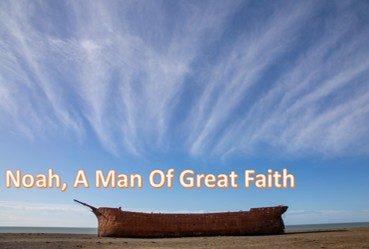
God would send a universal flood which would rise above the mountains, destroying all life, Genesis 6-9. To protect Noah and his family, God commanded Noah to build an ark. He gave specific instructions as to how it was to be built, Genesis 6:14-16.
It was to be four hundred and fifty feet long, seventy-five feet wide and forty-five feet high, Genesis 6:14-16. It was to have three floors (decks) with rooms on each floor, Genesis 6:16.
It was to be pitched within and without, Genesis 6:14. It would have a window, Genesis 6:16, which was probably an opening around the top rather than a single window, so that sufficient light would be able to get inside the ark.
A door was to be placed in the side of the ark, Genesis 6:16. After hearing all God was going to do and what He expected of Noah, his head must have been spinning.
A universal flood would have been shocking. Where would the water come from? On the third day of creation, it seems the entire surface of the earth was covered with water, and God had to gather the water into seas.
Noah does not question God about this coming catastrophic event. He accepts it by faith.
There was sufficient water for a universal flood. While the flood would be miraculous, the construction of the ark was left to Noah. He had to do his part to save his family. Building the ark would be a tremendous task.
Did Noah employ workers to help build the ark, or did he and his three sons build it? Most assume the ark was a flat-bottom boat. It would have required large timbers.
Nothing indicates that the construction of the ark was miraculous in nature. It took one hundred and twenty years of hard work, Genesis 6:3. This was a gigantic vessel. It would be like a great ocean-going vessel of today.
What if Noah had fudged on the dimension, cut back on the scale that God called for? What if he had substituted other woods in place of gopher (cypress) wood? Then there were all the people who watched it grow into a gigantic boat.
It had to be in plain view of the people. What do you suppose they were saying? Ridicule can get so bad that some give up. Not so with Noah. Peter says that Noah was a “preacher of righteousness,” 2 Peter 2:5. Considering the people’s thoughts were “evil continually”, Genesis 6:5, he did not have a single convert. How many of us would have given up?
According to 1 Peter 3:19, God was longsuffering with these people. Christ preached to them through Noah before the flood for one hundred and twenty years, yet without any response.
God’s patience will only go so far, but there comes a time when His longsuffering runs out.
The countdown gets down to seven days. In seven days, the world would undergo forty days of solid rain, Genesis 7:4. No doubt the rain came down in sheets and water spouts.
Also, the fountains of the deep (underground water) broke loose, Genesis 7:11. The ocean itself may have overrun the land. We can imagine that people began to find higher ground, with many no doubt climbing to the top of the highest mountains. Even if they did, the water rose higher than the tallest mountains, Genesis 7:19-20.
While the water saved Noah and his family, at the same time, it destroyed all those who were outside of the ark. Peter uses the ark and the waters that bore it up to illustrate how baptism saves us. Just as water saved Noah, so it saves us today as we demonstrate our faith in God’s word by being baptised.
How long were Noah and his family on the ark? Noah entered the ark seven days before it rained, Genesis 7:4 / Genesis 7:10. Rain began on the 17th day of the 2nd month of Noah’s 600th year, Genesis 7:11.
All the springs beneath the earth “burst forth” and it rained for forty days, Genesis 7:12. The waters flooded the earth for one hundred and fifty days, Genesis 7:24 / Genesis 8:3, while the ark floated. The ark came to rest on the 17th day of the 7th month, Genesis 8:4.
This may have been the little country of Armenia, which is in the northeast part of present-day Turkey. Noah removed the ark’s covering on the 1st Day of the 1st month of Noah’s 61st year, Genesis 8:13.
Noah and his family left the ark on the 27th day of the 2nd month, Genesis 8:14-10. They were in the ark for one year and seventeen days (five months floating, and seven months on the mountain) before coming out of the ark.
Many say the flood is nothing more than a myth. If we believe Genesis 1:1, “In the beginning God created the heaven and the earth”, then there is no problem in believing that God could produce a universal flood.
A universal flood would be a small event compared to creating the universe. If the flood is a myth, then we cannot trust the Bible to be truthful. This leaves us in the position of asking how then did our universe come into existence? Did something come from nothing? This is not logical.
For years, scientists believed the universe was static and had always existed. With more powerful telescopes, it was found that the universe is actually expanding. This led to the “big bang” theory, which assumed there was a terrific explosion which hurled billions of planets into space.
Even space expanded, making room for all the stars, galaxies and solar systems which originated from the explosion. But what would cause such an explosion that caused the “big bang”? Science has not yet come up with a natural explanation for the universe’s origin.
Hebrews 11:3 is still the best explanation we have. “By faith we understand that the worlds were framed by the word of God, so that the things which are seen were not made of things which are visible.” It comes down to the simple fact that the most logical explanation is that God is the true cause of the universe.