
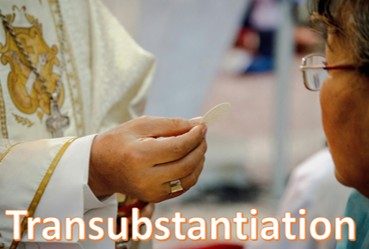
A number of months ago, I was speaking with a friend about the Lord’s Supper, and during the conversation, he revealed that he sincerely believed that the bread and the wine, after being consecrated by the priest, literally turn into the body and blood of Jesus at consumption.
We had a really good conversation about it, and even discussed what the early Church Fathers believed. However, no matter what I said concerning the subject, he was adamant that Jesus meant His words to be taken literally, hence the reason for writing this article. I’m sure you are aware that this doctrine is called ‘the doctrine of transubstantiation’.
This is defined in the Canons and Decrees of the Council of Trent as follows.
‘In the Eucharist are contained truly, really, and substantially the body and blood, together with soul and divinity of our Lord Jesus Christ, and consequently the whole Christ. The whole substance of the bread is converted into the body, and the whole substance of the wine into the blood.’
Thus, the idea is presented that, in partaking of the bread and fruit of the vine, one eats the literal body of Christ and drinks His literal blood. It is argued that when Jesus said, ‘this is my body’ and ‘this is my blood’, Matthew 26:26-28, he meant it was His literal body and blood.
The actual body suspended on Calvary and the actual blood shed at the cross. In His teaching, Jesus made frequent use of the metaphor, a comparison in which the likeness is implied rather than specifically stated.
When he said, ‘I am the door’, John 10:9, and ‘I am the vine,’ John 15:5, He obviously was using this form of speech. Likewise, when he said, ‘This is my body,’ Matthew 26:26, it is apparent that he was employing a metaphor since He stood before the disciples in the flesh.
And when he said, ‘This is my blood,’ Matthew 26:27, he could not have meant His literal blood since it was still flowing through His veins. Note also that Jesus doesn’t call it His blood in Matthew 26:29; He calls it the ‘fruit of the vine’. This should tell us He’s speaking metaphorically, not literally.
In November each year here in the UK, we celebrate what is called ‘Remembrance Sunday’, and the whole country comes together to pause to think about all those who served and died during WW1 and WW2. Note that it’s a remembrance day because those who died aren’t physically present with us anymore.
When it comes to the Supper, we are told time and time again it’s a ‘remembrance’ of Jesus, Luke 22:19 / Mark 14:22 / 1 Corinthians 11:24, because He is not physically present. The words, ‘in remembrance of me’, signify that He would not be present physically. The Lord’s Supper is a memorial and a proclamation, 1 Corinthians 11:26.
Moreover, the emblems were to serve as a memorial to Christ. A memorial stands for something, but is never the real thing itself. Were the bread and fruit of the vine the literal body and blood of our Saviour, they could not be taken in remembrance of Him, since they would then be the actual body and blood of Jesus. Therefore, the doctrine of transubstantiation violates the purpose for which the Lord’s supper is to serve.
As an outgrowth of transubstantiation, there came the teaching of the Sacrifice of the Mass. This is the theory that a priest repeats the sacrifice of Jesus on the cross each time that Mass is said. The priest’s prayer consists of asking God to make the gifts holy by sending down the Holy Spirit so that bread and wine may become the Body and Blood of Jesus Christ.
Not only is this not taught in Scripture, but the idea of a continual repetition of the death of Christ contradicts the plain teaching of the Hebrew letter, Hebrews 7:26-27. Since the sacrifice of Jesus was perfect, it need not be repeated.
The main text, which is used for ‘the doctrine of transubstantiation’, is found in John’s Gospel. At first glance, whilst reading John 6:53-56, it may come across as Jesus saying that we must literally eat His flesh and literally drink His blood. However, this is not the case as Jesus uses metaphors all the way through John’s Gospel.
When Jesus cleared the temple courts and was being challenged by the Jews, the Jews asked, ‘What sign can you show us to prove your authority to do all this?’ John 2:18. Jesus replied and said, ‘Destroy this temple, and I will raise it again in three days,’ John 2:19. Notice the reply from the Jews, ‘It has taken forty-six years to build this temple, and you are going to raise it in three days?’ John 2:20.
In other words, they thought Jesus was speaking literally, but Jesus was clearly speaking metaphorically, and we know this because John himself tells us in the next two verses, John 2:21-22.
When Jesus spoke to Nicodemus, He told him that ‘no one can see the kingdom of God unless they are born again,’ John 3:3. And what was Nicodemus’ response? He thought that Jesus was speaking literally, hence why he asks, ‘How can someone be born when they are old? Surely they cannot enter a second time into their mother’s womb to be born!’ John 3:4. And so, Jesus had to explain that He was teaching something metaphorical, not literal, John 3:5-8.
When we enter the next chapter, we find a Samaritan woman speaking with Jesus at the well. Jesus asks her to give him a drink, John 4:7, but she was stunned because she was a Samaritan and Jesus was a Jew asking her for a drink, John 4:8.
Jesus then tell her, ‘If you knew the gift of God and who it is that asks you for a drink, you would have asked him and he would have given you living water, John 4:9. She then asked Jesus where she could get this living water, John 4:10, and Jesus told her, ‘Everyone who drinks this water will be thirsty again, but whoever drinks the water I give them will never thirst. Indeed, the water I give them will become in them a spring of water welling up to eternal life,’ John 4:13-14.
Notice the woman’s response; she asks for this water so that she wouldn’t have to keep coming back to the well, John 4:15. In other words, while Jesus was speaking metaphorically, she thought Jesus was speaking literally.
When we enter John 6, after Jesus fed the five-thousand, we find Jesus saying, ‘Very truly I tell you, it is not Moses who has given you the bread from heaven, but it is my Father who gives you the true bread from heaven. For the bread of God is the bread that comes down from heaven and gives life to the world,’ John 6:32-33.
Now notice the reaction to Jesus’ words. Notice once again, they are thinking literally. ‘Sir, they said, always give us this bread,’ John 6:34. Jesus then goes on to declare that He is the Bread of Life, John 6:35. Once again, He is speaking metaphorically, not literally.
How do we know? We know because of what Jesus says next, ‘Whoever comes to me will never go hungry, and whoever believes in me will never be thirsty’, John 6:35. He’s clearly not speaking literally here because many Christians go hungry and thirsty to this day.
Jesus continues and declares, ‘I am the bread of life. Your ancestors ate the manna in the wilderness, yet they died. But here is the bread that comes down from heaven, which anyone may eat and not die. I am the living bread that came down from heaven. Whoever eats this bread will live forever. This bread is my flesh, which I will give for the life of the world,’ John 6:48-51.
Notice the reaction was just like the Jews, Nicodemus, and the woman at the well before them; the Jews thought Jesus was speaking literally. ‘Then the Jews began to argue sharply among themselves, ‘How can this man give us his flesh to eat?’ John 6:52.
And so when we come to John 6:53-56, we see that Jesus is clearly speaking metaphorically. We know this because Jesus says that the eating and drinking result in life, but the life is described as being the consequences of receiving Christ’s words, that is, His teaching, John 6:63.
Here are a few questions to ponder on. In 1 Corinthians 10:1-4, Paul speaks about their ancestors who ate bread and drank water from the Rock, who accompanied them. Is Paul speaking metaphorically, or is Christ literally ‘a Rock’ who accompanied them?
In 1 Corinthians 10:16-17, Paul speaks about the body and blood of Christ and how we are the body of Christ, the loaf. Is Paul speaking metaphorically, or are we literally ‘the loaf’?
If we grant that the bread and wine literally turn into the body or blood of Christ, my next question is, why do those who believe this disobey Jesus’ command by not drinking the wine? I’ve asked many people over the past few months concerning the Eucharist, why don’t they take the wine, or why are they not even offered the wine?
The answer always seems to be because of COVID or hygiene reasons. However, after a little research, I discovered that this practice of not allowing members to partake of the wine happened years before COVID or any hygiene reasons.
The Council of Constance in 1415 decreed that the laity should only receive Holy Communion in the form of bread (host) and explicitly forbade them from drinking the eucharistic wine (the ‘Precious Blood’). This was a significant shift from the early church practice, where both the bread and the wine were distributed to all communicants.
The other reason why members don’t take the wine is that they believe that Christ is totally present in the bread and or the wine. The Catholic church has always believed that the Eucharistic elements must consist of both bread and wine, but that Jesus Christ is equally present under each ‘species’.
In other words, He is totally present in the form of bread and totally present in the form of wine. And so, according to the Catechism, 1390, No. If one partakes of one element without the other, their communion is complete, because they have truly received Jesus Christ, whole and entire. I’m sure you noted that Jesus didn’t teach this anywhere in the Scriptures; Christ commanded us to take the bread and the wine, Matthew 26:26-28, not one or the other.
Something else I discovered was that the Council of Trent declares that the Mass is offered for sins and punishments not only for the living but also for the dead who may not yet be fully purified. This is speaking about those in ‘purgatory.’ Once again, I’m sure you noted that Jesus taught no such thing in the Scriptures.
When we approach the Scriptures on any subject, we must always be consistent with the text because it is the text itself which defines what is metaphorical or literal. We can appeal to the early church and the Church Fathers, but they aren’t our authority; the Bible is.
We must decide for ourselves whether we are going to fully obey Christ’s command concerning the Supper to partake of the bread and the wine, or whether we are going to go with manmade theology? Acts 5:29.