

There’s no doubt that the Book of Leviticus is probably one of the least-read books in the entire Scriptures. Some feel it is irrelevant today, and some feel it has no value for the Christian today, yet it’s full of deep truths, concerning sacrifice and worship.
When we approach any book of the Bible, we must remember that it is inspired by God, 2 Timothy 3:16, and it is useful for learning, encouragement, and gives us hope, Romans 15:4.
The Book of Leviticus is part of what is called the Pentateuch, meaning five, ‘penta’, which means five, and ‘teuchos’ means tool or implement. It’s commonly accepted that Moses is the author of the Pentateuch, that is, Genesis, Exodus, Leviticus, Numbers and Deuteronomy.
Genesis begins with creation, and it depicts the rise of God’s people. Exodus begins in bondage; it tells of the redemption from Egypt, and Leviticus begins in sacrifice; it sets forth the ritual of worship.
Moses probably wrote Leviticus during the time Israel was wandering in the wilderness, which would not be long after they had been delivered from Egypt, Exodus 40:17 / Numbers 1:1, between 1,440 and 1,400 B.C.
As we go through this study, you will notice that the phrase, ‘the LORD spoke to Moses,’ is found several times in the first twenty chapters, Leviticus 1:1-3:17 / Leviticus 4:1-5:19.
You will also notice that God speaks to ‘Aaron and his sons,’ several times throughout the book, Leviticus 6:9 / Leviticus 6:25 / Leviticus 8:1-2. There are also times throughout the book where God speaks to Moses and Aaron, Leviticus 11:1 / Leviticus 13:1 / Leviticus 14:33 / Leviticus 15:1.
The book begins with laws and regulations concerning offerings. There are five types of offerings discussed, burnt offerings, meal offerings, peace offerings, sin offerings and guilt offerings, Leviticus 1-7.
As the book continues, we read about God’s laws concerning sacrifices, Leviticus 8-10, God’s ceremonial laws concerning the priesthood, Leviticus 11-22, God’s ceremonial laws concerning purification, and His laws concerning sacred feasts and festivals, tithes, offerings, sabbatical and jubilee years and vows, Leviticus 23-27.
The Book of Leviticus is a book about the rituals of worship and holiness. In this, it is a continuation of the Law, which is outlined in Exodus. Exodus ends with the construction of the Tabernacle, Exodus 40:1-33, and Leviticus tells us about the worship which takes place within that Tabernacle, Leviticus 1:1.
Exodus ends with the glory of the Lord moving into the Tabernacle, Exodus 40:34-38, and Leviticus picks up with the presence of the Lord calling out to Moses from inside the Tabernacle. Leviticus teaches God’s people how they are to approach Him and live pleasing in His sight. Its central command is to ‘be holy’, Leviticus 19:2.
The last two chapters, dealing with the penalties for disobedience and with the making of vows before the Lord, Leviticus 26-27, have been described as an appendix or a supplement, which is something that was added on at the end of the book because there was no better place for it to go. They describe what is to take place if the people do not pursue a course of holiness.
Moses, being the mediator of God, wants the people to know that these laws didn’t come from him. He didn’t want them to think they were his laws, and he wants to make it clear that these laws came from God Himself.
God spoke to Moses from the ‘tent of meeting’, Leviticus 1:1; this is the tabernacle, and it would be from the tabernacle that God would speak to His people for the next five hundred years.
We see here God’s intentions concerning any offering; the offering isn’t to be forced upon or even asked for by the priests. An offering is given because the offeror simply wants to give, Leviticus 1:2 / 2 Corinthians 8:4.
The word for offering is ‘corban’, Leviticus 1:2, and it comes from a root word meaning ‘to approach’ or ‘to bring near’. Making an offering gave them the right to approach the Lord. In New Testament times, it came to describe that which was given or dedicated to the Lord, Mark 7:11-12.
In other words, if anyone didn’t make an offering, they couldn’t approach the Lord, and they couldn’t draw near to Him. Without any offering, without any sacrifice meant they couldn’t worship God, John 4:24 / Romans 12:1-2 / Hebrews 10:5-9.
Ross, in his commentary, says the following.
‘Sacrifice is at the heart of all true worship. It serves as the consecrating ritual for participation in the holy rites, it forms the appropriate tribute due to the LORD, and it represents the proper spiritual attitude of the worshiper.’
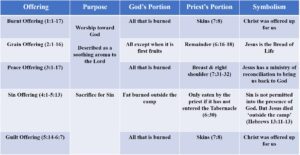
There are five specific types of offerings outlined in Leviticus 1-7. In all cases, the offering was to be spotless and without blemish. Furthermore, it was always an animal which had been domesticated and raised by men. Wild animals were never used as offerings.
All sacrifices are offered either as a means to secure fellowship or on the basis of an already existing fellowship. The sacrifices are said in Scripture to be the ‘food’ of God offered on the ‘table’ of God, Leviticus 21:6 / Leviticus 21:8 / Leviticus 21:17 / Leviticus 21:21-22 / Psalm 50:9-12 / Malachi 1:12.
Various parts of various sacrifices were given to the priest as part of his ‘wages’, Leviticus 2:3 / Leviticus 6:14-18 / Leviticus 7:6 / Leviticus 7:31 / Leviticus 10:12-15 / 1 Corinthians 9:13.
The five sacrifices were divided into two classes: first, the ‘sweet-smelling aroma’ class. this included the burnt, Exodus 29:15-18 / Leviticus 1:1-17, meal, Exodus 29:41 / Leviticus 2:1-16 / Leviticus 6:14-23 / Numbers 15:1-10, and peace offerings, Exodus 29:28-39 / Leviticus 3:1-7 / Leviticus 7:11-21.
The first class didn’t deal with the removal of sin or the securing of fellowship. They were offered on the basis of an already existing fellowship. Since they didn’t deal with the horror of sin, which is never pleasing to God, they are called a ‘sweet smelling aroma’, Leviticus 1:9 / Leviticus 1:13 / Leviticus 1:17. They are guarded from casualness by being said to be ‘most holy’, Leviticus 1:17.
The second class, the ‘sin and transgression offerings’ dealt with the removal of sin whether dealing with the man as a specific crime, involving the idea of restitution, the trespass offering.
There are standard rules established for the offering of all the sacrifices, but there are also a great number of exceptions to the rules depending on your circumstances, for example, your financial state, occasion, or order of sacrifice.
Notice that the offeror’s offering was done voluntarily, Leviticus 1:3 / Leviticus 1:10 / Leviticus 1:14. It was offered by their own free will and in accordance with what they could afford, 2 Corinthians 9:7.
Depending upon the financial status of the one making the offering, it could be comprised of a bull, Leviticus 1:3, a lamb, Leviticus 1:10, or a dove or a young pigeon, Leviticus 1:4.
We are taught by this that the sacrifice must be a personal issue. Some things were done by the worshipper and some by the priest, but they must do this for themselves.
The word used to describe the burnt offering is ‘olah’, Leviticus 1:3, and is taken from the root verb meaning, ‘to go up’ or ‘ascend’. It is an offering of ascension, which refers to the fact that the entire offering was burned and ‘ascended to God’.
It was the foundational offering which allowed men to come into the presence of the Lord. For this reason, a man makes this offering ‘that he may be accepted before the Lord’, Leviticus 1:3, and adds that ‘it may be accepted for him to make atonement on his behalf’, Leviticus 1:4.
Clarke, in his commentary, says the following.
‘By the imposition of hands, the person bringing the victim acknowledged the following.
1. The sacrifice as his own.
2. That he offered it as an atonement for his sins.
3. That he was worthy of death because he had sinned, having forfeited his life by breaking the law.
4. That he entreated God to accept the life of the innocent animal in place of his own.
5. And all this, to be done profitably, must have respect to HIM whose life, in the fullness of time, should be made a sacrifice for sin.
6. The blood was to be sprinkled round about upon the altar, Leviticus 1:5, as by the sprinkling of blood the atonement was made; for the blood was the life of the beast, and it was always supposed that life went to redeem life, Exodus 29:10.’
Constable, in his commentary, says the following.
‘This offering satisfied God’s desire for the love of His redeemed creatures as well as His offended justice. This offering satisfied God by its wholeness quantitatively and qualitatively. The Israelite worshiper offered a whole spotless animal in place of himself.’
A life was offered upon the altar; it was to be completely burnt upon the altar. With the other sacrifices, the offering was eaten by the priests with the one who gave the offering, but the burnt offering was completely consumed by the fire of the altar. This showed that man’s duty to God was not in the mere giving up of a portion but the entire surrender of ALL.
The lesson for us in regard to Christ is clear; it must be made ‘at the door of the tent’, this would help to stop the creation of ‘high places’, that is, idolatrous shrines, and would at the same time teach the worshipper submission to God, Leviticus 1:3.
Also, notice that the animal had to be ‘without defect’, Leviticus 1:3 / Leviticus 1:10 / Leviticus 4:4 / Exodus 20:24. This was one of the reasons Christ drove out the money merchants twice from the temple, they were selling all kinds of offerings to the masses and making lots of money from it, many were full of defects, John 2:13-22 / Mark 11:11-17.
The animal’s condition had to be perfect, not having any blemishes, and it could not be less than eight days old, Leviticus 22:17-28. It was then presented at the door of the tent, Leviticus 1:3. Before the tabernacle’s erection, the animals were to be offered at the Lord’s appointed place on an earthen altar, Exodus 20:24-25.
After the tabernacle’s erection, the animals were to be offered on the bronze altar at the tabernacle’s entrance, Leviticus 17:1-5. After Israel settled in the land of Canaan, they would still bring offerings to the tabernacle’s entrance, or later to the temple entrance, Deuteronomy 12:10-14.
The practice of laying their hand upon the head of the animal was done for all the animal offerings, Leviticus 1:4 / Leviticus 3:2 / Leviticus 4:4 / Leviticus 8:22 / Leviticus 16:21 / Numbers 8:10.
This gives us the idea that the offeror would be connected with the offering as well as the Lord, this had to be personal, Leviticus 1:2-3 / Leviticus 1:10 / Leviticus 1:14. The one who offered the animal had to place his hands upon its head, Leviticus 1:4 / Leviticus 3:1-2 / Leviticus 4:3-4 / Leviticus 4:13-15.
The word ‘atonement’, Leviticus 1:4, means to cover up; later in the New Testament, the word ‘atonement’ means to reconcile, Romans 3:25 / Hebrews 2:17. God cannot be approached with the guilt of sin on our shoulders; atonement must be made for sin, Habakkuk 1:13.
The sacrifice was then killed, and the blood of the animal was sprinkled at appointed spots or poured at the altar base, Leviticus 1:5 / Leviticus 1:11 / Leviticus 4:5-6 / Leviticus 4:18-19. The animal was then burned, and the sacrificial meal took place, Leviticus 6:26 / Leviticus 7:8.
In the case of the burnt offering, there was no meal at all since the entire animal was burned. Christ is our perfect sacrifice, Hebrews 9:13-14 / 1 Peter 1:18-19. Of the five main sacrifices, only the meal-offering did not involve blood.
In the private offerings, except where it required skill, the sacrifice was slain by the offeror themselves. In the case of the national or public sacrifices, they were performed by the priest. It was to be slain before the Lord, not only in his presence but with his approval, Leviticus 1:5.
In the blood was the life, Leviticus 17:11; the blood represented the life given. In the burnt and peace offerings, the sprinkling of the blood, though it must be performed, played a subordinate role; in the sin offering, it was central, Leviticus 1:5 / Leviticus 1:11.
Aaron’s sons are to skin the burnt offering and cut it into pieces, Leviticus 1:6 / Leviticus 1:12 / Leviticus 7:8 / 2 Chronicles 29:34, and put fire on the altar and arrange wood on the fire, Leviticus 1:7.
Clarke, in his commentary, says the following concerning the fire, Leviticus 1:7.
‘The fire that came out of the tabernacle from before the Lord, and which was kept perpetually burning, Leviticus 9:24. Nor was it lawful to use any other fire in the service of God. See the case of Nadab and Abihu, Leviticus 10:1 / Leviticus 10:2.’
Then they are to arrange the pieces, including the head and the fat, on the wood that is burning on the altar, Leviticus 1:8. Finally, they are to wash the internal organs and the legs with water, and then burn all of it on the altar, Leviticus 1:9.
This washing probably symbolised the need for internal purity. It is a burnt offering, a food offering, an aroma pleasing to the LORD, Leviticus 1:9 / Leviticus 1:13 / Leviticus 1:17.
You will notice that the offering of sheep and goats has more or less the same requirements as offering a bull, Leviticus 1:3-9. The offeror’s offering was done voluntarily; it was offered of their own free will and in accordance with what they could afford, Leviticus 1:10 / Leviticus 1:3 / Leviticus 1:14.
The sheep or the goats were to be a male without defect, Leviticus 1:10 / Leviticus 1:3. Notice the worshipper is told where to make the sacrifice, the northward direction from the altar, Leviticus 1:11, was designated by God as the place where the sacrifice was to be made. Over and over again, the Scriptures we read about not only how God wants to be worshipped but where He wants to be worshipped, John 4:21-24.
Aaron’s sons are to splash its blood against the sides of the altar, Leviticus 1:11 / Leviticus 1:5. They are to cut it into pieces, and arrange them, including the head and the fat, on the wood that is burning on the altar, Leviticus 1:12 / Leviticus 1:6-8 / Leviticus 7:8 / 2 Chronicles 29:34 / Genesis 15:10.
Then they are to wash the internal organs and the legs with water, and the priest is to bring all of them and burn them on the altar, Leviticus 1:13 / Leviticus 1:9. It is a burnt offering, a food offering, an aroma pleasing to the LORD, Leviticus 1:13 / Leviticus 1:9 / Leviticus 1:17.
The significance of the whole burnt offering was very great; the worshipper kept back nothing for themselves. Neither he nor his friends used or enjoyed any part of it; it belonged exclusively to God.
The offeror’s offering was done voluntarily; it was offered of their own free will and in accordance with what they could afford, Leviticus 1:14 / Leviticus 1:3 / Leviticus 1:10. If its birds, they are to offer a dove or a young pigeon, Leviticus 1:14.
Clarke, in his commentary, says the following.
‘Among fowls, only pigeons and turtle-doves were commanded to be offered, except in the case of cleansing the leper, mentioned Leviticus 14:4, where two clean birds, generally supposed to be sparrows or other small birds, though of what species is not well known, are specified. Fish were not offered, because they could not be readily brought to the tabernacle alive.’
The priest is to bring a bird to the altar, wring off the head and burn it on the altar and allow its blood to be drained out on the side of the altar, Leviticus 1:13. Next, the priests are to remove the crop and the feathers and throw them down east of the altar where the ashes are, Leviticus 1:14.
Finally, the priest is to tear it open by the wings, not dividing it completely, and then burn it on the wood that is burning on the altar, Leviticus 1;17. It is a burnt offering, a food offering, an aroma pleasing to the LORD, Leviticus 1:17 / Leviticus 1:9 / Leviticus 1:13. Notice they weren’t required to wash the birds; it’s possible that they were regarded as clean already.
God always looks after the poor in society and always makes allowances for them, Leviticus 5:7-10 / Leviticus 12:8 / Leviticus 14:21-32. We see this happening with Mary and Joseph when they offered their sacrifice. They were obviously very poor, Luke 2:24. We must remember in all of these sacrifices that it was the act of the sacrifice itself that was more important to God, 2 Corinthians 9:7 / Mark 12:41-44.
The phrase, ‘an aroma pleasing to the LORD,’ is found three times in this chapter, Leviticus 1:9 / Leviticus 1:13 / Leviticus 1:17. When the Scriptures speak about an ‘aroma’, a pleasing aroma, this isn’t suggesting that God has a nose to smell the sacrifice.
The idea behind it is that God smells or accepts the repentant heart of the person who has been obedient to Him through the offering of sacrifice, Ephesians 5:2 / Philippians 4:17-18.
This sacrifice sets forth Christ’s offering Himself without spot to God in performing the divine will with joy, even to the point of death, Hebrews 9:11-14. The offering is a sweet aroma, Ephesians 5:2; the whole burnt offering is both atoning and substitutionary, Christ dies in our place.
The animals sacrificed all symbolise Christ in some aspect of His redeeming character. The young bull, His patient endurance as a Saviour, 1 Corinthians 9:9 / Isaiah 52:13. The goat, a sinner, and when used of Christ, as He who was numbered with the transgressors, Isaiah 53:12.
The turtle doves or pigeons, mourning innocence, Isaiah 38:14 / Hebrews 7:26. Poverty, Leviticus 7 / Philippians 2:5-8, He who became poor that we might become rich, 2 Corinthians 8:9.
Atonement, Romans 5:11, atoning blood of Christ, Deuteronomy 12:23 / Leviticus 3:17 / Acts 15:20. This is the only sacrifice in which the entire offering is burnt and given to God. Significance of total consecration and devotion to God, Romans 12:1.