

1 Corinthians 9 appears to be an explanation of Paul’s selfless statement in 1 Corinthians 8:13. Paul was ‘free’ in the sense that he had the same liberties as any other Christian.
As an ‘apostle,’ Paul could have truly pressed his liberties and made others bend to his scruples, yet he chose to give up any of his liberties so that souls would be saved, 1 Corinthians 9:1.
Apparently, some in Corinth were rejecting Paul’s apostleship, 1 Corinthians 9:2. None of the following statements would make sense regarding liberties if Paul were not an apostle.
Therefore, he defends his apostolic office by saying that he had ‘seen Jesus our Lord’, a qualification for apostles, 1 Corinthians 9:1 / Acts 1:22 / Acts 22:14-15 / Acts 26:15-18.
The Corinthian church was a result of Paul’s labours, and they really had no grounds to discount his words. The Corinthians had spiritual gifts that were administered to them by Paul.
Only an apostle of Jesus Christ had the power to transfer the gifts of the Holy Spirit, Acts 8:14-17. The fact that Paul laid his hands on the Corinthians and gave them spiritual gifts is a sign of his apostleship, 1 Corinthians 9:2.
Those faithful brethren in Corinth knew assuredly that Paul was an apostle. These faithful brethren were the ‘seal’, in Greek it’s the word ‘sphragis’ of Paul’s apostleship, 1 Corinthians 9:2. The word ‘seal’ is ‘the impression of a signet-ring, a seal’. The seal of the king’s ring carried the weight of authority. It represented the validity of a matter.
The fact that the Corinthian church was established and brethren were ‘in the Lord’, 1 Corinthians 9:2, through baptism made for a valid argument regarding the apostleship of Paul, Galatians 3:26-27.
In the opening verses, Paul shows that he realises that there are members of the church in Corinth who either question or even deny his apostleship, 1 Corinthians 9:3-6.
1. He was unmarried, an argument which certainly carried weight with Jewish converts, who had been brought up to believe that marriage is a divine obligation.
In Judaism, a man who was unmarried at thirty years of age, ‘diminished the Face of God in the world’. Furthermore, no unmarried man would be considered worthy to be regarded as a ‘Rabbi’ or ‘teacher’.
2. He did not accept payment for his ministry.
Every Teacher in Judaism was expected to accept payment for his teaching, and if Paul declined to follow the traditional practice, it must be because his teaching was worthless.
3. He was not one of the ‘original’ apostles.
Chosen and sent out by the Lord personally. Indeed, he was late on the scene! Consequently, in their estimation, he did not possess the same degree of authority.
4. And, his attitude towards Gentiles who wish to become Christians was far too lenient!
They objected to his teaching on ‘Freedom in Christ’. In 1 Corinthians 9:1-2, Paul declares his qualifications.
1. He had ‘seen the Lord’ after His resurrection, 1 Corinthians 9:1 / Acts 1:21-22.
This was necessary if he was to become a ‘witness’. When a replacement for Judas was chosen, this was a major issue. Note that ‘witnesses’ cannot possibly have ‘successors’.
Consequently, the Roman Catholic doctrine and claim of ‘apostolic succession’ is false. Also, this fact nullifies the claim of the ‘Watchtower’ followers to be ‘Jehovah’s Witnesses’. The claim is as fabricated as the name ‘Jehovah’.
2. He had been chosen by the Lord Himself, Acts 1:2 / Galatians 1:1.
Read Galatians 1-2. He had demonstrated ‘the signs of an apostle’, 2 Corinthians 12:12. The Jews demanded ‘a sign’ from anyone who claimed to speak for God, Matthew 12:38. A message from God must be validated by a demonstration of divine power!
Paul has now given a proper defence, as in a legal trial, regarding his apostleship. The word ‘this’, 1 Corinthians 9:3, seems best to describe the previous two verses where Paul defends his apostleship. In 1 Corinthians 9:3-14. He argues for his right to the privileges and respect received by the other apostles.
Paul had rights as an evangelist, apostle and Christian; however, he waived those rights for the benefit of others. Again, let us remember that liberties are under consideration.
Though many would not see it to be lawful to support a gospel preacher, or the apostles, Paul reminds them that just because he preaches does not negate his right, or liberty, to eat and drink, 1 Corinthians 9:4. Paul also had the right to ‘take a believing wife,’ 1 Corinthians 9:5. Though many had wives, Paul did not take advantage of this liberty.
Constable, in his commentary, says the following.
‘Paul may have mentioned Peter in particular because he had a strong following in Corinth, 1 Corinthians 1:12. His references to the Lord’s brothers in this verse and to Barnabas in the next do not necessarily mean that these men had visited Corinth. Perhaps the Corinthians knew about their habits of ministering second-hand.’
Paul said that he had a right, liberty, to ‘not work’ as one who labours in the kingdom of God, 1 Corinthians 9:6 / 1 Corinthians 4:12 / 1 Thessalonians 2:9 / 2 Thessalonians 3:7-9 / Acts 20:34. The preachers of the Gospel had a right to not work at secular employment but to be supported by the brethren, 1 Corinthians 9:14.
Paul now gives three Illustrations to get across the point that it would have been a liberty of Paul’s to take wages from the brethren; however, he did not do this.
1. Soldiers do not serve for free, 1 Corinthians 9:7.
2. Farmers plant with the expectation of a return from their crop, 1 Corinthians 9:7.
3. The labourer among animals receives wages for his work, 1 Corinthians 9:7.
It has always been lawful for a worker to be paid his wages for labour, 1 Corinthians 9:8. In 1 Corinthians 9:9, Paul quotes from Deuteronomy 25:4. This was an issue of cruelty because while the ox was muzzled during laborious work, it could not eat.
The Gentiles were of this practice; however, the Lord commanded that the Hebrews allow their ox to eat while treading out the corn. If it is cruel to make an ox work and not let him eat, then it is a cruel act to make an evangelist labour with no compensation.
The evangelist is pictured as a sower sowing seed in the ground, 1 Corinthians 9:10. The evangelist was preaching and teaching to the Corinthian brethren and was due to their just compensation of the brethren’s ‘carnal things’.
Wiersbe, in his commentary, says the following.
‘Keep in mind that, for the most part, the Greeks despised manual labour. They had slaves to do manual labour so that the citizens could enjoy sports, philosophy, and leisure. The Jews, of course, magnified honest labour.’
The word ‘is it too much’, 1 Corinthians 9:11, emphasises the Corinthians’ attitude toward paying evangelists, Galatians 6:6. Paul may have been killing two birds with one stone here.’
The thrust of the apostle’s point is liberties, areas where it does not get one closer to God if we do or do not do them. Whether to receive wages for the work of a preacher may be done or not done. Those preachers who received wages were doing so because it was indeed work.
Another proof that he had the right to receive compensation was that other preachers at Corinth had already been receiving compensation for their labours, 1 Corinthians 9:12. At this point, one may expect Paul to demand compensation; however, this was not his intention to bring all this up.
Why didn’t the apostle use their right to receive compensation for their labour? So that the Gospel plan of salvation is not hindered, 1 Corinthians 9:12. It may be that some weak brethren would find an occasion to stumble in this area.
Some may have believed that if Paul, Silas and Timothy had taken wages from them, then their motive for preaching was money rather than a love for people’s souls. Rather than pressing his rights, Paul gave them up for their sakes.
Under the Mosaic Law, the priest who laboured in teaching, sacrificing, changing the showbread and keeping the candlesticks lit was authorised to take wages in the form of parts of the animal sacrifices, Numbers 18:8-20.
While other tribes farmed, the priests were about the business of the altar and temple, 1 Corinthians 9:13. Clearly, Paul authorises a local preacher, who is doing the work of an evangelist, 2 Timothy 4:1-5, to receive wages from the brethren, 1 Corinthians 9:14.
This work is not only in proclaiming Gospel truths to the lost but to the brethren as well, 1 Corinthians 9:11, that all may be edified in the knowledge of Jesus Christ, Ephesians 4:11-12.
The word ‘commanded’ or ‘ordain’, KJV, in Greek is ‘diatasso’, and it means ‘to make arrangements, to arrange for oneself, get things arranged, to be appointed’.
God made arrangements for those who would be preachers of the Gospel and appointed for them a means of wages through the brethren. Each local church must make judgments based on contributions as to what the local preacher may be compensated.
We see this when Jesus sent out the twelve apostles to preach the Gospel, Matthew 10:9-10. These men brought the blessings of the Gospel to people, and the people were to share their blessings with the messenger, 1 Corinthians 9:11.
In 1 Corinthians 9:15-23, Paul’s drive came from his being obligated to the Lord to preach. Paul’s glory was in the fact that the Corinthians had obeyed the Gospel through his teaching, 1 Corinthians 2:1-5 / 1 Corinthians 9:2.
Though the Lord had ‘commanded’, 1 Corinthians 9:14, that such preachers are compensated and ‘other’, 1 Corinthians 9:12, preachers in Corinth had received such compensation, Paul would not take it.
Paul would rather die than have a brother in Christ stumble in this area of receiving wages, 1 Corinthians 9:15. Clearly, the receiving of wages from a local church or not receiving wages was a matter of judgment rather than a doctrinal must.
Some preachers, like Paul, were tentmakers, Acts 18:3, and still others receive wages from churches that they are not even a member of, Philippians 4:15. Apparently, Paul perceived that there were brethren at Corinth who would be offended by his taking wages from them, so he did not do it for their souls’ sake.
Paul is not trying to prove a case for receiving wages, but he has in mind the soul and love of a brother in mind, 1 Corinthians 8:13. Though it was his right to receive wages and though it was his right to eat any meats, he was willing to forgo those rights for the sake of others’ souls. This is brotherly love personified.
So, if eating meat sacrificed to idols was offensive to some, Paul would not do it, 1 Corinthians 8:13. If being compensated for his work as an evangelist caused some to stumble in offence, he would not take it.
To demand wages from the brethren would have been to glory in the position of an evangelist. Paul’s purpose for preaching was not for monetary gain but to gain the souls of men. Woe would be pronounced upon Paul or any others if the Gospel is not preached.
Notice Paul was ‘compelled to preach, 1 Corinthians 9:16. The Lord had handpicked Paul for this work, Acts 9:15-16. Paul intended to be obedient to the Lord’s command, Acts 26:16-19. The apostle Paul was compelled by Jesus to be an apostle and preacher, 1 Corinthians 9:17.
Constable, in his commentary, says the following.
‘If he preached the gospel willingly, he would receive a reward (pay) from the Lord. If he did so unwillingly, he would not receive a reward but would be simply doing his duty as a steward, manager of a household, 1 Corinthians 4:1-2 / Luke 17:7-10.’
Paul would have had great feelings within for helping others obey the Gospel had he done this voluntarily, along with receiving wages as was his right, his reward, 1 Corinthians 9:18 / 2 Corinthians 11:7-12.
Paul’s work, however, was of necessity because it was of necessity by the Lord; he recognizes that the Gospel message has been entrusted to him by the Lord to care for and distribute.
Paul’s outlook on a reward appears to be different from others’ views. The preacher certainly has the right to receive wages, and that point has been established above.
These men enter into the work of evangelists voluntarily and receive their just rewards, inward satisfaction for saving souls and compensation for doing so.
Paul’s reward was that he gained the souls of men; rather than receiving wages, he would rather preach without the chance of a brother saying, ‘Paul, you’re only doing this for money.’ Paul, therefore, chose not to demand his ‘right in the gospel’ of receiving wages for preaching.
This whole section is stressing, 1 Corinthians 8:13, regarding giving up rights for the sake of others’ souls. Paul said, ‘Let no man seek his own, but each his neighbour’s good,’ 1 Corinthians 10:24.
The word ‘right’, 1 Corinthians 9:18, in Greek is the word ‘exousia’, and it means ‘freedom of choice, right to act, decide, or dispose of one’s property as one wishes’.
The Greek word ‘exosia’ is used in other passages in this fashion: 2 Thessalonians 3:9 / John 10:18 / 1 Corinthians 7:37 / 1 Corinthians 8:9 / 1 Corinthians 9:4-12 / Hebrews 13:10 /Revelation 13:5 / Romans 9:21.
The Christian has the ‘right,’ the freedom of choice, the right to act, decide, when participating in things lawful but not necessary. There are many areas in which we use our judgment to accomplish God’s will.
It is our judgment to use more than one cup when serving the Lord’s Supper, conducting Bible classes, using songbooks, and so forth. While these expediencies are not demanded, the Christian has the right to use these things because they do not violate any other laws of God.
If a brother is conscientiously bothered by the use of these things, we may want to stop and do something different. If however, a brother demands that we stop due to his perception of the liberties being sinful, we must stand our ground, Galatians 2:3-5.
In 1 Corinthians 9:15-18, Paul defends his principle of becoming ‘all things to all men’ which his critics regard as ‘carrying popular favour’. He insists that he takes this stand in order to ‘save some’, and he asserts his ‘right’ to be materially supported, even though he does not actually exercise it.
1. He implies that the apostles took their wives with them on their travels, 1 Corinthians 9:5.
Perhaps because it would create a favourable impression on the women in the Greco-Roman world.
2. Others received support that was granted without opposition, 1 Corinthians 9:7, such as soldiers, shepherds, vine-dressers, and Priests, 1 Corinthians 9:13.
3. Finally, he argues that simple gratitude should inspire in them a willingness to ‘share’ material blessings, 1 Corinthians 9:15.
Some churches understood this and acknowledged this obligation, e.g., the church at Philippi, which ‘once and again sent to my needs’, Philippians 4:15-16. The fact that it was he who brought the Gospel to Corinth and spent time with them should have led them to provide him with support in his ministry.
An ‘apostle’ is ‘one sent’, from the Greek ‘apostolos’. Paul and Barnabas are both called ‘apostles’, 1 Corinthians 9:6 / Acts 14:14. The difference is that Barnabas was an apostle of the church in Antioch, by whom he and Paul were sent out. This is why, on their return from the First Missionary Journey, they reported to the church in Antioch.
Incidentally, when Paul set out to Damascus, armed with letters from the High Priest in Jerusalem, he could be called ‘an apostle’ of the High Priest, Acts 9:1-2. The authority of an apostle depends on the authority of the one who sends him out. Only those chosen and sent out by Christ personally are backed by the authority of Christ, Luke 10:16.
In Ephesians 4:11-13, Paul lists the offices and the various gifts with which Christ blessed the church. The list consists of ordinary and extraordinary, temporary and permanent gifts.
The extraordinary but temporary gifts were the offices of apostle and prophet. The permanent and abiding gifts are the offices of evangelists and Pastors, the word is a form of ‘poimenos’, and refers to elders or shepherds and teachers.
These ‘gifts’ were all given for the edification, i.e., the ‘building up’ of the church. The word ‘edification’ comes from the Greek word, which means ‘to build a house’.
Note! The translation of these verses, in some versions, conveys an erroneous idea, Ephesians 4:13. These translations state, ‘till we all come TO the unity of the faith…’ The correct rendering is, ‘till we all come, IN the unity of the faith to a perfect man.’ i.e., this means to ‘maturity’; manhood; no longer being babes in Christ.
We already possess the ‘unity of the faith’, Ephesians 4:13. ‘By one Spirit we have all been ‘baptised into one Body,’ 1 Corinthians 12:13. The faith has ‘once for all time been delivered to the saint’, Jude 3.
Any conduct or teaching that violates the unity of the Body is a sin that brings grave consequences, 1 Corinthians 3:16-17. The passage teaches that, through the exercise of the various abilities and talents that the Lord has bestowed on the members of the church, the church, the Body, is able to build itself up.
Paul said in 1 Corinthians 9:1 that he was free, and again in 1 Corinthians 9:19, he states that he is free. Paul’s liberty, as others’ liberty, was to eat meat sacrificed to idols, take a believing wife, and receive wages for his preaching.
Constable, in his commentary, says the following.
‘Paul was a free man, not a slave of any other human being. Nevertheless, as the Lord’s servant, he had made himself subject to every other human being so he might win some to Christ. Serving people rather than commanding them is the way to win them, Mark 10:45.’
Paul voluntarily gave up these things in many cases so as not to offend others. Paul voluntarily brought himself under bondage to others in that he humbly submitted to others’ spiritual weakness in areas of indifference that he may help them in the long run, 1 Corinthians 9:19.
This verse teaches a valuable principle that must be understood correctly in view of all Scriptures. The Jews held stringently to dietary laws expressed in the Pentateuch, Leviticus 11 / Deuteronomy 14. Circumcision was a vital part of Jewish culture and law as well, Genesis 17:11.
At a time when men and women were in a state of change from the Law of Moses to the Law of Christ, many held tightly to that Law that had been a part of their heritage and society for as far back as they could remember. The road to the Law of Christ was not easy for many, though the Old Testament Scriptures foretold of its coming, Jeremiah 31:30-40.
Paul’s objective was to help these Jews see their need for Christ, due to their sin, and thereby ‘win’ the many, 1 Corinthians 9:19-20. If Paul came into a city and ate swine’s flesh, showing disdain for circumcision and the Sabbath, the minds of the Jews would have been turned away from him.
Since neither of these issues were a matter of salvation Paul did whatever others were doing for propriety’s sake, Acts 18:8 / Acts 21:26. Yet when one would teach that these dietary laws, circumcision, or any other part of the Mosaic Law was essential to salvation, Paul rigidly opposed it as a false doctrine, Acts 15 / Galatians 2:2-4 / Galatians 5:3-6.
Paul wanted to be less offensive so that he could gain many. A great example of this spirit is that Paul had Timothy circumcised so as not to offend any Jews that they may come in contact with while preaching, Acts 16:3.
Note, however, that when the doctrine of Christ was at stake, Paul cared not that he offended. In fact, he pressed the matter diligently even if it meant losing his life, Acts 21:13.
The Lord Jesus practised this same approach, when one presses these liberties and binds them as Law, Jesus in no way accommodated such false teaching but aggressively opposed the teaching, Luke 11:37-54.
Paul’s consistency of behaviour is illustrated in these verses. Since keeping some aspects of Mosaic Law, such as dietary laws, circumcision, and the Sabbath, would not have hindered Paul’s objective of heaven, neither would not doing these things among the Gentiles obstruct his heavenly goal.
Paul abstained from Jewish law around the Gentiles as he practised it around the Jews so that he may gain the many, 1 Corinthians 9:21. We may practice some things around some and not do so around those we know it offends.
Barrett, in his commentary, says the following concerning 1 Corinthians 9:21.
‘This is one of the most difficult sentences in the epistle, and also one of the most important, for in it Paul shows how the new relation to God which he has in Christ expresses his debt of obedience to God.’
Paul was not a lawless individual; he was ‘under law to Christ’ 1 Corinthians 9:21. The teachings of Jesus were binding and essential, 2 John 9. What this verse teaches us is that there is a law to follow, the Law of Christ. So many do not understand that there is a clear distinction between liberties, expedients, and law.
Some confuse lawful living with destroying the grace of God and making the cross of Jesus Christ of no effect. The author of Hebrews proves that we are currently under the Law of Christ, Hebrews 7:12.
Certainly, Paul did not become a lawless man of fornication and murder to save the fornicators and murderers. Those areas of liberty are under consideration, and the weak brother is understood to be the one who does not have knowledge of certain liberties and thereby abstains from such for conscience’s sake, 1 Corinthians 8:7 / Romans 14:1-9.
Paul used wise judgment as to when to exercise or abstain from exercising a liberty for the sake of the individual people he was with. His objective remained constant: to gain souls.
To be a joint partaker with other saints is to be understood in the realm of salvation and heaven. Paul would have hindered his own chances of making it to heaven if he were inconsiderate of others in the realm of Christian liberties, 1 Corinthians 8:11-12 / Romans 14:15.
Paul was not just being a good boy by giving up such liberties rather than pressing them. He did so for the sake of the souls involved, including his own, 1 Corinthians 9:22-23.
A very familiar scenario is given by Paul. The athletic contest in and around Corinth was well known. We are all familiar with the ‘Olympic Games’, which were revived in 1896 by the French Baron Coubertin, who formed the Olympic Association a couple of years earlier, but the similarity between the Ancient and the Modern Games exists in name only!
In fact, the Olympics, as they are popularly called, were not the only ‘Games’ celebrated by the Greeks. Other Games were also held in Paul’s time, and he is no doubt thinking not of the Olympic Games, but of the Isthmian Games with which the Corinthians were both familiar and proud, because they were held very close to Corinth, every two years.
That pride is reflected in the strict conditions of qualification that Paul has in mind as he writes.
1. Only athletes of pure Greek blood were allowed to compete.
2. The athletes had to show proof of their ancestry.
3. No one who had a criminal record, or who had forfeited his citizenship by breaking the Law, was allowed to complete, no matter how otherwise qualified he might be.
No talk of ‘human’ rights! If you committed a crime, you forfeited your rights!
4. Only men were allowed to take part.
Although history records the names of several rich women who owned winning chariots, they were not likely to have been present at the Games anyway! It was said that it would be ‘unethical’ and ‘inappropriate’ for women to be present. The reason? The athletes competed naked.
And, even in modern Olympics, the first Games in which women were allowed to compete were in 1900, in Paris. I think they were allowed to compete in Tennis and Golf!
As a matter of fact, the first woman to become an Olympic Champion was an Englishwoman named Charlotte Cooper, who won the Tennis Singles Title that year. Some Women’s Athletic events were added in 1948.
5. Those who qualified to participate were required to undergo months of rigorous, supervised training.
We know that today’s athletes spend months in intensive training in order to be fit enough to compete. You may recall that before the London Games, we read newspaper reports describing the intensity of the physical preparation to which the athletes subjected themselves. Out on the road before daybreak! Running hundreds of miles a week! Spending hundreds of hours in the Gym! All in order to reach peak fitness.
Paul refers to this intensive training and points out that it is endured, not to win a gold medal which would be a permanent reminder of a victory, or to receive a knighthood, or some other honour, but to be awarded a crown of leaves, in Olympia a crown of olive leaves, and in the Corinthian Games, a crown of pine leaves, which almost certainly withered before the year was out.
Of course, other honours lasted longer, most of which were bestowed on the winner by his home city. When he returned home, the successful Olympian would be treated as a general returning from a victorious battle.
The city walls would actually be thrown down so that he could enter like a conqueror, and they would even erect a statue of him in the city so that his fellow citizens could honour him.
Some Greek poets were renowned for writing poems in which they celebrated, named and praised the successful athletes, because of the honour they brought to their cities.
Why were the games regarded as important? And they were certainly regarded as important! Even if Greek states were at war with each other, when the time for the Games came around, the war was suspended for the duration of the great event, because the Games were regarded as important in promoting Greek Unity!
The Corinthians knew all this, and, because they were intensely proud of their Games, Paul’s illustration in this chapter would resonate with them and carry great weight. The lessons drawn from it made an impression on them. They felt involved! He was talking about them!
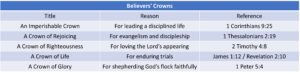
Paul says, in these ‘games’, athletes endured all this to win a wreath of Pine leaves that withered away, awarded to the one winner, but the prize for which we seek endures throughout Eternity, a ‘Crown of Life’, and, importantly, there are no losers! Everyone who finishes the course received the prize!
His aim in using this example is to encourage his Corinthian brethren to remain faithful, and so he says, ‘run in such a way that you may obtain it’, 1 Corinthians 9:24.
Though many may enter an event, there is only one who shall win, 1 Corinthians 9:24. Each contestant has the same goal of victory; however, only one will win the crown.
As the athlete prepares for the one championship race, even so the Christian is to strive to attain the heavenly reward, 1 Corinthians 9:25. He then tells them how they must qualify in 1 Corinthians 9:25.
1. Be temperate.
The word that is translated as ‘temperate’ in several versions really means ‘self-controlled’. Some people suppose it permits ‘moderation in all things’, i.e. ‘everything is allowed ‘in moderation.’ But it actually means that there must be ‘self-control in all things’.
The Greek athlete endured at least ten months of rigorous training, regarding it as a matter of honour to scrupulously abide by the rules and the strict code of conduct associated with the Games.
2. Be dedicated and decisive, 1 Corinthians 9:26.
We should notice that Paul makes this personal, 1 Corinthians 9:16-17. All this applies to himself as much as to his brethren. When he urges them to ‘strive’, he tells them that this is what he also must do. He is not exempt from hardship, and he is not saved because he is an Apostle.
Instead, he tells them, ‘I don’t run like a man who doesn’t know where he is going!’ On the contrary, he knows what his goal is, and has also considered the cost and has decided that it is something to which he is prepared to make a commitment.
Notice the two statements which follow. ‘I fight not as one who beats the air!’ In other words, he is not putting on a show! He is not ‘shadow-boxing’. He is not, as we say, going through the motions, and it is here that far too many translations miss the point!
For example, the New King James Version says, ‘I discipline my body and bring it into subjection’, and this completely misses the force of his statement. He says, ‘I pommel my body’.
This is a technical expression that literally means ‘to strike it full in the face’. The word describes the most devastating blow that a boxer could deliver to an opponent.
He adds, ‘I keep it under.’ He subjects his body to constant stress and tension. In fact, he uses a word from which we get our word ‘agonize’. The preparation an athlete underwent in order to be fit for the Games amounted to physical agony.
Why does he endure such exhausting training? Disqualification, 1 Corinthians 9:27. Paul kept his attitude toward liberties and expedient matters in check lest he lose his own soul, Romans 14:15 / 1 Corinthians 8:12.
Jesus Himself puts it like this, ‘no man who puts his hand to the plough and looks back is fit for the Kingdom of God’, Luke 9:62. The man who handles the plough does not gaze around him or allow himself to be distracted when he ploughs. He fixes his eyes on a point in the distance and steers towards it, and in this way, he produces a straight line.
We should never forget, it is the one who ‘endures to the end’ who shall be saved. It is he who remains ‘faithful’ that the crown is awarded. And everyone who finishes the course is awarded the prize, Acts 14:22 / Matthew 7:13-14 / Revelation 2:10.
The Christian must ensure they don’t get disqualified, they must listen to many warnings about falling away, etc., Romans 1:28 / Romans 7:6 / 1 Corinthians 10:12 / Galatians 5:4 / Hebrews 3:12 / Hebrews 3:14 / Hebrews 4:11 / Hebrews 6:8 / Hebrews 6:3-6 / 2 Peter 2:20-22.
All of these verses refute the argument that claims a child of God cannot sin, 1 John 3:9. John advised the Christian on what to do when he does sin and also, he describes the person who says he never sins, 1 John 1:6-10 / 1 John 2:1.
Apostasy is a subject that concerns only Christians. The very fact that the word exists declares that the apostasy exists and that it is possible for a Christian to ‘apostatise’. It focuses attention on the condition. Whether or not a child of God can fall away and be lost, and thus cease to be a son of God, is an issue not to be treated lightly.
Christian liberties are introduced in 1 Corinthians 6, when Paul said, ‘All things are lawful for me; but not all things are expedient,’ 1 Corinthians 6:12. 1 Corinthians 7 briefly touches upon the subject of liberties when Paul said, ‘Circumcision is nothing, and uncircumcision is nothing; but the keeping of the commandments of God,’ 1 Corinthians 7:19.
Liberties are dealt with in full in 1 Corinthians 8, as Paul discusses the issue of eating meat sacrificed to idols. The fact that liberties exist is firmly fixed in chapters six and seven.
1 Corinthians 8 introduces another idea regarding liberties that is fully developed in 1 Corinthians 9. That idea is the fact that the Christian may sin while using liberty, 1 Corinthians 8:9.
The word ‘liberty’ means to have freedom or power of choice. Matters that do not affect my salvation are termed matters of liberty, adiaphora or matters of indifference.
There are times in a Christian’s life when said liberties may have to be forfeited for the sake of others. Paul displays the heart of one who truly loves souls, 1 Corinthians 9:18. Paul had many ‘rights’ and ‘liberties’ as a Christian; however, he would never press those rights on others to the point of causing them to sin, Romans 14:15.
1 Corinthians 9 is a chapter of admonition to all saints. Paul uses himself as an example of one willing to give up all rights or liberties for the sake of others. Paul had the right to lead a believing wife, forbear working, and receive compensation for his work as an evangelist; however, he forfeited those rights so that others would be saved.
The thought of sin on the part of the individual practising liberty is now fully developed in 1 Corinthians 9. Heaven was the goal at hand for self and others.
If, while practising a liberty, I cause a brother to forfeit his salvation through sin, then I have also been rejected by God for my part in that brother’s sin, 1 Corinthians 9:27.
The message is that while we make our trek toward heaven, only those who discipline themselves to consider others, in relationship to the gospel truths, shall be in heaven. Often, people want to know how far Christians should permit the weak brother to dictate our actions.
Paul answers this question in Acts 15:1-21, when it was said that the Jews who had obeyed the Gospel yet clung to many Mosaic Laws demanded that people be circumcised.
The apostle Paul said in Galatians 2:3-5 that we would give way to their subjection not even for a moment. The answer to the question is simple. When brethren claim that our liberties are sinful, then we must stand our ground lest they be found to bind where God has not bound or loose where God has not loosed.